

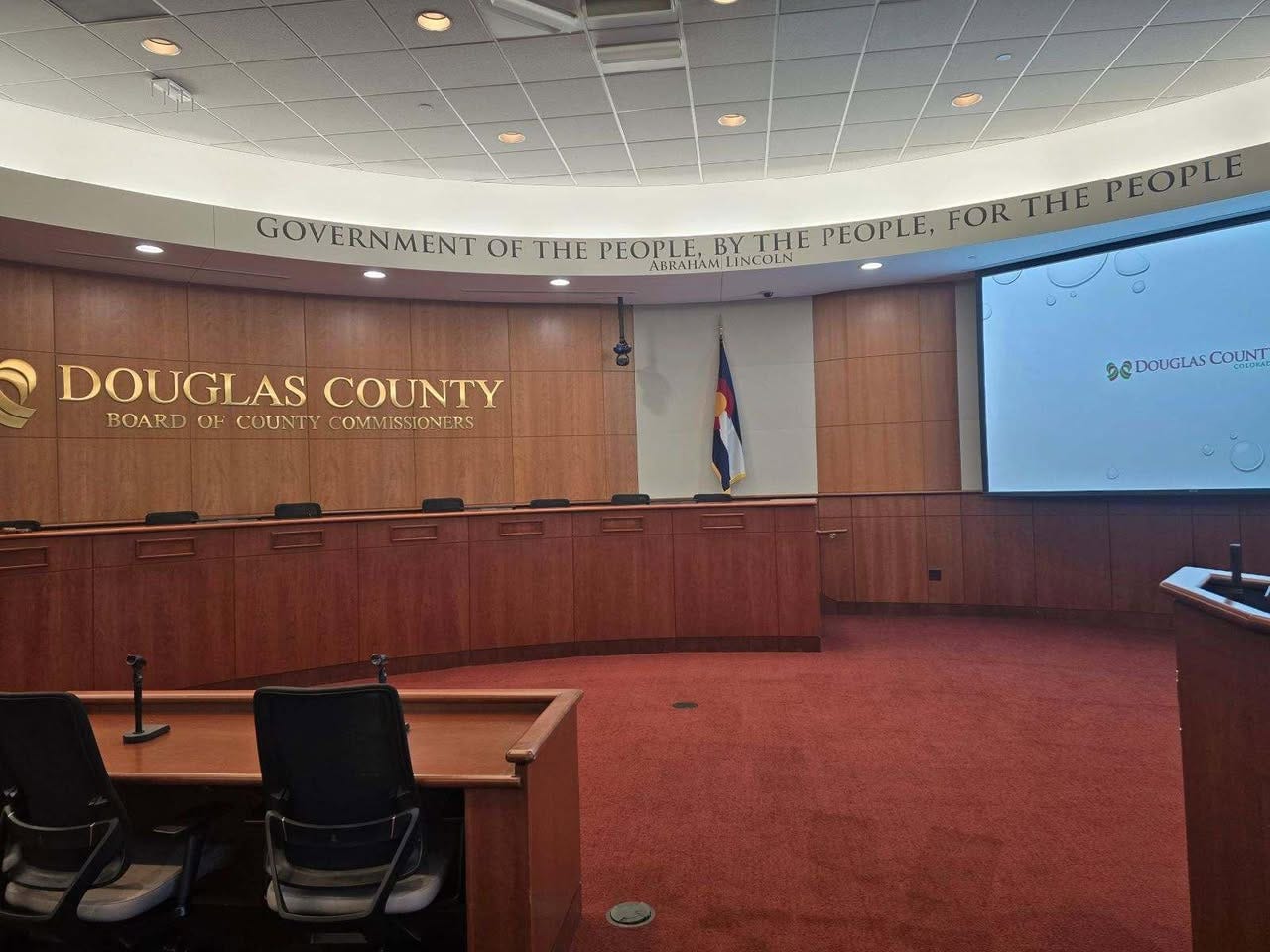
On the third Tuesday of most months, there is a meeting in a hearing room on Third Street in Castle Rock. If you have never been, let me set you down in a chair near the back so you can see what I see.
At the front, a raised dais. Three commissioner seats. Behind those three seats, whether they are filled by people you voted for or people you have never heard of, sits the entire weight of Douglas County: more than 400,000 of us. That is a larger population than the city of Tampa. Larger than New Orleans. Larger than Cleveland. And in front of the dais, a line of your neighbors, each holding a little slip of paper with two, sometimes three minutes of comment written on it, waiting to be heard by a governing body of only three people.
Watch the room long enough and a number starts to press on you. It has pressed on me a lot lately. On a three-member board, it takes only two votes and those two votes can do almost anything they want. Two. Where the road goes: two votes. What the budget funds: two votes. How a piece of land gets used, what gets built next to your subdivision, whether a project lives or dies: two votes. Not the considered majority of a deliberative body. Two neighbors who happen to agree on a Tuesday.
I believe that arrangement is wrong. This November, you get to fix it, and I am going to vote yes. But I owe you more than a yes. I owe you both of my reasons — the clean one I am proud of, and the other one, the one a talk-radio host is supposed to keep behind his teeth. You are going to get both, because if I give you only half you would be right to wonder what I left out and why.
The reason I’m proud of
People want to make this about those three men currently sitting in those chairs. It is not about them. In cowboy English you should know that I would be making this exact argument if all three commissioners were my closest friends and this county stayed reliably conservative until the sun burns out. Because the problem was never who the three are. The problem is that there are three.
Run the math the way a CFO would run it, because that is what this is — a math problem pretending it sits in a civics class. Divide 400,000 people among 3 commissioners and each one carries better than a 130,000 constituents. For what is ostensibly local government, that could be an entire congressional district’s worth of people, riding on each chair, for what is supposed to be one of your most local, most reachable, most answerable layer of government. When two votes carry the whole county, the distance between you and a decision that reshapes your street is not a hallway you can walk down. It is a steep canyon. That is my diagnosis. Everything after this is detail.
Now, when I say the words “add commissioners,” I can hear the objection, because I would raise it myself. Here we go — bigger government, another layer, another salary, the camel’s nose under the tent, the proverbial first step. That’s a fair reflex and it deserves a real answer. So let me give you the answer that settled it for me: the neighbors already did this, and the sky did not fall.
Colorado law has allowed any county over 70,000 people to move from 3 commissioners to 5, by a vote of the people, for decades. This is not unique. And the three largest suburban counties along the Front Range have already done exactly that. Adams County runs a five-member board. So does Arapahoe. So does El Paso — El Paso, home to the Air Force Academy and Focus on the Family, a county no one has ever mistaken for a hotbed of big-government adventurism. Weld and Pitkin Counties got to five as well, by a slightly different legal road called home rule. So when someone tells you a five-member Douglas County board would be some radical experiment, you can tell them the truth: it would make us the last of the big Front Range counties to do the obvious thing, not the first. We would simply be catching up to the counties we are already the size of.
That is the case I am proud of. If it were the only thing in my heart, I would shake your hand right here and let you go. But it isn’t, and you would smell it on me.
The reason I’m supposed to keep quiet
Here is the other reason, and I am going to say it out loud because you deserve to weigh the whole person making this argument, thumb on the scale and all.
Douglas County is changing. For a long time this has been one of the wealthiest, most reliably conservative counties in all of Colorado — an island of red in a metro sea that turned blue years ago. And that island is fading. Not blue. Not even purple yet. But pink, and a little pinker every cycle, as the growth pours into the north end — Lone Tree, the Parker corridor, the edge that bleeds into Aurora. That discoloration from bright red, to whatever it ends up, is bringing metro-Denver politics up the highway with it. I have watched what happened to Arapahoe County. I have watched Jefferson County go. I do not want to stand here in ten years and watch the same tide close over Douglas County. I will say it flatly: part of why I am voting yes is that I would like this county’s government to have some structure in it that keeps us from simply dissolving into the rest of the map that has made the Front Range the sister of California.
There. That is the part I am not supposed to say. Now let me do the thing that actually separates an honest person from someone just running a partisan play. If I am going to confess that I want a political outcome, I feel obligated to tell you, just as plainly, that the tool I am reaching for might not deliver it. And might even turn in my political favor.
Why I won’t sell you a promise the math won’t keep
This measure does two things at once. It adds two seats, and it moves us toward electing commissioners by district instead of the way we do it now, where every commissioner is chosen by the whole county at large. That second part — the districts — is where I have to be blunt with you, because districts are a double-edged sword and I refuse to hand you only the edge that flatters my side.
Think about what a district actually is. It is a line drawn around a piece of the county, and the people inside that line get to elect their own commissioner. Today, with Douglas County still leaning right, lines drawn by the current board would probably produce a map where most of those districts lean the way I do. That is the comforting edge, and a lot of people cheering for this measure are holding only that edge and grinning.
But turn the blade over. A district is also the single most reliable machine ever invented for guaranteeing a growing minority its own seat. As that pink north end fills in, which it is, a district drawn around Lone Tree and the Aurora fringe is exactly the instrument that would send a commissioner those neighborhoods could never elect countywide. Under the current all-at-large system, a countywide conservative majority sweeps the whole table; the north end can grow and grow and still elect no one. Carve it into its own district, and you have handed it a seat at the table. So the honest truth is this: the very structure some of my allies think will protect them is, on a ten-year horizon, the structure most likely to seat this county’s first Democratic commissioner. Both of those things are true at the same time, and anyone who tells you otherwise is selling something you shouldn’t be buying.
This is the part that most people rooting for this measure have never thought through, so let’s go into the room where it actually happens. When you vote in November, you are not drawing any lines. You are choosing between two methods — five commissioners each from their own district, or three from districts plus two still elected countywide. That is all you decide. The actual lines, the map that determines who can win and who cannot, get drawn afterward, by the board sitting in office at that moment, bound only by a rule that says the districts must be within five percent of each other in population. Read it again, because it’s the whole game: the voters pick the method, but whoever holds the board when the map is drawn holds the pen. That is not a conspiracy theory I am spinning you. It is the plain architecture of the statute, and it is the most important sentence you will read.
Which is why the choice between those two methods is not a technicality. That choice is the ballgame, and it cuts in a direction that ought to make a conservative think carefully rather than cheer reflexively. If you want the structure that does the most to pace the county’s change instead of accelerating it, you want the second method: three districts plus two at-large. Those two countywide seats are a firewall. As long as a countywide majority holds, those two chairs stay with that majority no matter how the district lines fall. That choice blends real neighborhood representation with a countywide backstop. The all-five-by-district method is the purer, more representative option, and precisely for that reason it is the one that most quickly hands a rising north end a proportional share of the board the day the demographics tip. I am telling you which lever does what, including the lever that works against my own stated hope, because that is what it means to check my reasoning now instead of later.
Let me be exact about the size of my political claim, so you will know its limits. Neither method “keeps Douglas County red.” Nothing on this ballot can. Expansion plus districts is a mechanism for making county government track the county’s real geography — and the geography is trending pink no matter what I want. The most a conservative majority can do through this structure is pace the change, and hold that countywide firewall for as long as a countywide majority survives. That is not nothing. But it is a great deal less than the promise some people are making, and I will not make that promise to you. My governance reason does not depend on which way the county breaks. My political reason is real, but it is bounded and I have shown you exactly where the boundary sits.
The strongest case against me
As a lawyer I would not trust a man who only argued his own side, so let me give you the other side.
The cost is real. Two more commissioners means two more salaries, and behind each salary a tail of benefits, retirement, and staff. The county Republican Party puts the recurring figure at somewhere around half a million dollars a year. Now, against a $700 million county budget that is a rounding error. But “it’s small” is not the same sentence as “it’s nothing,” and anyone who waves the cost away entirely is being glib with your money, with our money. I would rather look at it honestly and tell you I think representation for 400,000 people is worth a rounding error.
The second objection is the one I respect most, and it comes from good conservative instinct. Matt Smith, a vice chair of the Douglas County GOP, opposes this, and his argument is simple: the county is well run, so why re-engineer the machine that is running it? That is a genuine article. An instinct against fixing what is not visibly broken. My answer is not that Douglas County is broken. It plainly isn’t. Yet. My answer is that three commissioners is simply Colorado's default — the baseline every county gets until its voters choose otherwise. Colorado law only lets a county grow past it once it crosses 70,000 people. Douglas County crossed that line back in the 1990’s and never looked back. We have more than doubled since then, to better than 400,000. A default built for every county, large or small, is a poor fit for a county this size no matter how well the current occupants may be performing.
And there is a third objection, aimed straight at the districts I have already told you I have doubts about: at-large commissioners answer to everyone, while district commissioners answer only to their slice and can trade favors across the dais. That is a true cost of districts, and it is the single best reason a thoughtful conservative might prefer the three-plus-two method, the one that keeps two seats answerable to the whole county, over the all-by-district option. I think that objection is correct, which is exactly why I have told you the two methods are not interchangeable.
Where I land
Set my two reasons side by side, because I am standing squarely on both. The governance reason, which owes nothing to anyone’s tribe: 400,000 people, only 3 seats, 2 votes move the whole county. That math does not work, and it would not work regardless of who sat in those chairs or how the county votes. And the political reason, offered to you honestly and with its limits admitted out loud: a changing county is better served by a government that grows to match it, and paced deliberately, than by one frozen in place until the day it snaps all at once and we find ourselves living in the asylum.
Three votes for 400,000 people is not representation. It is a bottleneck we have simply grown used to, the way you stop hearing a highway you have lived beside for twenty years. In November, Douglas County gets to decide whether to widen it. I am a yes on the math, and, out in the open where you can see it, on the politics, too. I have shown you my thumb and I have shown you the scale. Now the decision is yours, which is exactly where it belongs. I just want you to take my side.
Just a clarification. The districts will be drawn by an independent redistricting committee based on a new law that went into effect on Aug 12, 2026. HB26-1038 lays that out.
Absolutely agree. 5 commissioners and 5 districts. Current board members….and the process….are all untenable! As a resident in “unincorporated Douglas County” (south of Parker) feel fortunate that we escaped Highlands Ranch in 2001 as it has turned light blue. Yuk!