

Sunday evening, a few days after the 25th anniversary, I went to a September 11th remembrance event. It was the kind of evening this country still does well. Rows of chairs. Neighbors filing in, finding seats. Good people. Serious people. The kind who give up an evening because they refuse to forget.
I deliberately avoided people I knew. Sought seating on the back row. I assumed this would be a tough evening for me. As people chatted, exchanged handshakes, waved to friends and acquaintances, I found my spot. Back row. Top of the auditorium. Near the end of the row. I could leave if necessary. Turns out the perfect spot for reasons you’ll read later.
The program moved the way these programs move. Remarks. The movie. Then the presentation of colors and the Pledge of Allegiance. After the movie and ceremony, a panel discussion.
And then a survivor’s brother stood up and told us about his brother.
His brother was murdered in the towers. The family waited, he told us. And waited. His brother’s remains were finally identified in April of 2002. Seven months.
And the room gasped.
I want to be careful here, because that man’s grief is sacred, and those 7 months were agony for his family. Real agony, the kind no explanation repairs. But I have to tell you what that gasp meant, because I was sitting in the back of the room when it went up. The audience heard 7 months and they heard neglect. They heard a brother sitting forgotten in a drawer while a bureaucracy shuffled papers. You could feel it move through the room: how could it possibly take that long?
That’s when I left. I sat in my car in the parking lot, too worked up to stay, and I will be honest about why. I know what those 7 months actually were. I had stood on the ground where they happened, in the middle of that man’s wait. And nobody in that room, through no fault of their own, had ever been told.
So let me tell you. By the end of this essay, you are going to read that date, April of 2002, the way I heard it from the back of that room. The story runs through a place almost no American has ever heard of: a garbage dump on Staten Island. I mean that literally. And I believe it is one of the most sacred pieces of ground in this country.
In January of 2002 my job took me there numerous times. I was the general counsel of FEMA then, and I kept a journal in those years. What I saw that day, I wrote down the same week, and I am going to quote those pages exactly as I typed them, because I was thirty years younger and the page does not flinch and the page does not forget.
First, the problem, because that explains everything. When the towers came down, 16 acres of lower Manhattan became the largest crime scene in the history of crime. A 110 stories of building, twice, plus everything and everyone inside and around those towers, compressed into a burning pile 7 stories tall and 6 stories deep. Somewhere in that pile were the murder weapons, pieces of two Boeing 767s. Somewhere in that pile was the evidence a nation at war would need. And somewhere in that pile were nearly 2,800 human beings, whose families stood at the fences, watching, waiting, holding photographs.
Police procedure says you process a crime scene where it lies. You tape it off, you grid it, you go inch by inch. You cannot do that to 16 burning acres in the middle of the financial capital of the world. The scene had to move. All of it. So we made one of the great logistical decisions in American history: every truckload of that pile would be treated as evidence, and every ounce of it would be taken somewhere and searched. By hand.
The somewhere was Fresh Kills, on the western shore of Staten Island. History has a dark sense of humor, because Fresh Kills was, until 6 months earlier, the largest landfill on the face of the earth. 50 years of New York City’s garbage. The city had finally closed it in March, 2001, forever, by law. Its retirement lasted 173 days. On the very night of September 11th, the first trucks rolled through its gates carrying the World Trade Center, and the world’s largest dump came out of retirement to do the most delicate work any piece of ground was ever asked to do.
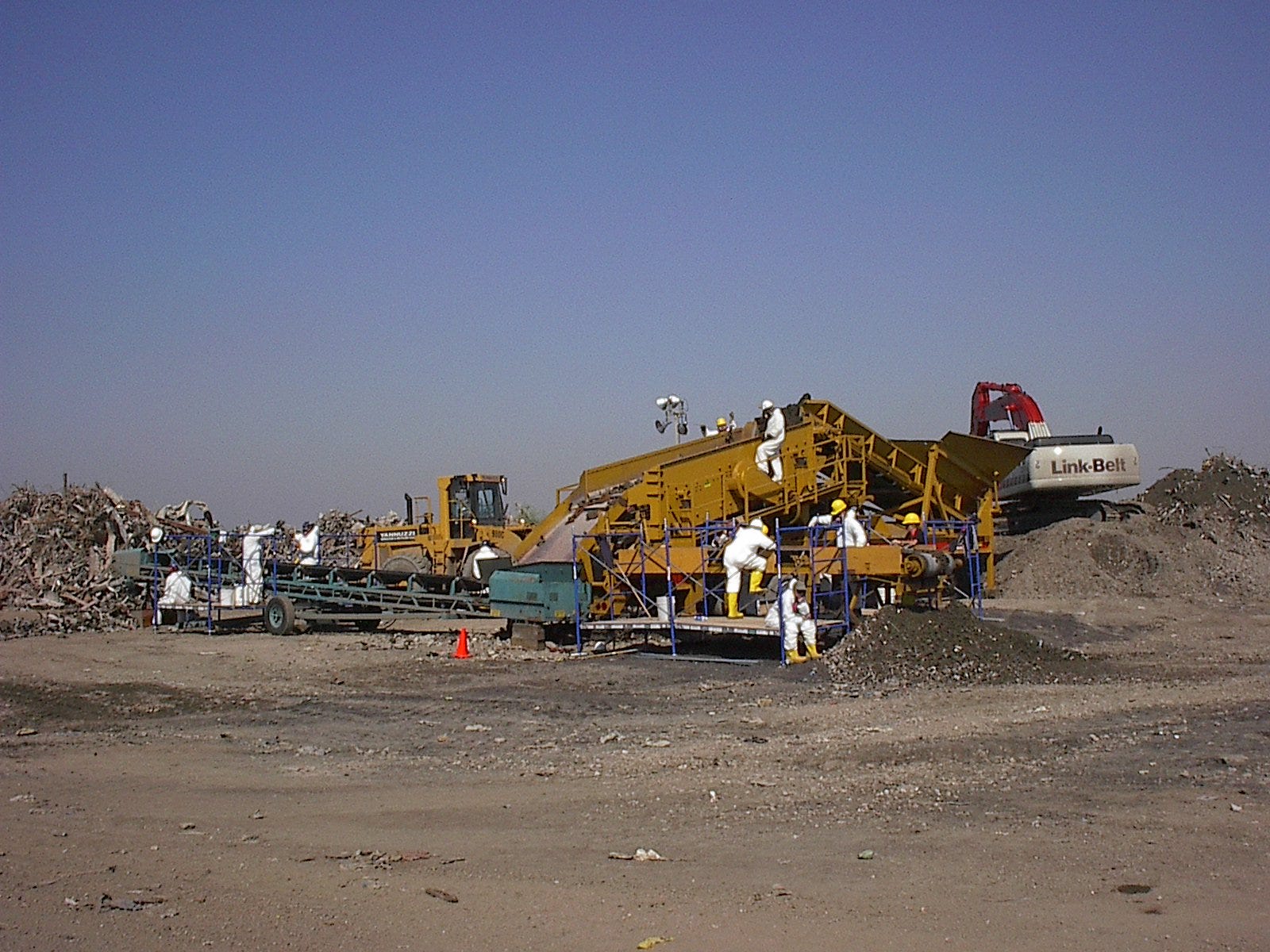
Here is how it worked. Picture an assembly line, because that is what they built. A disassembly line, for the worst day in American history.
The debris came out of Ground Zero by truck and by barge, tracked by GPS, chain of evidence preserved, down the harbor, around the clock. At the landfill, sanitation workers unloaded it and the machinery took over. Cranes and grapplers pulled the great steel aside. Everything else went through mechanical screeners that shook the wreckage into sizes. Chunks bigger than 8 inches. Pieces between 2 and 8 inches. Fragments between 2 inches and ¼ of an inch. The United States of America decided that the World Trade Center would be searched down to pieces the size of your fingernail.
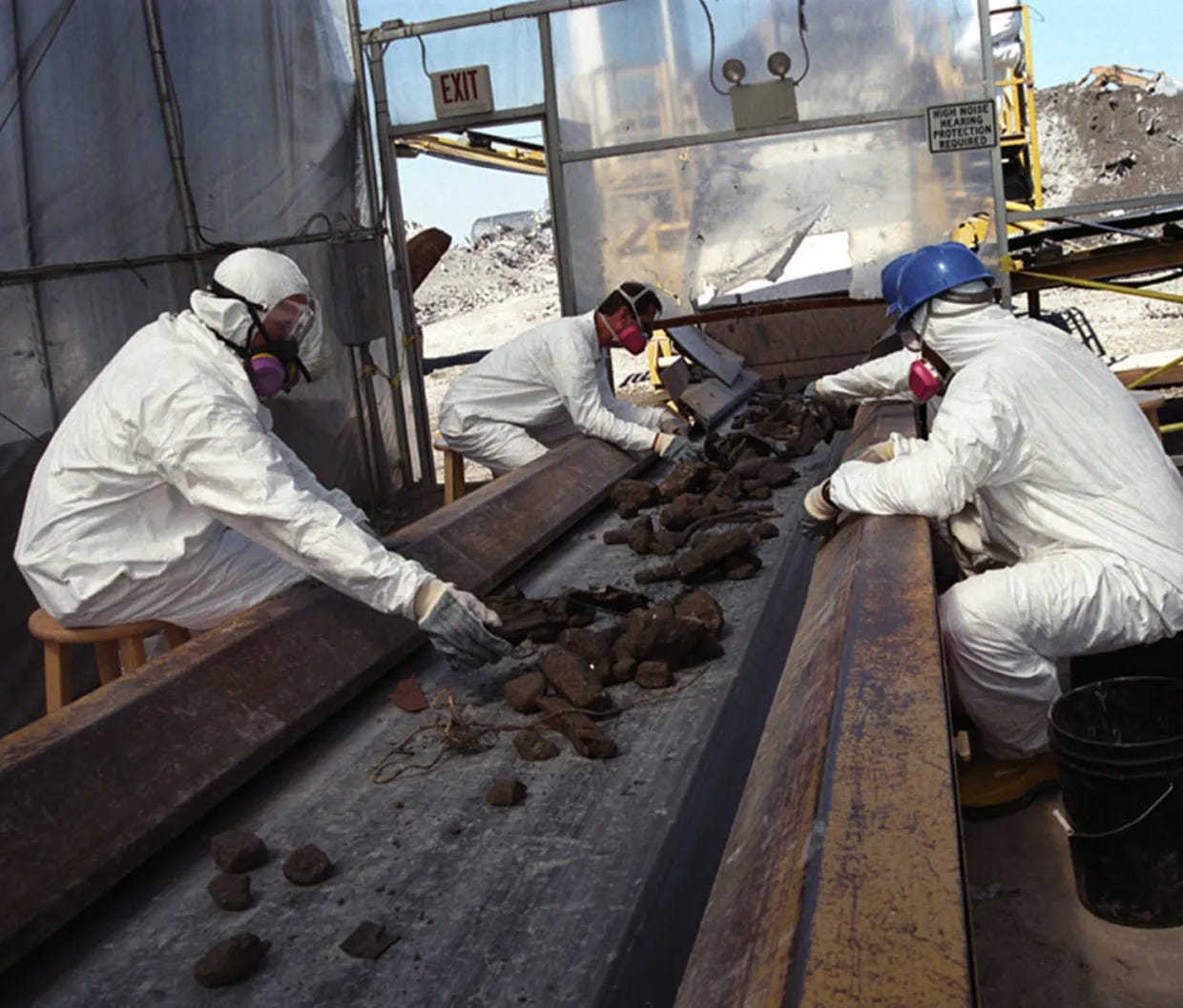
Then the belts. The screened debris rode conveyors, and standing along those conveyors, in 12-hour shifts, 7 days a week, through the heat of that Indian summer and the sleet of that first winter, stood detectives. NYPD. FBI. Federal investigators from across the government, with the medical examiner’s people beside them. They wore white protective suits, and they picked through the ruins of the towers piece by piece by piece. What they were looking for went into white buckets, and the white buckets went to a morgue tent, right there on the landfill.
The people who worked it gave the place a name. They called it the Hill. And the Hill grew. Over 10 months it rose some 80 feet, a man-made mountain with a clear view across the harbor to the hole in the skyline it was made of.
That is what I drove into in January 2002, escorting a congressional delegation. FEMA had a hand in the place: we were paying for much of the operation, and when the early weeks proved chaotic, it was FEMA that brought in the Army Corps of Engineers to impose order. So I went to see what the taxpayers were buying. From my journal, dated January 11, 2002:
“The drive to the Fresh Kills landfill on the south end of Staten Island started by literally driving through Ground Zero. As we drove through the site the perspective finally set in more clearly than could be discerned from the viewing stands. The PATH tunnel tube openings, the parking garages, the depth of the crater all came into proper perspective as we passed workers, cranes, debris piles and trucks.”
“Fresh Kills was as secure as Ground Zero. Even with a police escort we were stopped twice as we entered the landfill, once at the gate and again as we approached the actual site where the debris was being delivered. It is a crime scene and is being treated as such. The day we were there they had processed one million tons out of an original estimate of 1.2 million tons. They had also just upped the estimate to 1.4 million tons.”
In month four, they had already hand-searched one million tons, and the pile kept growing behind them, because Ground Zero kept sending more. The final count would come in around a million and a half tons. Here is what I wrote next, and 25 years later I would not change a word:
“Only in the United States would we expend the money, use the human resources and take the time to sift through 1.4 million tons of debris by hand, looking for body parts, evidence and any sort of identifying object for the victims’ families, for the FBI, police and fire departments. Huge front end loaders and pickers scatter larger debris into ‘fields’ that are raked over. Vibrating separators put the debris into differing conveyor systems to be hand-picked and examined by people.”
And then I wrote one sentence and gave it a paragraph of its own. It gets the same treatment here.
“An average of thirty human body parts are found each day.”
30 a day. Every day. For 10 months. Each one spotted by a human being standing at a belt, lifted by a gloved hand, carried to the morgue tent, logged, and sent to the medical examiner in Manhattan, where scientists matched it against DNA from hairbrushes and toothbrushes that grieving families carried in from every suburb in the tri-state region. That is what the men and women on the Hill did before breakfast, every morning, through the winter of 2001 and the spring and summer of 2002. Then they went back to the belt
Two more scenes from my journal that day. The first is the vehicles.
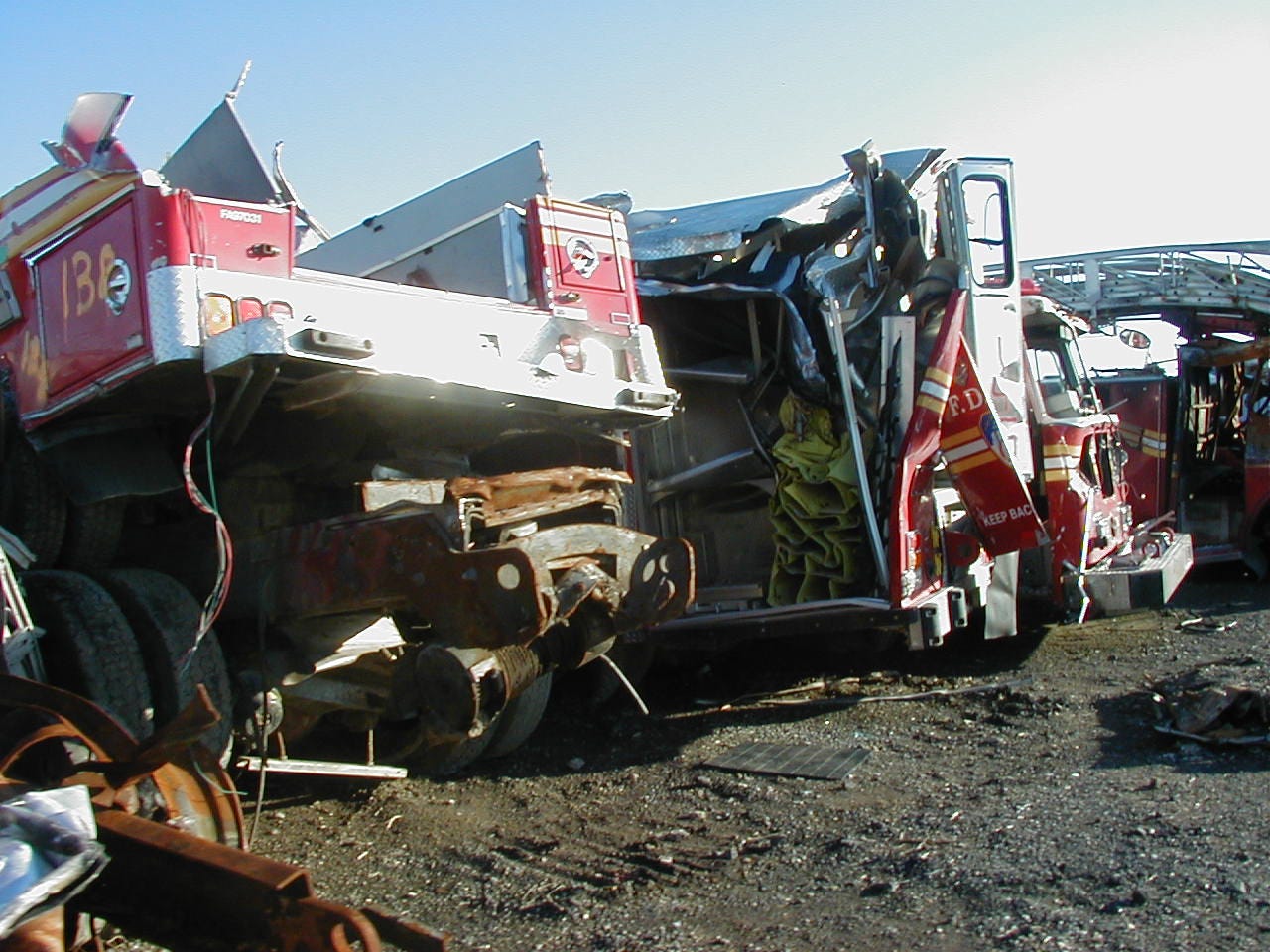
“As we traveled the perimeter of the site we came to the vehicle stack. Thousands of cars, trucks, fire trucks, ambulances, delivery vehicles, police cars, and pickups are piled row upon row. Many are smashed and crushed as if from a salvage yard. Hook and ladder fire trucks are smashed and crushed. Tires are burned exposing the wheel and the steel belts. It is an imposing and sobering site.”
Years later I learned what those fire trucks did to the people of Staten Island, a borough full of firefighting and police families. The medical examiner’s staff who worked the Hill have said it since: of everything that came through those gates, a million and a half tons of it, the sight that broke them was the crushed hook and ladders arriving on flatbeds. The apparatus their neighbors rode to work.
The second scene is stranger, and it belongs in the record precisely because nobody talks about it.
“One pile of debris is steel that was being diverted (well, actually the better word is stolen) by criminal groups. It’s now in an evidence pile. Another pile are beams, joints, pipes, being held for future study. The huge piles of steel girders have been cut into three foot sections and sent to Europe for recycling. And, a pile of airplane jet engines laid next to a trailer.”
Every clause of that paragraph is a story. Even at the site of a mass murder, somebody tried to steal the steel, and the NYPD built a case. Engineers set beams aside for study, and those beams became the science that changed skyscraper codes across the world. The girders were cut and shipped and melted, and today there is World Trade Center steel sailing in the bow of the USS New York, resting in firehouse memorials in all 50 states, standing in museums on 5 continents. And off to one side, next to a trailer, sat the engines of the murder weapons, waiting for the FBI. I stood looking at them in the cold. The landfill had a stink to it that afternoon, and I wrote that I could not stop wondering whether some of what I was smelling was the pile itself. I have never fully stopped wondering.
Now the part the country never learned. From the belts on that hill, the searchers recovered thousands of human remains, more than 4,000 by the counts the agencies published. They recovered tens of thousands of personal effects, a number usually given as 54,000. Read the inventory slowly. Wallets. Wedding bands. Watches stopped that morning. Family photographs that floated down a hundred floors and survived, landing on a dust-strewn sidewalk, or the front porch of a small merchant. Police shields and firefighters’ helmets. Office ID cards, the kind you wear on a lanyard and never think about, which became for some families the only object that came home. Every item was cleaned, catalogued, photographed, and where a name could be found, returned.
There are mothers who buried a son because a stranger in a white suit on a garbage hill in Staten Island refused to let a quarter-inch of him go unfound.
And the finding never ended. The remains went to the medical examiner of the City of New York, which made the families a promise in 2001: we will never stop trying to put names to what was recovered. They meant it. The lab has run and re-run the DNA as the science improved, decade after decade. Of the roughly 2,753 people murdered at the World Trade Center, more than 1,600 have now been identified, and identifications are still being announced in this decade, from fragments recovered a quarter century ago, some no bigger than a pea. About 1,100 souls have never been matched. Their remains rest today in a repository at bedrock beneath the September 11th Memorial, so that the unidentified went home to the site anyway, together. The New York Medical Examiner’s Office continues, to the moment you are reading this, to continue to try and match fragments to DNA samples. The work has not stopped.
The wait was terrible. And the wait was the search.
Now come back with me to that Sunday evening, and to the brother, and to April of 2002. I do not know whether his brother came home from the pile itself or from the belts on the Hill, and it does not change what I am about to say. 7 months means that in month 5, and month 6, and month 7, and even today, somebody was still looking. It means a searcher in the wreckage or a detective at a conveyor, standing a 12-hour shift in the cold, watched a million tons of ruin go past a quarter-inch at a time, and did not miss him. It means a scientist took what that stranger’s gloved hand lifted out and worked it against a toothbrush the family had carried in, and refused to quit until it had a name. Both things are true at once, and the family deserves both said plainly. The wait was terrible. And the wait was the search. The gasp in that room was right to be a gasp. It was pointed at the wrong thing. It should have been gasp in awe of what this nation was doing to find that brother.
I owe you the hard chapter too, because you do not read this Substack for the brochure version. When the operation ended in the summer of 2002, the finest material, the sifted dust that had been searched to a quarter inch and could be searched no further, stayed on the Hill, capped and sealed under a dedicated mound. Some families could never accept that. They believed, not unreasonably, that within that dust was some measure of the people they loved, and they fought in federal court for years to have it moved to a proper resting place. In 2008 a judge ruled against them, and the ruling closed the courthouse without closing the wound. I will not referee that grief. I will only say that both things are true at once: the people on the Hill searched that material with a devotion no crime scene in history had ever received, and the mothers and fathers at the fence deserved a better set of choices than physics and chemistry allowed anyone to give them. Twenty-five years later, both truths still stand on that hill together.
One more bill came due. The Hill was made of the same dust as the pile. The sanitation workers, the detectives, the agents and engineers who stood at those belts breathed it for ten months. More than 100 of New York’s sanitation workers alone have since died of September 11th illnesses, and the detectives of the Hill fill the rolls of the World Trade Center Health Program, which set an enrollment record last year, in the 24th year. The men and women who brought everyone else home have been dying of the errand ever since. Say their trade names, because nobody ever does: sanitation men. Crane operators. Evidence techs. The unglamorous half of heroism.
Today the machinery is gone. The mound is grassed over, and Fresh Kills, the world’s largest garbage dump, is becoming the largest new park New York has built in a century. Kayakers paddle the creeks. Hawks hunt the meadows. On the western mounds there is a rise with a clear view across the harbor to lower Manhattan, where light now stands in the skyline’s missing tooth. Most of the joggers who will someday run that path will never know what the ground under them did in the winter of 2001. That is why I wrote this.
Because here is the whole thing in one breath. In the worst season this country ever endured, America looked at a mountain of ruin containing its murdered neighbors, and it did not bulldoze, and it did not bury, and it did not look away. It put on white suits and picked the mountain apart with its hands, down to a quarter of an inch, for 10 months, so that a wedding band could go back to a widow and a name could go back onto a fragment of bone.
Nobody made a movie about it. Nobody built the Hill a monument.
The Hill was the monument. It still is.
And somewhere out there is a man who waited 7 months for his brother. I was too upset to stand up in that room and say what I should have said, so I will say it here, where he might someday read it. Sir: they never stopped looking for him. Not for one single day.
Now you know.
A version of this essay aired on The Situation with Michael Brown on 850 KOA on Monday, September 14, 2026. If someone you know still thinks nothing good happened after September 11th, send them the podcast or “The Gasp.”
Michael, this took my breath away. I have a dear friend who was a Fire Captain in Brooklyn during 9/11. One of his guys asked him if Joe could work for him the night of September 10. Joe worked a double shift that day and night so one of his crew could be where he needed to be. The next morning as he was returning home after the shift ended, he saw the smoke. He got back to the site as soon as possible. He found the member of his Truck who was assigned to stay with the Truck. The man was obviously in shock. He asked where the rest of the crew was and was told they were all gone, including the man he had worked for the previous evening. That man and the rest of the crew were gone, never to be found, as he would have been had he not done a favor for someone. He and his wife now live in Florida but they return every year for the Memorials. It is equally heart breaking every year. I have forwarded this to Joe whom I know will greatly appreciate that you shared this information I am sure he has never heard before.
Bless you!
Mr. Brown, I witnessed this start to happen from a vantage point half a country away, and deep down inside I understood what would be the conclusion before it came to pass. I am sincerely grateful for your candor. May you know The Holy Ghost as a Comforter, Consellor, Companion and Friend.