

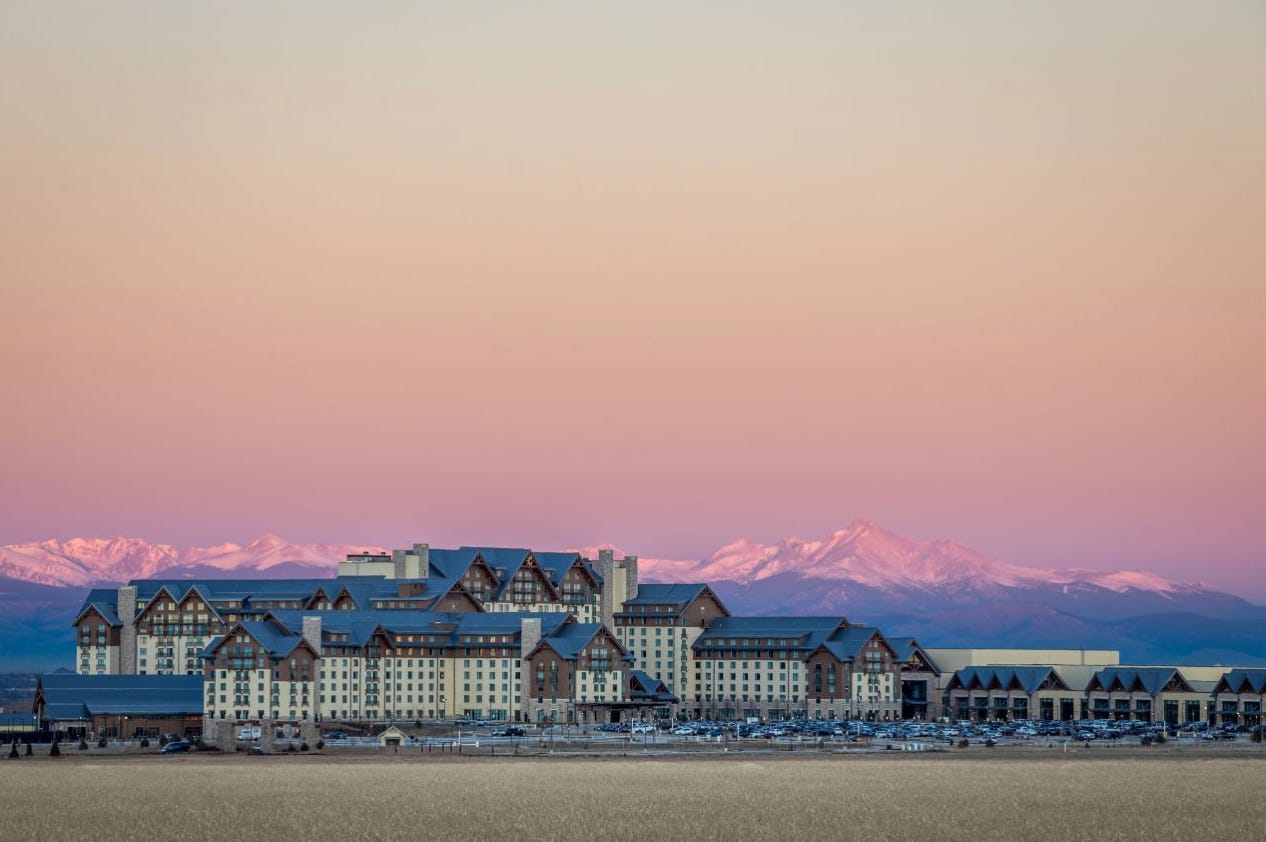
My friend Jon Caldara wrote something last week that made me laugh out loud, and then made me a little angry. That is the mark of good writing, so start with his, over at Complete Colorado. My story stands on the shoulders of his. I would just copy and paste his story, but he can be such a jerk. Friends are like that.
Jon has spent a good part of his life, like many of us, at conferences. And if you have ever been to one, you know the truth Jon tells. You fly into a city you have always wanted to see, you land, you climb into a hotel van, and then you disappear into a windowless box for 3 boring days. The only local culture you experience is a $12 Caesar salad and an overpriced shot of tequila.
Jon calls the Gaylord Rockies “a massive Dave and Buster’s with hotel rooms.” I would call it a resort you check into and can never leave. It was built next to the airport on purpose: so the conventioneers never risk bumping into the actual city they flew all that way to see.
And good for them. If a grown adult wants to pay $400+ a night to be sealed inside a climate-controlled biosphere and sold a commemorative fleece vest that signals you hiked a fourteener, this is America. Have at it.
Here is where I stop laughing.
You are paying for it. You, the person who has never slept a single night in that hotel, and never will.
I want to go where Jon’s column pointed but did not have room to walk. Who actually owns this thing. Where this playbook was written. And what, exactly, the state of Colorado is being asked to do about it right now, this month, while most people are not watching this, but are focused like a laser on the Denver Broncos.
What’s happening right now
This is not ancient history. It is a live decision.
The Nashville company that owns the Gaylord Rockies is reportedly ready to spend more than $300 million to add a new tower of hotel rooms and to expand the resort’s water park, growing the place from about 1,500 rooms to nearly 2,000. Two years ago, the resort filed plans with the city of Aurora to add 450 rooms and a 47,000-square-foot indoor water-park addition.
The question, per reporting by Mark Samuelson in The Denver Gazette, is whether the owners are also back at the table asking Colorado taxpayers to help pay for it.
Here is what we know. On August 21, the state’s Economic Development Commission reviewed an update on the Gaylord and then closed the doors to the sunlight and went into executive session about the Aurora tourism award. No formal application has been filed yet. But a source close to the commission told the Gazette there is “an understanding one would be forthcoming,” tied to the room expansion. And the commission is expected to take the Aurora award back up at a public meeting in September.
That is now. Which is exactly why this is worth your three minutes before the vote, instead of your outrage after it.
The number already on the books
Before we talk about the ask, look at what is already committed.
According to The Denver Gazette, which obtained the records under Colorado’s Open Records Act, the company that owns the Gaylord Rockies is on track to collect as much as $1.3 billion in tax incentives over 23 years, through 2043. Not million. Billion.
Here is the mechanism, which I want you to understand, because the mechanism is the outrage. When you buy a meal or a room at nearly any business in Colorado, the sales tax you pay goes to the government, ostensibly to build roads, hire police, and keep the lights on. At the Gaylord, the city of Aurora hands almost all of it back to the hotel:
• 96.3% of the sales tax collected there, refunded to the owner.
• 96.25% of the lodger’s tax, refunded.
• 93.3% of the use tax, refunded.
• Plus the property-tax increment, and other lodging taxes and fees.
The original deal let the first $10 million in annual revenue flow to the city of Aurora, and everything above that flowed back to the ownership. On top of the local package, the state (you and me as taxpayers) kicked in $81.4 million under the Colorado Regional Tourism Act of 2009.
For scale: a site-selection specialist quoted by the Gazette called the package twice as generous as anything he advises his own clients to accept. He said a responsible incentive is about half of the new state and local taxes for the first 10 years. This one refunds 93% - 96% for more than twenty years. And the Denver Urban Renewal Authority, which does this for a living, told the Gazette it typically caps these deals at 20% of a project’s total cost. Aurora went to 96%.
The part that should end the conversation: this hotel is a cash machine
Set aside the philosophy for a second and just look at the business.
Last year the Gaylord Rockies booked 80% of its rooms, ran about $26 million a month in revenue, and generated $313.2 million for the year, an 8% jump over 2024. Its parent company’s stock, Ryman Hospitality Properties, trades on the New York Stock Exchange under the ticker RHP and is up 71% over five years. Call your financial advisor. Two years after the hotel opened, Ryman bought out its development partner’s remaining 35% stake, plus 130 acres of adjacent land, for $210 million.
This is not a struggling business begging for a lifeline so it can survive. This is one of the most successful hotels in the state, owned by a thriving public company, asking taxpayers for a top-up so it can get bigger and make more.
Read that again because everything the boosters say next is designed to make you forget it.
The villain you were promised, and the one you actually have
I could tell you a rich Oklahoma family is reaching into your pocket. I personally think it would make a better story. It just is not true anymore. That’s fine, because the true version is worse.
There really was a Gaylord family. Edward L. Gaylord inherited The Daily Oklahoman and ran the Oklahoma Publishing Company out of Oklahoma City. He built an empire: the Grand Ole Opry, Opryland, and the whole string of Gaylord convention hotels trace back to him. He died in 2003.
Here is the irony, and it is delicious. Mr. Gaylord was a hard-right newspaper baron who spent his career on the editorial page railing against government spending, and who sat on the board of the conservative Council for National Policy. And according to his own biography and criticism from the Columbia Journalism Review, his paper editorially cheered for public subsidies to a Bass Pro Shop while his company held a 19.9% ownership stake in it. The man who preached against handouts helped design the machine that runs on them and which we now call corporate welfare. Yeah, an Okie built that.
But the Gaylord family does not own the Gaylord Rockies, and gets nothing from Aurora’s $1.3 billion. In 2012, Gaylord Entertainment sold the Gaylord Hotels brand and management rights to Marriott International, converted itself into a real estate investment trust, and renamed itself Ryman Hospitality Properties. It literally surrendered the right to use the Gaylord name on anything but the buildings.
So the entity collecting your money in Aurora is a publicly traded REIT whose largest shareholders are the big index funds: Vanguard, BlackRock, GAMCO. The hotel is operated by Marriott under a long-term management contract. And the Gaylord Rockies itself was developed by a Houston firm, RIDA Development Corp.
The family is gone. The name stayed on the door. And the playbook of corporate welfare the family invented kept getting run, city after city. That is the real story, and it is bigger than Colorado.
The Gaylord subsidy tour
Every Gaylord-branded resort in the country is a monument to other people’s money. Let’s take a tour. I have flagged, honestly, where the dollar figures are firm and where the public record only shows that incentives existed.
Nashville, Gaylord Opryland. In 2017, Metro Nashville handed Ryman roughly $13.8 million in tax breaks to build a water park called SoundWaves at the Opryland resort. A councilman named John Cooper voted no, and warned his colleagues: “Every time that we need something in the future for our districts, a reading instructor for children, a police man, a body camera or a stormwater drain, you will find it in an Opryland swimming pool.” Cooper was later elected mayor of Nashville. For its first years, the water park was closed to locals; the public only got in when the pandemic forced the company to sell day passes at nearly $50 a head. (Figure firm.)
National Harbor, Maryland, Gaylord National. The resort sits inside a large publicly financed development outside Washington, D.C. Prince George’s County committed about $50 million in bonds tied to the project. (The $50 million bond figure is firm; the full public-financing picture for the surrounding development is larger and harder to pin to a single clean number.)
Grapevine, Texas, Gaylord Texan. A roughly $500 million resort that opened in 2004, built with city and county tax incentives, land, and infrastructure support from Grapevine. (That incentives existed is documented; I could not verify a clean, single dollar figure I would put in print, so I am not going to invent one.)
Kissimmee, Florida, Gaylord Palms. Opened in 2002 as a public-private partnership with Osceola County providing land incentives and infrastructure. (Same caveat: the arrangement is documented, the precise dollar total is not cleanly public in what I could verify.)
Chula Vista, California, Gaylord Pacific. This is the one that ought to scare Aurora, because it is the newest, and it is the same developer. RIDA, the Houston firm that built the Gaylord Rockies, built this one too, right on San Diego Bay. To help fund the $1.3 billion resort, the city and port floated $383 million in public bonds through a government financing authority. The promise was the usual promise: the hotel throws off so much tax revenue that it pays for itself.
Watch what actually happened. The resort opened in 2025. In its second year, the tax revenue coming off the property, about $25 million, is already falling short of the bond payments it is supposed to cover, about $29 million. The authority is covering the roughly $3 million gap out of reserves. This is not a projection. The Voice of San Diego reported it this month, the same week Jon published his column here. (Figures firm.)
The newest hotel in the chain is already underwater. And Aurora is being asked to add a wing to the one out by the airport.
“All or nothing” is a bluff. Aurora, remember this.
Here is a fact worth tattooing on the arm of every elected official who will ever hear one of these pitches.
When Gaylord first came to Colorado’s Economic Development Commission, it asked for $153 million from the state tourism program, 95% of the sales tax the hotel would generate. The commission, in a 7-to-2 vote in 2012, gave it $81.4 million, 66%. That is a $71.6 million haircut, cutting the request nearly in half.
And now the punchline. Gaylord built the hotel anyway. All 1,501 rooms of it. The “we need the full package or the project dies” claim, the one that always accompanies these deals, got called by the state of Colorado, and the project went up regardless. The threat was a bluff. It is almost always a bluff, because these companies do the deal wherever the math works, and the math worked in Aurora with the smaller number.
That $81.4 million state award drew a lawsuit in 2013 from a group of competing Colorado hotels, who asked a fair question: why is a one-stop resort 12 minutes from the airport getting money from a fund that was supposed to nurture tourism around the state? A judge ruled against them in 2014, and the project moved ahead. But the question they asked never got answered. It is the same question hanging over the September meeting.
It isn’t new money. Gaylord’s own competitors say so.
The single strongest objection to this deal does not come from conservatives and libertarians like me. It comes from other people in the hotel business, and it is about the math.
The Gaylord is designed, on purpose, so the money never leaves the building. As one industry insider put it to the Gazette: “The Gaylord model, as noted in their marketing, is that everything is there. You meet, shop, eat and drink there and then you go to DIA and you go home. That’s not a regional economic impact. Those are two very different things.”
Now push it one step further, the way that source did. If an expanded Gaylord lands a convention by pulling it away from downtown Denver, or the Broadmoor in Colorado Springs, or a lodge in the mountains, Colorado gains nothing. No new visitor. No new money. You have simply moved a Colorado dollar from one Colorado hotel to another, and you used the taxpayer’s own money to move it. The state subsidized Gaylord to take business away from Gaylord’s Colorado competitors, and then those same competitors get to help pay for the subsidy through their taxes.
Call it what it is. The government picking a winner and billing the losers.
Think about Jake Jabs, the way Jon does. Jake built American Furniture Warehouse the old-fashioned way, by selling furniture to people who wanted furniture. When a business like Jake’s needs help from the government, it gets exactly one thing in the mail. A tax bill. The little operator pays full freight, and then his taxes help cover the big operator’s freight too.
And before anyone files me under “Republican crank,” let me be clear. This is not a Republican sin or a Democratic sin. Both parties love a ribbon-cutting. Both parties love corporate welfare. This particular deal got its state blessing under a Democratic governor and has had plenty of Republican hands on it since. Corporate welfare is the one truly bipartisan program in America.
My own confession
I have to be straight with you. I have gone to these conferences. I have stayed in these hotels. I have eaten the $12 salad, (but never bought the fleece vest), and enjoyed almost every soulless minute of it. I am not against the Gaylord. If Ryman wants to build another tower onto its beautiful corporate hotel out there by the airport, wonderful. I might even come stay in it if I have a 5:00 a.m. flight out of Denver International. No, scratch that. If I have a 5:00 a.m. flight out of DIA, now I am definitely staying at the Westin on the airport.
So build it. Build it with Wall Street’s money, and Marriott’s money, and your Houston developer’s money. You have plenty. Your stock says so.
What Aurora and the state should actually do
Diagnosis is easy. Here is my prescription, because a column that only complains is just noise and you have enough noise in your life.
One. Say no to any new incentive on the expansion. An 80%-occupancy hotel generating $313 million a year does not need public money to add rooms it has already decided it wants. If the expansion pencils out, and Ryman’s own filings say it does, Ryman can fund it.
Two. Fix the statute. The most alarming line in the Gazette’s reporting came from a source close to the commission, who said that if Gaylord’s application “fits the statute,” the commission may not have “a lot of wiggle room to say no.” He said the Regional Tourism Act was drawn so loosely it was practically written to build a NASCAR track. A law that ties the state’s hands while a billion dollars walks out the door is a broken law. That same source offered the honest remedy: if the hoteliers do not like it, they should get the statute repealed. Take him up on it.
Three. Demand real net-new proof. No RTA dollar should move without a hard, independent showing that the visitors are genuinely new to Colorado, not conventions shuffled across town. If the money just moves business between Colorado hotels, the statute’s own purpose is not met, and the answer is no.
Four. Cap it, sunset it, and claw it back. Cap any incentive near what DURA uses, around 20% of project cost, not 96%. Put a hard end date on it. And write in claw-backs, so if the promised jobs and out-of-state visitors do not materialize, the taxpayer gets the money back. Chula Vista is what happens when nobody writes that clause.
Five. Do it in daylight. A billion-dollar decision about your money does not belong in an executive session. If this deal is as good for Colorado as its backers claim, they should be glad to make the case at the public microphone in September, with the numbers on the table.
The choice
This is a state that tells us every year that it is broke. Broke for roads. Broke for the schools. But somehow never too broke to route $1.3 billion to a hotel by the airport that most of the people paying for it will never enter.
Their hands are not tied. Ours are not either.
We can say no. Let Gaylord build the next tower the way Jake Jabs built his store: with its own money, for its own customers, at its own risk. That is not anti-business. It is the most pro-business idea there is. It is called paying your own way.
The commission meets this month. Tell me in the comments what you would say to them if you had the microphone, and tell me why. If you have documents or firsthand knowledge of how these deals get done, my door is open at michaelbrown at iheartmedia dot com.
Colorado taxpayers already bought a ticket to a hotel they will never enter. We do not have to buy them a second one.
Sourcing and Verification
I keep verified fact, attributed claim, and my own opinion separate, and I flag what still needs checking. Here is the spine of the reporting, with each source’s lean noted so you can weigh it yourself.
The current Aurora ask (August–September 2026). Mark Samuelson and Dennis Huspeni, The Denver Gazette (”Is Gaylord Rockies Resort seeking more taxpayer tourism dollars?”, Aug. 26, 2026), with news partner 9NEWS. Right-leaning outlet. Source for the $300 million-plus expansion, the growth from ~1,500 to ~1,950 rooms, the prior 2024 filing to add 450 rooms and a 47,000-sq-ft water-park addition, the EDC’s August executive session, the expected September public meeting, the “no wiggle room” and “NASCAR track” quotes, the “self-contained universe” quote, the $313.2 million in 2025 revenue, 80% occupancy, and RHP’s 71% five-year stock gain. Note: as of publication, no formal incentive application had been filed. Whether Gaylord ultimately asks for new public money, and how much, is not yet a matter of public record. I have said so plainly rather than assuming the worst number.
The $1.3 billion figure and the rebate percentages. The Denver Gazette (”Owner of Gaylord Rockies resort to reap $1.3 billion in tax incentives,” May 21, 2021), based on records obtained under Colorado’s Open Records Act. Right-leaning outlet. Source for the $1.3 billion / 23-year / through-2043 estimate, the 96.3% / 96.25% / 93.3% rebate structure, the first-$10-million provision, the “twice as generous” specialist assessment, and the DURA 20% cap. The estimate is a projection over the life of the agreement, not a check already cashed; I have described it that way.
The Regional Tourism Act award and the reduced amount. Sentinel Colorado reporting on the Colorado Economic Development Commission’s 2012 vote: request of $153 million (95%), award of $81.4 million (66%), on a 7-2 vote. Center-left local outlet. The 2013 competing-hotels lawsuit and 2014 ruling: Sentinel Colorado and court records (1405 Hotel, LLC v. Colorado Economic Development Commission). Primary/court source.
Corporate structure. The 2012 sale of the Gaylord Hotels brand to Marriott and the conversion of Gaylord Entertainment into Ryman Hospitality Properties: Ryman Hospitality investor releases and contemporaneous CNBC / PR Newswire coverage. Company-primary and business-press sources. Ownership by Vanguard, BlackRock, and GAMCO, and the absence of Gaylord family control, per public shareholder data. RIDA Development Corp. (Houston) as developer and the $210 million buyout of the remaining 35% stake: Sentinel Colorado and The Denver Gazette.
Edward L. Gaylord. Biography, the Council for National Policy membership, and the Bass Pro Shop editorial-conflict episode (with the 19.9% ownership stake), as reported in his biographical record and criticism attributed to the Columbia Journalism Review. Attributed claim, flagged for a reader’s own check. The Bass Pro conflict is the one item here I would most want a second primary source on before I leaned my whole case on it; I have used it as color and irony, not as a load-bearing fact.
The national track record. Gaylord Opryland SoundWaves water park, ~$13.8 million in Metro Nashville tax breaks (2017), and the John Cooper quote: contemporaneous Nashville reporting and Pat Garofalo’s “Boondoggle” newsletter. Cooper’s later election as mayor: public record. Gaylord National / Prince George’s County ~$50 million in bonds: Washington Examiner and county records. Gaylord Texan (Grapevine) and Gaylord Palms (Kissimmee): incentives, land, and infrastructure support are documented in general accounts, but I could not verify clean single-dollar figures, so I have not printed any. Gaylord Pacific / Chula Vista, $383 million in public bonds and the ~$25M-vs-$29M second-year shortfall: City of Chula Vista releases and Voice of San Diego (Sept. 2, 2026).
What I could not reach. The precise dollar amount and mechanism of any new 2026 incentive request, because none has been formally filed. The exact original public-financing totals for the Grapevine and Kissimmee resorts. And the internal deliberations of the EDC’s August executive session, which were closed. Where I could not confirm, I said so instead of guessing.
I was just in Denver and on the way back to the airport asked “WTF is that?” Thanks for the knowledge.
Hi. Rockies was the first built after the Marriott purchase. Construcion defects througtlout the conplex. Had to purxhase additional land in order to frustrate the invasion of development on all sides of the complex, which detract from the rustic setting. Looks nice. Not worth the hassle., nor the price.