

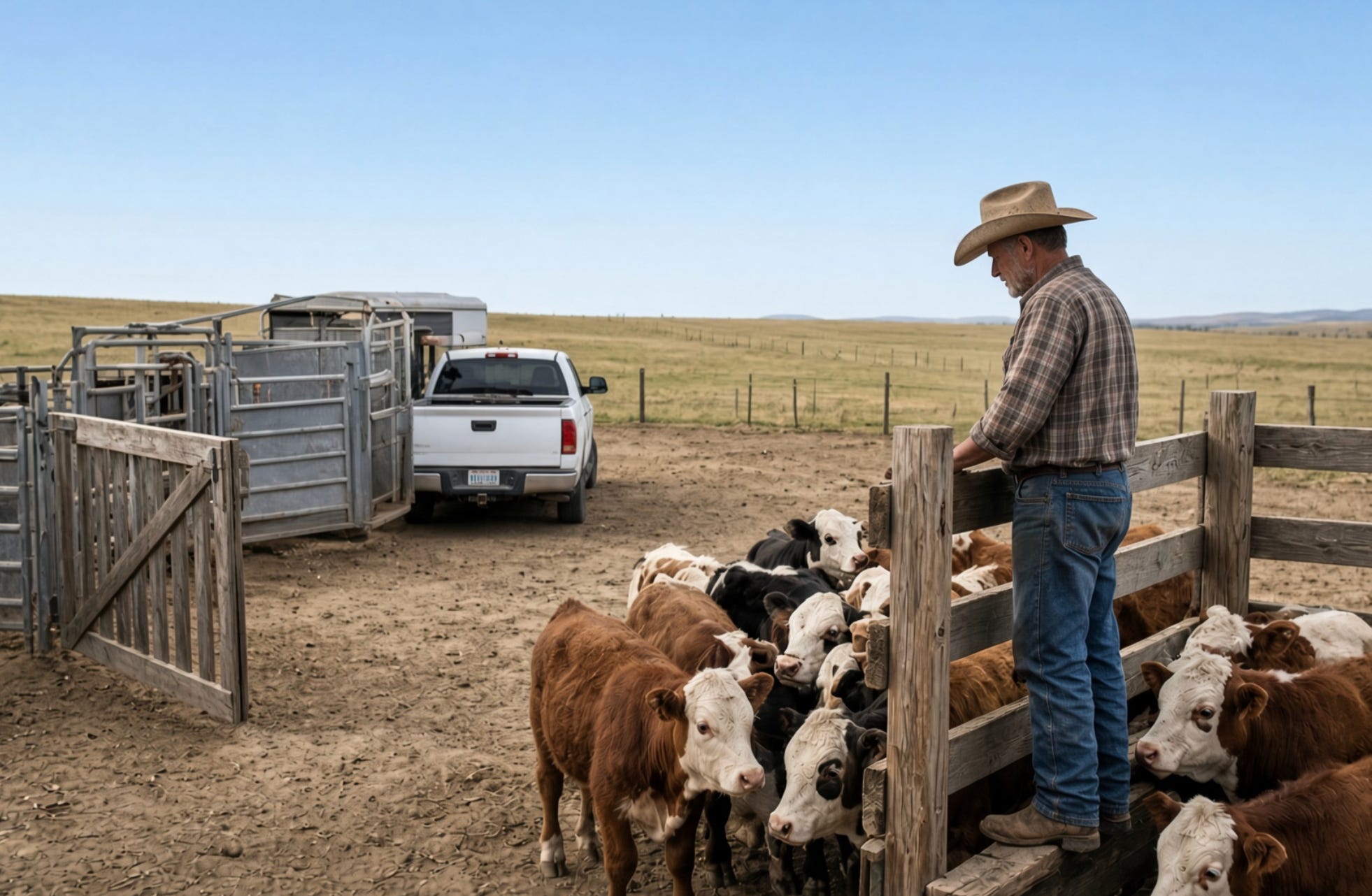
On Friday, August 21, the President went on television and announced a plan to make your hamburger cheaper. For 90 days, he said, the government would waive the tariff on 300,000 metric tons of imported ground beef, and it would sell for 25% below market prices. He did not say how, he did not say who would be on the hook to mark it down at the register, and — as of my writing — he has not signed it. The White House says an executive order formalizing the directive is coming within about two weeks. It follows a February order that quadrupled U.S. beef imports from Argentina on the same theory: cheaper foreign beef, cheaper groceries.
The on-air version of this essay today told you the human story — the rancher at the gate, the drought, the record price that arrives the same summer he has nothing left to sell. This is the long version. This is where I give you my research: how the price of beef is actually built, from a calf on a dry pasture to the package in your cart, and why the people who study cattle markets for a living — not activists, university economists — think this deal does almost nothing for you and real damage to them.
Grab a coffee. If you didn’t grow up in ranching country like I did, this may be something you’ve never encountered.
First, how a price becomes a price
Most of us picture “the beef market” as one thing. It isn’t. That animal changes hands three or four times before it’s dinner, and every handoff is a separate market with its own price.
It starts with the cow-calf producer — the rancher with the mother cows. Each cow gives about one calf a year. The calf nurses on grass and gets sold at weaning, around 500 to 600 pounds, usually at auction. From there it may go to a backgrounder who grows it on grass, then to a feedlot that finishes it on grain to around 1,400 pounds. The feedlot sells the finished animal to a packer — the processor that does the slaughter and cutting and turns a steer into what the trade calls “boxed beef.” The packer sells that boxed beef to the retailer, and the retailer sells it to you.
Three prices matter in that chain, and the whole story is in the gaps between them. There’s the price the rancher and feeder get for the live animal. There’s the wholesale “boxed beef cutout” the packer gets. And there’s the retail price you pay. When people yell about beef, they’re almost always yelling about one of those three gaps without knowing those gaps even exist.
Here’s the piece that surprises people. Four companies — Tyson, JBS, Cargill, and National Beef — slaughter roughly 85% of the fed cattle in this country. In 1971 the top four had about 25% of the market. Today it’s around 85%, and about a dozen plants produce nearly half the beef in America. When four buyers stand between hundreds of thousands of ranchers and every grocery store in the nation, the ranchers are what economists politely call “price takers.” They sell into a market with almost no one bidding.
It gets thinner than that. There used to be a robust “cash” market, where packers and feedlots haggled a price out in the open every week, and that public price told everybody what cattle were worth. If you’ve never been to one of those markets, you’ve missed great theater. That market has withered. Today, depending on the region, as little as 20 to 25% of fed cattle trade in that open, negotiated way. The rest sell on formula contracts — priced off that shrinking public number. So, a smaller tail is wagging a bigger and bigger dog. Critics have argued for years that a market this thin is easy to lean on and lousy at discovering an honest price. The USDA proposed a rule on exactly that problem in 2024.
That’s the process. What happens when you can’t build cows very fast?
You cannot make beef fast
A factory short on inventory runs a second shift. A rancher can’t. A cow carries a calf about 283 days, or about nine months, same as us, and gives you one calf a year. From the moment a rancher decides to grow his herd to the moment that decision puts more beef on a shelf is 2 to 4 years.
And there’s a cruel twist inside to this timeline. To grow the herd, a rancher keeps his heifers instead of selling them. Rebuilding the herd actually takes animals off the market. Rebuilding makes beef scarcer before it makes it cheaper. That’s why beef runs in long, slow cycles instead of snapping back. Biology sets the speed limit, and you really can’t negotiate with biology.
The smallest herd since Truman
Put that slow-motion supply next to today’s numbers and you see the problem.
On January 1, 2026, the USDA counted 86.2 million head of cattle in the United States. That is the smallest herd since 1951. The smallest herd in 75 years. The beef-cow herd, the mothers that make the whole thing go, stood at 27.6 million. Last year’s calf crop, 32.9 million, was reportedly the smallest since 1941.
Why so small? Drought. Years of it across the Plains and the West burned up the grass and sent hay prices through the roof. So, tens of thousands of ranchers did the only thing they could. The ranchers sold the cows they could no longer feed. This spring, by one industry measure, over 70% of the nation’s beef cows were sitting in drought. And each of those was the object of a rancher’s decision: sell now or hold off hoping for something better.
Then a second blow happened. A flesh-eating parasite called the New World screwworm came marching north through Mexico in 2025, and the USDA slammed the southern border shut to live cattle to keep the screwworm out. That cut off the Mexican feeder cattle normally flowing into American feedlots. That means a whole supply line, gone, on top of the drought. Two different wounds with the same result: fewer animals in the pipeline. Neither one has anything to do with imports of foreign hamburger.
You have to understand what that record price at the butcher counter actually is. It is not the sound of a fat, happy industry gouging you. It’s the sound of a starving industry. Scarcity created the price. And the number of operations that raise beef cattle fell from 729,046 in 2017 to 622,162 in 2022. That works out to about 15% of them gone in only five years. Nearly 4 in 10 American farmers are now over 65. Cattle ranching is an old, shrinking, exhausted business that finally caught a good price on the far side of a decade of hell. Ask any rancher.
Record price, empty pasture
In 2025 and 2026, the cow-calf rancher (the one who owns paid-for cows on paid-for grass) is actually making money. University of Kentucky economists put the true net profit somewhere around $478 per cow in 2025. That’s not nothing. That’s a good year, and those ranchers earned it.
But “record price” and “rich” are not the same word. Ask any business owner selling something and they will tell you the same thing.
The man who liquidated in the drought caught one high cull-cow check and then had nothing left to sell. The rancher who held on is profitable. But that rancher is sitting on a shrinking, drought-exposed, expensive-to-replace herd. That rancher’s bred heifer used to rebuild his herd with now runs around $2,500. One link up that chain, the feedlots buying calves at record prices are on razor-thin margins. And the packers everyone loves to blame? Right now they’re losing money. For example, Tyson booked a $138 million operating loss on beef in a single quarter this summer, with volume down as prices increased.
What does all of that mean? In 2026, the rancher isn’t pocketing the gap between the pasture and the cash register, and neither is the meat packer. Who is? R-CALF, the ranchers’ group, ran the numbers and pointed at retail. R-CALF estimates the retail margin per animal climbed from about $1,345 in the 2016-to-2019 window to roughly $2,035 in early 2026. At the old markups, they calculate, Choice beef would run about $1.40 a pound less than it does now. I’ll note that as their analysis, not gospel. However, if the gap is being held at the cash register, then cutting a tariff way upstream, on the raw import, is unlikely to ever reach your grocery cart.
Why we import beef at all
Now the imports paradox most people miss.
The United States is the largest beef producer on Earth and one of the largest beef importers. That sounds insane until you learn what we import. We import mostly lean trim. More than 70% of imported beef is just that: lean trimmings. Our grain-fed cattle produce fatty beef; the 80/20 hamburger Americans want has to be blended from fatty domestic beef and very lean imported beef, most of it from cull cows and grass-fed cattle abroad. But the smaller our herd gets, the fewercull cows we slaughter, so the more lean trim we have to import. The shortage and the imports have the same root cause: the drought-shrinking herd.
Where does it come from? Through the first ten months of 2025, roughly: Australia 24%, Brazil 20%, Canada 18%, Mexico 12%, New Zealand 11%, Uruguay 7%, Argentina 2%. We imported something on the order of 4.4 billion pounds in 2025. Beef comes in under a “tariff-rate quota.” A set volume enters cheap, and anything above it pays a stiffer out-of-quota tariff. Friday’s announced deal waives that out-of-quota tariff on 300,000 metric tons for 90 days.
How much is 300,000 metric tons for 90 days? Only bout 44 days’ worth of the country’s ground beef, or roughly 15% of a year’s imports, according to one analyst. That is a bump, not a flood.
What the deal actually does — and doesn’t
Will this lower your grocery bill? Barely, according to the economists who study this.
Derrell Peel at Oklahoma State University is the most-cited cattle economist in the country, and not a protectionist, put it plainly: we’re already “importing about as much as the market wants,” so waving in more tariff-free tons mostly displaces tons that were coming anyway. He called the move “more political messaging than meaningful market intervention.” David Anderson at Texas A&M University expects minimal price impact. When the friendliest available experts tell us the consumer relief is small, the relief will most likely be small indeed.
This isn’t theoretical either. We’ve tried this before. In February, the President signed an order quadrupling beef imports from Argentina. The President used the same logic, the same promise of relief. What happened to retail ground beef between February and July? By one market analysis it went up, from about $6.74 a pound to $6.89. More imports arrived; the shopper paid more, not less. There’s also less to the “25% below market” line than it sounds: the 90% lean imported trim this deal targets already trades at roughly that discount to domestic beef, so the promise mostly describes a price that already exists rather than a new cut coming to your grocery cart.
The minute the deal hit, cattle futures fell off a cliff: October live cattle down more than $5 intraday. That’s the market’s gut reaction, and its gut said this is bad for cattle. By Friday’s close they’d clawed most of it back to near-flat. And? The deferred contracts, cattle priced two years out, closed higher. Translate that from trader to my cowboy English and it says the market believes this gimmick does nothing to fix the underlying shortage. The high prices are still coming in 2027. What the deal did move was the mood in the one season that counts. It told every rancher sitting at that kitchen table, deciding whether to keep his heifers and rebuild: the minute your prices get high enough to make rebuilding worth the risk, we will open the import spigot.
The confidence in the belief that a high price will still be there in 3 or 4 years, is the entire fuel supply for a herd rebuild. And this deal spent some of it to buy a soundbite, a headline. The announcement literally said it was meant to give “the great American beef herd” room to grow, while doing the one thing most likely to talk ranchers out of growing the beef. That’s not a cure.
And it wasn’t just the cattle groups. Within hours, the sharpest pushback came from the President’s own party — the Republicans who represent cattle country. Nebraska’s Deb Fischer said we can’t lower grocery prices “at the expense of American producers.” Her Nebraska colleague Pete Ricketts warned that “short-term policy shifts do not equal long-term solutions.” It’s as though he quoted this entire essay in nine words. Montana’s Tim Sheehy allowed that the President’s “heart is in the right place” but said the move would “harm our ranching families, most of whom are MAGA Republicans.” Missouri’s Jason Smith, who chairs the tax-writing Ways and Means Committee, called on the administration to reverse course. When a President’s own farm-state senators break with him on the subject they know best, that is not partisan noise, and it deserves to be heard.
The President’s deal
Here’s what I believe to be the strongest case for the deal.
Beef is at record retail prices, and that pain is real and it is regressive. It hits working families hardest because for them ground beef was the affordable protein. Tariffs on lean trim are, functionally, a tax on the exact ingredient that makes cheap hamburger, so cutting them is a clean way to ease the squeeze. We genuinely can’t self-supply that lean trim right now, so imports aren’t a betrayal of ranchers. They’re how the hamburger gets made. And the honest expert consensus is that drought, not imports, is what shrank the herd and drove up the price. So, blaming imports, the argument goes, scapegoats a minor factor and lets ranchers dodge the hard truth that only rain and time fix this.
Points one, two, and four of that are true.
But the argument fails
Their argument fails on magnitude and timing, not on the facts.
Yes, the pain is real. But this deal doesn’t fix it. Even its friendly forecasters say it won’t meaningfully cut retail prices, because we already import what the market wants and because the gap is being held at retail, not at the border. So maybe you’re trading a few cents on ground beef against a real hit to the one thing that lowers beef prices for years: the herd rebuild. That’s a bad trade even by the deal’s own numbers.
And yes, drought is the primary villain, not imports. Seal the border tomorrow and the pasture is still dust. But conceding that imports aren’t the disease is not the same as saying an import surge is good medicine. It’s the wrong medicine at the worst possible moment. It’s medicine with almost no cure and a genuine side effect. You can be for cheaper beef, as I am, and still see that this particular move mostly buys a headline.
The most serious case for the deal — point by point
The best argument for Friday’s move doesn’t come from the White House podium. It comes from thoughtful free-traders who concede almost everything I’ve said: that scarcity, not imports, sets the price; that the herd is at a 75-year low; that lean imports complement American beef rather than compete with it, but they still land on “do it.” So that argument deserves a real answer, not a dismissal. Here it is, plank by plank, with my opinion on each.
“Imports are a complement, not a competitor, so the rancher isn’t harmed.” Largely true, and I’ve said so myself: the imported 90% lean goes into the grinder, blended with domestic fatty trim, not into the steak case the rancher’s premium animals serve. Where it strains is at the margin. A packer who can reach for guaranteed tariff-free foreign lean has a little less reason to bid up the domestic cull cow that supplies the very same lean. “No harm” is too strong. “Little direct harm to the steak market” is right.
“The diagnosis was right; the dose was just too small — so raise it.” This is the cleverest move in the group, and it carries its own refutation. The argument openly concedes that February’s Argentina expansion delivered no relief at the register. We saw round beef go up, not down. But if more imports didn’t lower the price when scarcity governs the price, a bigger slug of imports won’t lower the price either. You don’t fix an antibiotic that failed against a virus by doubling the dose of the antibiotic. When the same people who promised relief from the first dose now promise it from a larger one, the honest read isn’t “escalate.” It’s that the lever was never connected to the thing they were trying to move.
“A futures dip is repricing policy risk, not a collapse — the price level holds.” Agreed — and I corrected my own copy to say exactly that. It’s the fairest hit on the rancher-defense case, so I’ll take it on the chin: cattle prices recovered to near-flat by Friday’s close, and the deferred 2027 contracts actually rose. So, I am not claiming this one window crashes cattle prices. My claim is narrower, and I think sturdier: it isn’t the single window, it’s the pattern. Two discretionary import windows in six months, plus an open promise to “raise the dose,” tells every rancher weighing a rebuild that Washington will cap his upside each time it appears. That’s not a price crash. It’s policy uncertainty — the precise deterrent the economists name when they explain why the rebuild keeps not happening.
“Cheap hamburger during the rebuild protects the rancher’s future customer.” The strongest of them all. If families quit beef for chicken and never come back, the rancher rebuilds a herd for a market that already walked away. But two things blunt that argument. First, beef demand has stayed remarkably strong even at record prices. So, the great defection is a forecast, not yet fact. Second, and decisive: a window that doesn’t lower the shelf price cannot protect the customer anyway. You can’t keep hamburger “within reach” with a discount that, by February’s own evidence, never reaches the register. If protecting demand is the goal, the tools that do it are the supply-side ones I’ll get to. Those tools are not a 90-day import pulse the shopper will never feel.
“It’s an orchard — you buy fruit at the market while the saplings grow, and nobody thinks that uproots the orchard, as long as the buying stops when the trees bear.” A lovely analogy that hides its own assumption: that the buying stops. The rancher’s entire fear is that it won’t. The rancher fears that every time his saplings near fruit (prices near the level that would finally justify replanting), Washington buys another load of foreign fruit to hold the political price down, and the grower never gets the harvest that would pay for the planting. Two windows in six months, with more promised, isn’t a farm family buying apples for one lean season. And notice the analogy quietly casts the rancher as the fruit-buyer. He isn’t. He’s the grower, selling into the very market the imports are built to soften.
“The benefit is disciplined — a commitment to sell 25% below market lands the relief at the retail counter, not in a middleman’s margin.” This is the softest plank in the platform. There is no published mechanism, no enforcement, and no answer to the obvious question: 25% below which market? The 90% lean trim this targets already trades at a discount to domestic beef. So “25% below market” may simply describe the price of imported lean beef that already exists, disguised as a new cut headed for your cart. A “commitment” with no power behind it is a press release. And February is the control group: same promise, and the price rose.
Give POTUS his deal — but look at what actually helps
Here’s what makes the honest version of this fight interesting. The import window is not the only thing the administration is doing, and the other things are the real work.
This month, USDA began a phased reopening of the U.S.-Mexico cattle border, the Douglas, Arizona port on August 24th, that the screwworm outbreak forced shut in 2025. Those Mexican feeder cattle come north to be fed in American feedlots and cut in American plants. Reopening that channel restores a genuine piece of the supply chain instead of bypassing it. But this move isn’t cost-free. A screwworm case turned up in Sonora, and plenty of ranchers are uneasy about reopening at all. And it treats supply, which is the actual problem. Then in June, USDA launched a $500 million program called SPUR, aimed squarely at the small and mid-sized meatpackers that take on the Big Four and explicitly excluded the four giants. That is a direct answer to the packer-concentration problem I laid out earlier: keep independent bidders alive through the trough, and the rancher has more than four buyers when his calves are finally ready.
I think those are good policy. They treat the disease. Which is exactly why the 300,000-ton hamburger window stands out as the odd one out. Strip it away, and the administration is doing the patient, supply-side work — restore the border, keep the small packers breathing, let the herd rebuild. Bolt it on, ten weeks before the campaign season heats up, and you’ve added the one instrument that doesn’t help the herd, delivers a discount the register won’t feel, and quietly tells the rancher his upside gets capped the moment it arrives. Keep the three tracks that treat the disease. It’s the fourth track, the one with the announcement and the 25% savings nobody can show you that earns the Band-Aid name.
What would actually work
If you want beef cheaper and you want it to stay cheaper, there is no shortcut. You need more American cows, which means you need three unglamorous things: rain, time, and a policy environment that lets a rancher believe a high price will still be there in 4 years so he’ll take the risk of rebuilding. Everything that steadies that confidence would push toward a bigger herd and lower prices: reopening the cattle border the right way, keeping independent packers alive so four buyers don’t become the whole market, honest country-of-origin labeling so shoppers can choose American, and restraint on surprise import moves. Some of that is already underway; give credit for it. The 90-day import window is the one piece pulling exactly the other way.
That’s the fracture. Rain and time and confidence are the cast. Friday, the President reached for a Band-Aid. I’m going to reach for a grilled burger.
A comparison of price versus value. The price of gold and meat share a curious quality. Amount of both is a reflection of value. Divide an ounce of gold by the number of dollars for purchase. Only the scent of metal on the paper of the bill. It isn't worth much. Divide an hour to prepare the serving by the number of dollars to purchase the shelter, table, plates, utencils and whatever is served. As repeatedly witnessed time and time again in my life, there is barely a snack, when the desire is dinner. History and EVERY philosophy has yet to demonstrate a solution to feed everybody. I could rant for the rest of the night, ... but I have to get some rest. The sun rises tomorrow, and so must I.