

Since I originally wrote about LINK, Douglas County quietly posted a new FAQ section on their website defending the Link On Demand program. Under the heading “Economic Impact,” it says the following — in its entirety:
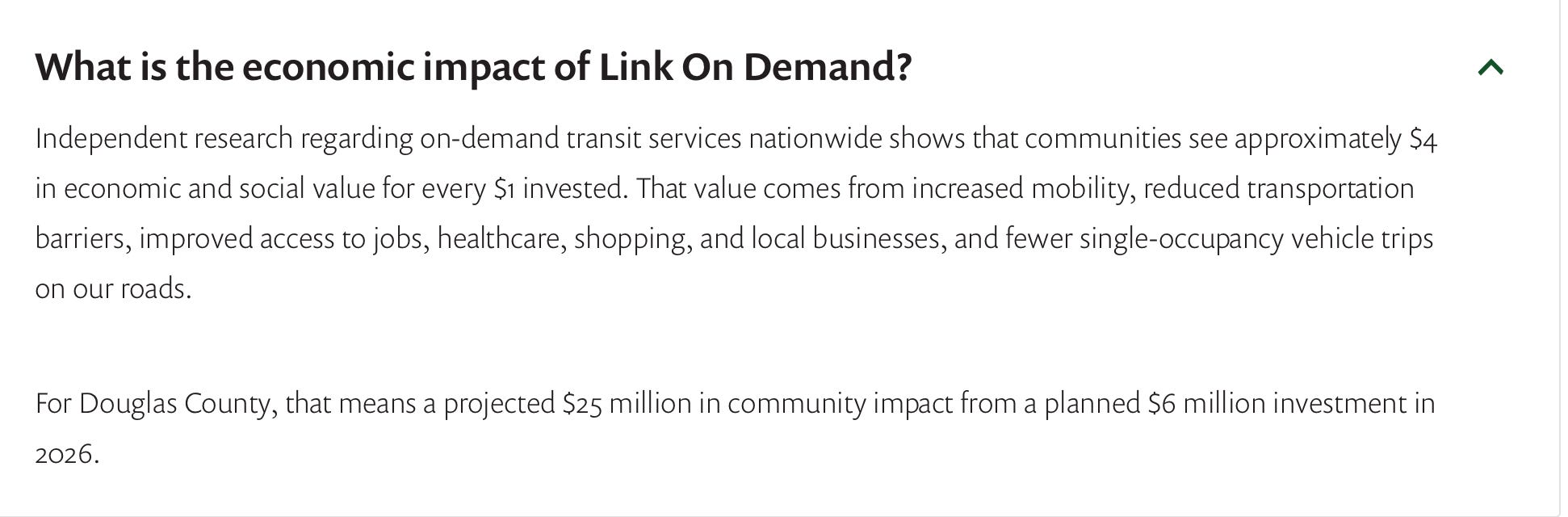
Four dollars back for every dollar spent. Twenty-five million dollars in community impact from a $6 million program. Independent research.
Sounds great. Let’s find the research.
The “Independent” Research Is the Transit Lobby’s Own Study
The “$4 for every $1” figure has two primary sources in the transit policy world, and Douglas County almost certainly drew from one or both.
The first and most widely cited is a study commissioned by the American Public Transportation Association — APTA. Specifically, the study was directed by the Transit Development Corporation, the education and research arm of APTA itself, and administered by the National Academies through the Transportation Research Board as part of a program designed to fund quick-response studies on behalf of APTA and its committees.
APTA is the transit industry’s own trade and lobbying organization. They paid for a study concluding that transit investment is economically beneficial. Calling that “independent research” requires a creative definition of the word “independent.” It’s the equivalent of the American Petroleum Institute commissioning a study on the economic benefits of oil and gas, then a county government citing it as independent energy research.
What did the APTA study actually measure? It analyzed $232 billion in transit investments — major urban infrastructure: light rail, subways, commuter rail, bus rapid transit in dense metro corridors — and projected a 4-to-1 return in economic activity over a 20-year horizon. The economic multiplier was built on network effects, congestion reduction across entire metro areas, transit-oriented real estate development, and expanded labor market access through high-frequency service. None of those dynamics exist in a free rideshare app operating in Highlands Ranch.
The second possible source is a 2026 University of Illinois Chicago study that examined on-demand transit specifically and reached a similar conclusion. This one is a closer analog — but only superficially. The UIC research examined transit systems in rural areas and communities with populations under 50,000, quantifying benefits in places where riders have no private transportation alternative and access to healthcare and employment would otherwise be impossible.
Douglas County has a population approaching 400,000. It has Uber. It has Lyft. It has the highest median household income of any county in Colorado — approximately $139,000, placing it among the top 15 wealthiest counties in the entire nation. The UIC study was designed around communities with no market alternatives. Applying it to Douglas County — where the private market was already solving the problem before the government decided to undercut it — is not a methodology. It’s a marketing move.
The Researcher Himself Said This Doesn’t Mean What Douglas County Says It Means
Here is the detail that turns the county’s FAQ from misleading into something considerably worse.
The lead researcher on the UIC study — Dr. P.S. Sriraj, Director of the Urban Transportation Center at the University of Illinois Chicago — explained directly and on the record what the $4 figure does and does not mean:
“In reality, the $4 return does not translate into revenue flowing back to the state. Instead, that $4 reflects the overall impact on society because of that dollar investment.”
The person who produced the number said it does not translate into revenue flowing back to anyone. It is a theoretical accounting of diffuse social benefits — improved mobility, better health outcomes, reduced strain on social services, workforce participation. These are real benefits worth counting in a comprehensive social analysis. But they are not money. They do not fund the program. They cannot offset the program’s cost. The researcher said so, unambiguously, in the same interview where he described his findings.
Douglas County’s FAQ takes that number — specifically designed to capture non-financial social value — and uses it to imply financial self-sufficiency: “$25 million in community impact” presented as justification for a $6 million spending commitment. The sleight of hand is elegant but not accidental. “Community impact” sounds like a return. The reader is supposed to conclude the program generates value exceeding its cost. What the underlying research actually says is that some diffuse, non-monetized social benefits may be roughly four times the program’s cost — and none of that flows back as revenue to offset a single dollar of the $6.3 million annual tab.
One more detail worth noting: APTA has already revised the number upward. Their latest 2026 study now claims $5 in economic returns for every $1 invested in public transit — up from $4 in previous iterations. When the multiplier gets adjusted whenever a new advocacy document is needed, you are not looking at science. You are looking at advocacy in a lab coat, and Douglas County just cited it as gospel.
Why This Is Not Just a Douglas County Story
If you live in Denver, Aurora, Lakewood, Westminster, Thornton, or anywhere else in the eight-county RTD service area, you have been reading this as someone else’s problem. It isn’t.
RTD collects a 1% sales and use tax across the Denver metro area — that single revenue stream funds roughly three-quarters of RTD’s operations. Every time you buy something taxable in the metro, a penny on the dollar goes to RTD. RTD then distributes some of that money through partnership grants to local programs. One of those local programs is Link On Demand.
Here is the context that reframes this entire picture.
RTD is currently facing a $250 million annual budget shortfall against a $1.5 billion budget. Operating costs are rising faster than tax revenue. Federal relief funds that sustained the agency through the pandemic years are gone. RTD is cutting jobs — what management is calling an “operations realignment.” RTD’s fare revenue has collapsed from $154 million annually to approximately $57 million — a $100 million drop — as ridership has fallen by 40%. Transit advocates tracking the agency’s trajectory say that between 2024 and 2026, RTD will have run three consecutive years of deficits totaling nearly a billion dollars.
RTD is, by any reasonable measure, a transit agency in distress.
And simultaneously, RTD is writing partnership checks to Douglas County — the wealthiest county in Colorado, the 7th wealthiest in the nation, with a median household income of $139,000 and a poverty rate of 3% — to subsidize free on-demand rides for any resident who wants one. Not for seniors who have no other means of transportation. Not for the disabled, for whom ADA-mandated paratransit services already exist. For anyone. Including, as a driver explained to CBS News, employees commuting to Charles Schwab and DISH Network.
If you live in Denver and you wonder why bus routes feel squeezed, why the agency is cutting management positions, why RTD’s CEO is warning of “difficult decisions” — part of the answer is that RTD’s partnership program is sending your sales tax money to fund free Uber rides in the metro area’s richest suburbs. That is not a Douglas County story. That is your story.
What “Independent Research” Actually Requires
There is a broader principle worth naming, because this pattern appears constantly in local government spending debates and almost never gets called out.
The argument structure works like this: a government agency wants to spend money on a program. It finds a study — usually commissioned by an industry group, a trade association, or a vendor with a financial interest in the outcome — that shows a positive return on that category of spending. It describes the study as “independent research.” It applies the study’s multiplier to its specific program. It announces a projected “community impact” that exceeds the program’s cost. It declares the program fiscally sound.
Not one link in that chain requires the study to have been conducted on anything resembling the program being justified. Not one link requires the multiplier to apply to the specific community. Not one link requires the “impact” figure to represent actual revenue rather than theoretical social value.
Douglas County’s FAQ is a textbook example. The study was commissioned by the lobby. It modeled urban rail infrastructure. Its lead author explicitly disclaimed the revenue implication. The county applied it to suburban microtransit in the nation’s 7th-wealthiest county. And nobody asked a single follow-up question.
Until now.
The Verdict
Douglas County’s “independent research” is a study commissioned by the transit industry’s lobbying arm, modeling urban rail infrastructure, whose lead researcher explicitly said the $4 return “does not translate into revenue flowing back.” It has been applied — without methodological justification — to a free suburban rideshare program in the wealthiest county in Colorado, while the agency co-funding that program is laying off workers to close a $250 million deficit.
The FAQ was posted in response to scrutiny. It cited research that doesn’t say what the FAQ says it says. And it omitted the one sentence from that research that would have answered the original question honestly.
That’s not an oversight. That is how government spending defends itself when it can’t defend itself on the merits.
Commissioner Laydon’s program has a 4.9-star rating and 83,000 rides. It also has a $6.3 million annual cost, a co-funder that is hemorrhaging money, a private-sector competitor it is systematically undercutting with public funds, and a self-funding claim built on research that its own author says doesn’t mean what the county is saying it means.
Douglas County — enjoy the ride. The rest of the metro area is paying for it too.
Mmm. Using your numbers, that breaks out to $75 per ride, if those two numbers can be compared.
I think the program should be cut back, not expanded, as the winds are blowing.
Excellent research, analysis and conclusions ! As a Douglas County resident it pains me to see such BS from so called conservative county commissioners. Time for change