


Every campaign tells two stories about itself. One is the speech. The other is the spending report.
I’ve spent a good part of my life in and around campaigns, some of them for offices bigger than governor. When a seasoned operative picks up a rival’s filing, he skips the contributions page and goes straight to the expenditures. Contributions show who likes a candidate. The expenditure page shows what the people running the campaign believe will win, and what they are willing to be paid for.
This piece is a lesson in how to read that page.
I’m using Colorado’s two major-party campaigns for governor because the records are public, the race is live, and the contrast makes about as clean a teaching example as I’ve ever seen. If you support Victor Marx, stay with me. Nothing in here depends on whether you like Victor Marx or Phil Weiser. It depends on math, and you can check every number yourself in the state’s public database.
The Marx campaign has raised close to $4 million. Where did it go?
I went and looked. Then, because a number means nothing without something to measure it against, I looked at Phil Weiser’s campaign, too.
How a campaign is supposed to work
Strip away the slogans and every serious campaign runs on the same few rules. None of them are partisan.
Rule one: raise early, and raise cheap. Finding new donors costs money. A campaign rents mailing lists, sends letters, makes calls, and pays a vendor, and the first gift from a new donor often barely covers what it cost to find him. Campaigns accept that early in the cycle because the donor gives again in the summer and the fall. Prospecting is a spring activity. As the election gets close, it stops making sense, because a donor found in October has no time left to repay what it cost to find him.
Rule two: spend late, and spend on voters. Money in the bank wins nothing. The point of raising it is to put the candidate’s face and message in front of people who will decide the race, at the moment they are deciding. In Colorado that moment is now. Every active voter gets a ballot in the mail. This year county clerks mailed them between October 2 and October 9. Drop boxes open October 12, clerks start counting October 19, and Election Day is November 3. A campaign’s persuasion money should be landing in voters’ living rooms the same weeks the ballots land on their kitchen counters.
Rule three: know your math. As of June, according to the Secretary of State’s figures, 52% of Colorado’s registered voters were unaffiliated, 25% were Democrats and 23% were Republicans. A Republican running statewide can turn out every Republican in Colorado and still lose. He wins only by persuading a big share of unaffiliated voters, most of whom have never heard his podcast and never will. Republicans have not won a governor’s race here since 2002, or any statewide race since 2016.
Rule four: small dollars are seed. A grassroots donor base is a real asset. The way you use it is to take $50 from 20,000 people and turn it into television, radio and digital advertising that reaches a million voters who have never heard of you. The donors make the reach possible. The reach is what wins.
Rule five: build an organization you can trust with money. A statewide campaign is a small business with a deadline. It needs staff on a payroll, people who can work a voter file, and a compliance professional who keeps the books legal, because campaign finance mistakes cost money and headlines.
Now hold both campaigns up against those rules.
The scorecard
These figures come from the Colorado Secretary of State’s campaign finance system, TRACER, through the reports both campaigns filed October 6, which cover activity through September 30. I downloaded every itemized expenditure for both campaigns and added them myself. Weiser’s line items match his reported total to the penny. Marx’s match his within $552.
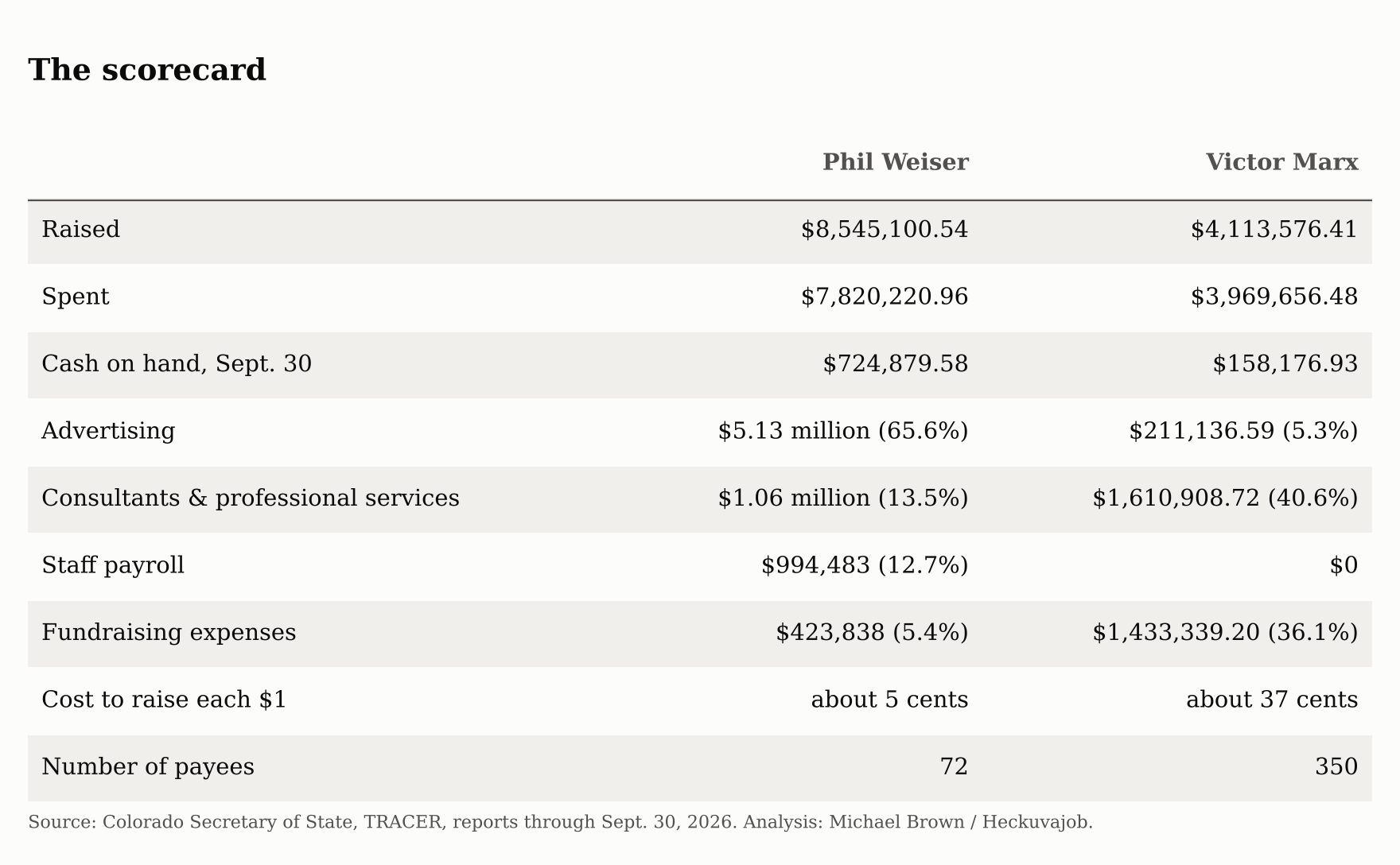
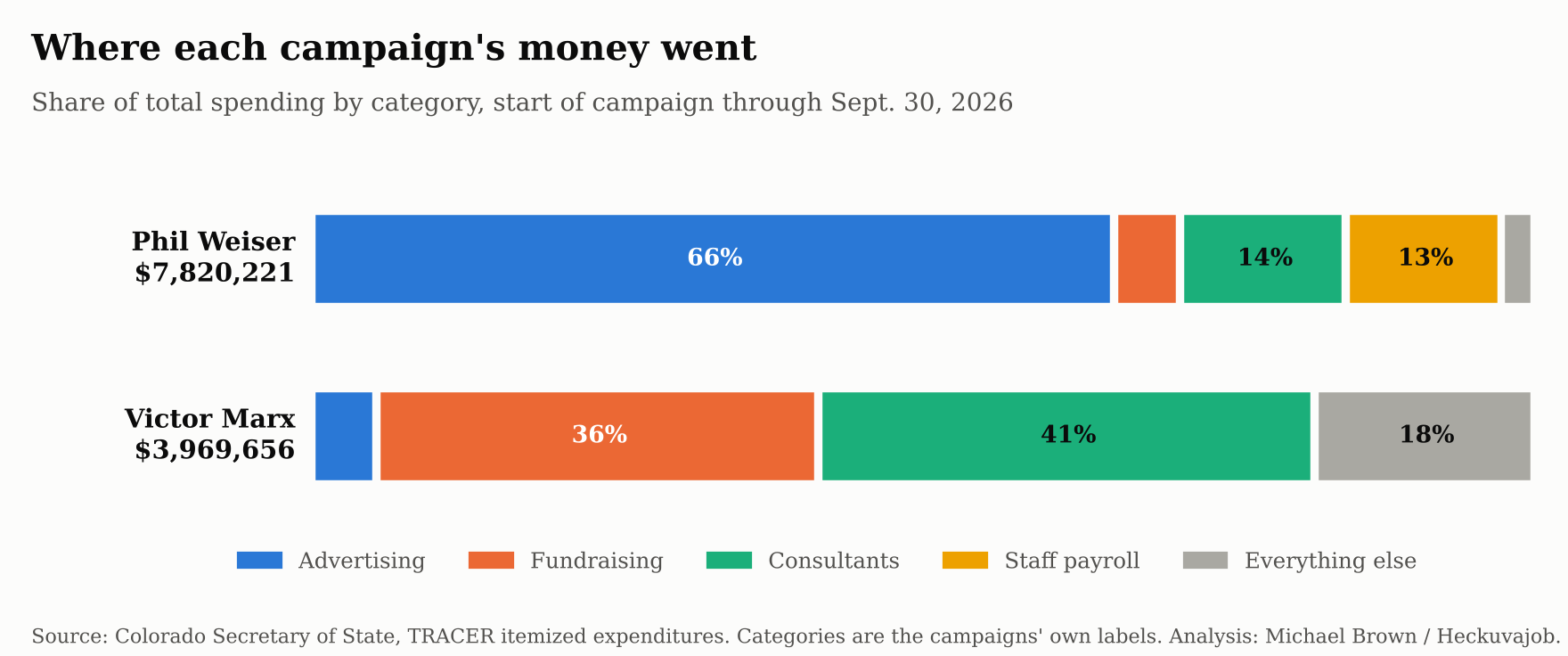
Yes, the Democratic nominee raised twice as much. Of course he has more left. That’s what I assumed when I started. Then I lined the campaigns up month by month, and the size of the bank account turned out to be the least interesting difference between them.
Rule one, applied: what it costs to raise a dollar
The largest single payee of the Marx campaign is a company called HSP Direct, of Ashburn, Virginia. The campaign labels every payment to HSP the same way: fundraising expenses. The total through September is $1,422,272.05.
The campaign also pays WinRed, the platform that processes online donations for Republican campaigns. WinRed takes a small fee on each transaction, and it has charged the Marx campaign 19,312 separate times, for a total of $105,617.84.
Add those two and divide by everything the campaign has raised. About 37 cents of every dollar given to Victor Marx has gone to the cost of raising it.
That’s the conservative figure. Another vendor, Active Engagement, received $377,954.15, billed partly as fundraising, partly as consulting and partly as advertising. Count all of it as fundraising and the figure approaches 46 cents. I use 37 because it rests only on what the campaign itself labeled fundraising.
The Weiser campaign reports $423,838 in fundraising expenses, which already includes its online processor, ActBlue. Add about $12,800 in processor fees booked elsewhere and divide by $8.5 million raised. About a nickel. If you also count two digital consulting firms that do some fundraising work, it rises to about 8 cents.
Victor Marx pays more than seven times as much as Phil Weiser to raise each dollar.
The Marx campaign has an answer, and it deserves to be heard in full. In May, campaign communications director Roger Hudson told Jimmy Sengenberger of the Denver Gazette: “The front end costs are a little higher, but they pay off throughout the entire race. Anybody who’s run a campaign knows that.”
As a statement of rule one, that’s correct. Prospecting costs a lot up front and pays later. The question is when the front end ends. Here are the HSP Direct payments, month by month:
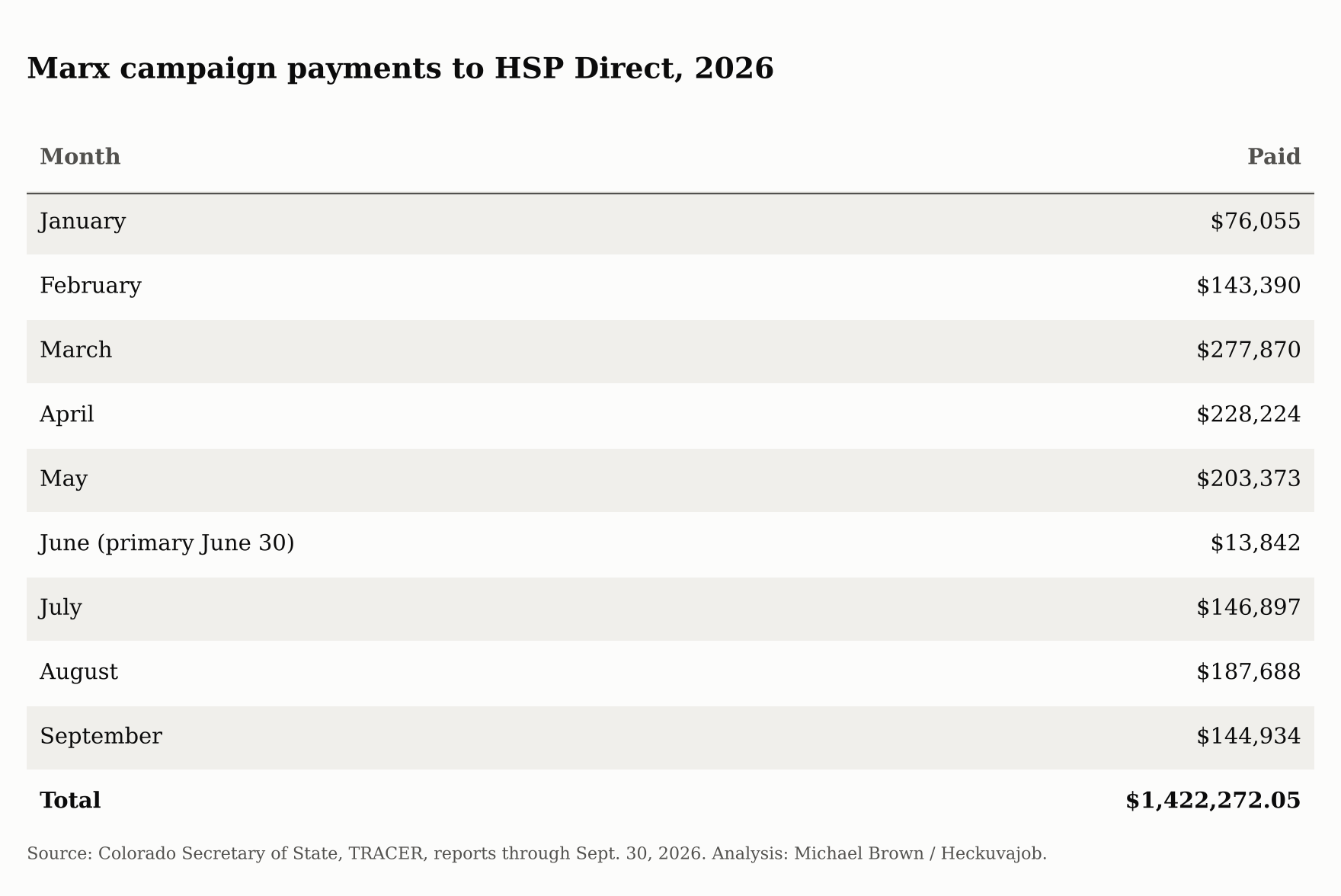
The primary was June 30. Spending on HSP dipped in June, then came right back. August was bigger than every month except March, April and May. Since the primary, HSP has been paid $479,519. That’s three times what the campaign has in the bank today.
By the measure Mr. Hudson himself offered, the front end never ended.
Rule two, applied: when the money went, and where
Here is the comparison that stopped me cold. Look only at the three months since the primary, July 1 through September 30.
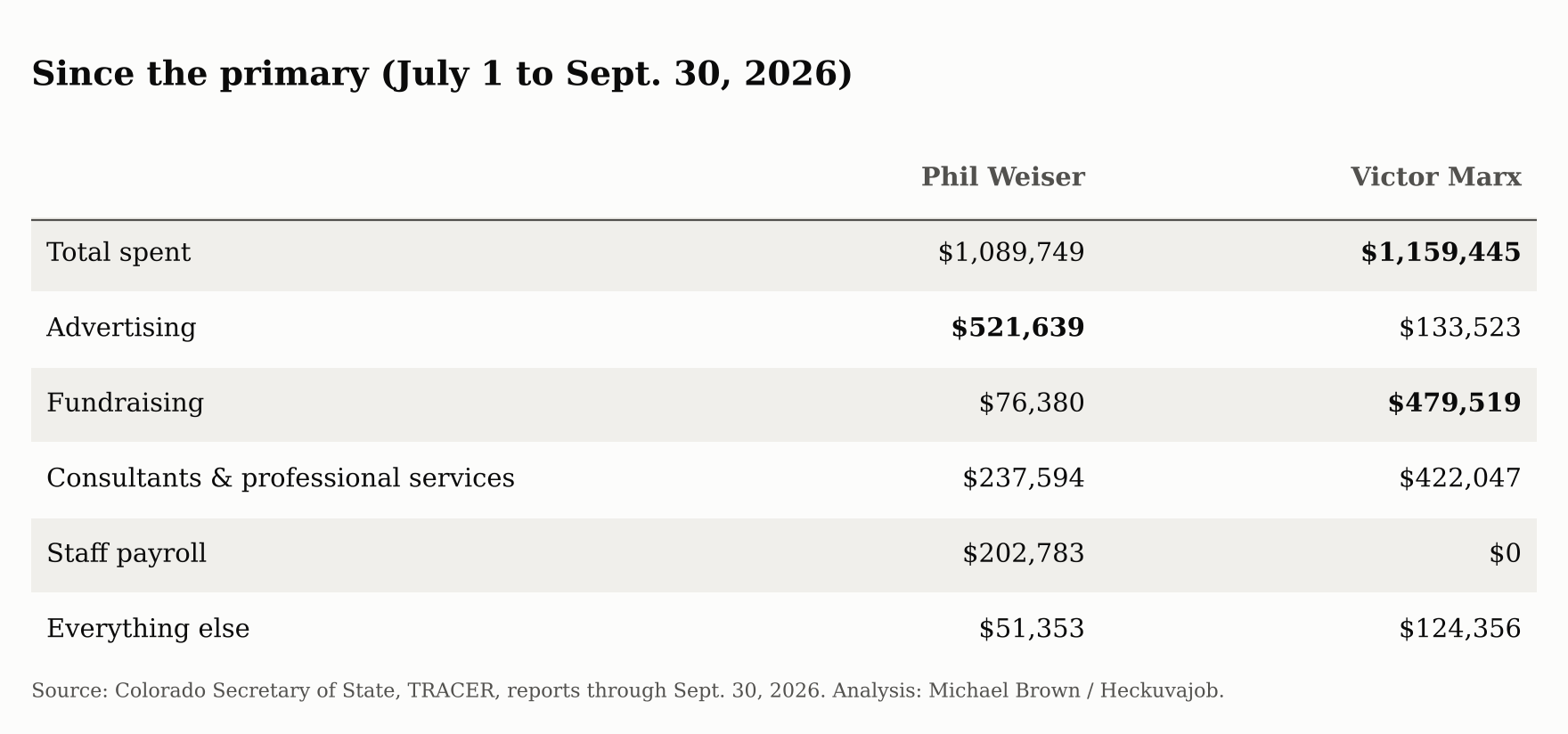
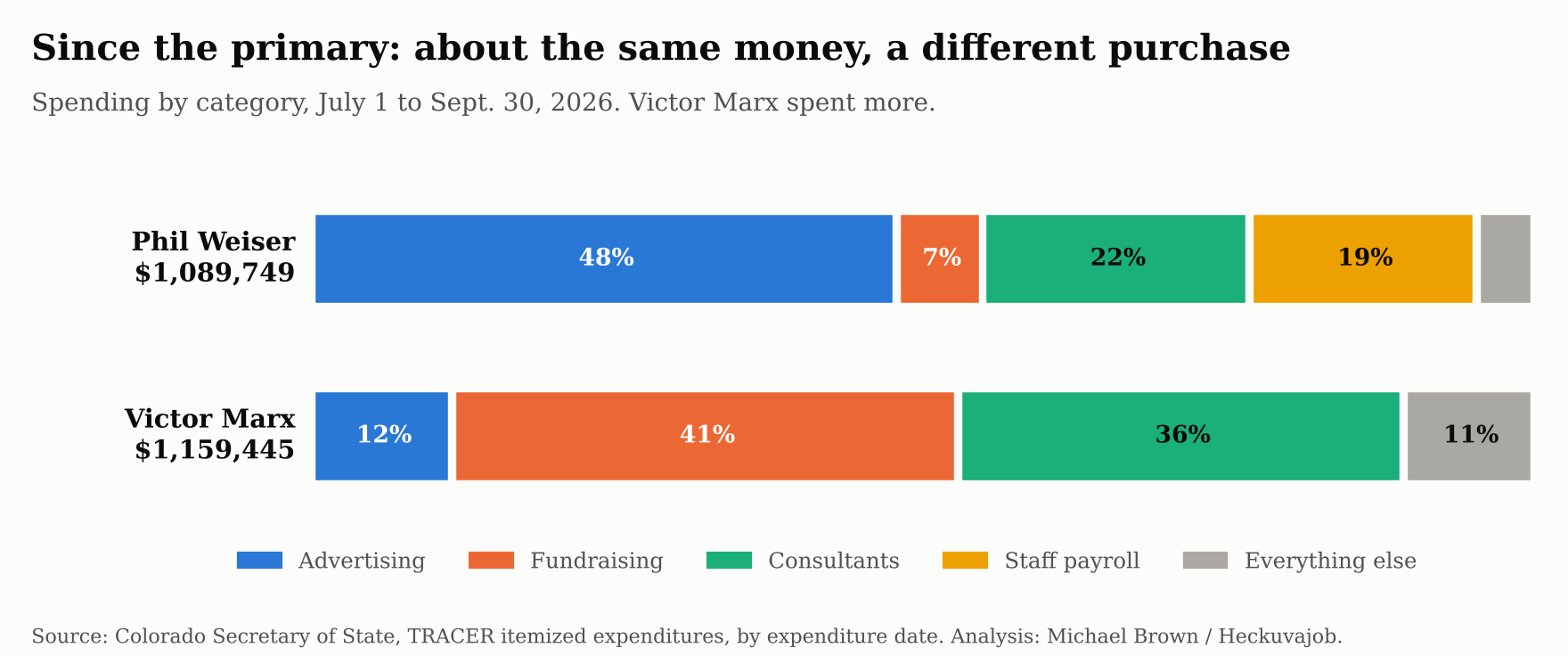
Since the primary, Victor Marx has spent more than Phil Weiser. The general election did not find the Marx campaign broke. It found the campaign spending its money on something other than voters.
Now zoom in on September. Phil Weiser’s campaign has said publicly that its first general-election ad, called “Plan,” began running September 21. The filings back that up. Weiser’s largest vendor is BlueWest Media, a Denver firm that buys airtime for campaigns, mostly television. BlueWest was paid on September 16 ($111,785), September 22 ($148,115) and September 29 ($86,442), a total of $346,342. The campaign’s digital ad firm, Rising Tide Interactive, was paid $148,731 in the same two weeks. In all, the Weiser campaign spent $715,855 in September, and $519,347 of it was advertising.
During those same weeks the Marx campaign paid HSP Direct $144,934 to keep mailing donors.
One campaign was buying airtime. The other was buying stamps.
The Marx campaign does report some advertising: $211,136.59 over the whole cycle. Read the line items and you find yard signs, printing, a text-messaging service called Peerly ($8,240) and the billboard company Lamar ($7,781). I went through all 350 payees. Not one is a television station, radio station, cable system or firm that buys airtime for campaigns.
A fair caveat: a campaign can buy digital ads through a consultant, and those wouldn’t appear as a separate line. I have not checked the Meta or Google ad libraries for Marx ads. If you’ve seen one, tell me where.
Rules three and four, applied: the grassroots question
The Marx campaign has a second answer, and on the facts, part of it is right.
They say Victor Marx runs a grassroots campaign, built on small donors and real people. I checked the donor records, and on that point they are correct.
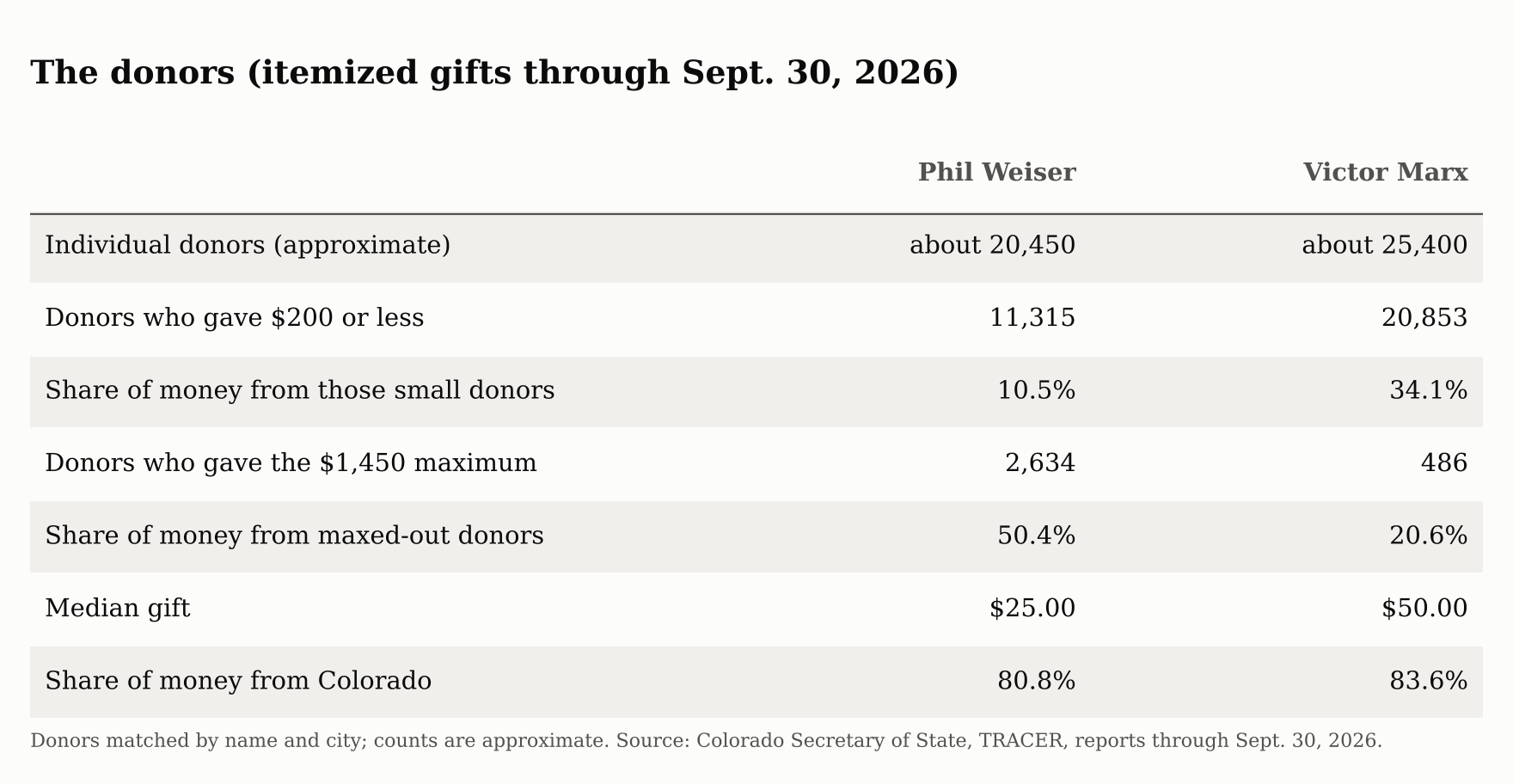
Victor Marx has more donors than Phil Weiser. Far more of them are small donors, and a larger share of his money comes from Colorado. Half of Weiser’s money came from people who gave the legal maximum, and more of it came from California, New York and Washington, D.C. By the grassroots measure, Marx has the broader base.
That is exactly why rules three and four matter.
A Republican can’t win Colorado on his base. There aren’t enough Republicans. The grassroots base is supposed to be the seed: $50 from 20,000 people, turned into advertising that persuades unaffiliated voters who will never attend a rally. That conversion is the whole reason to build a small-donor base in a state where your party is in third place.
The Marx campaign took the $50 and spent 37 cents of every dollar finding the next person to give $50. About five cents went to advertising.
Twenty-five thousand Coloradans paid for something real. What they bought was a mailing list.
Rule five, applied: the organization
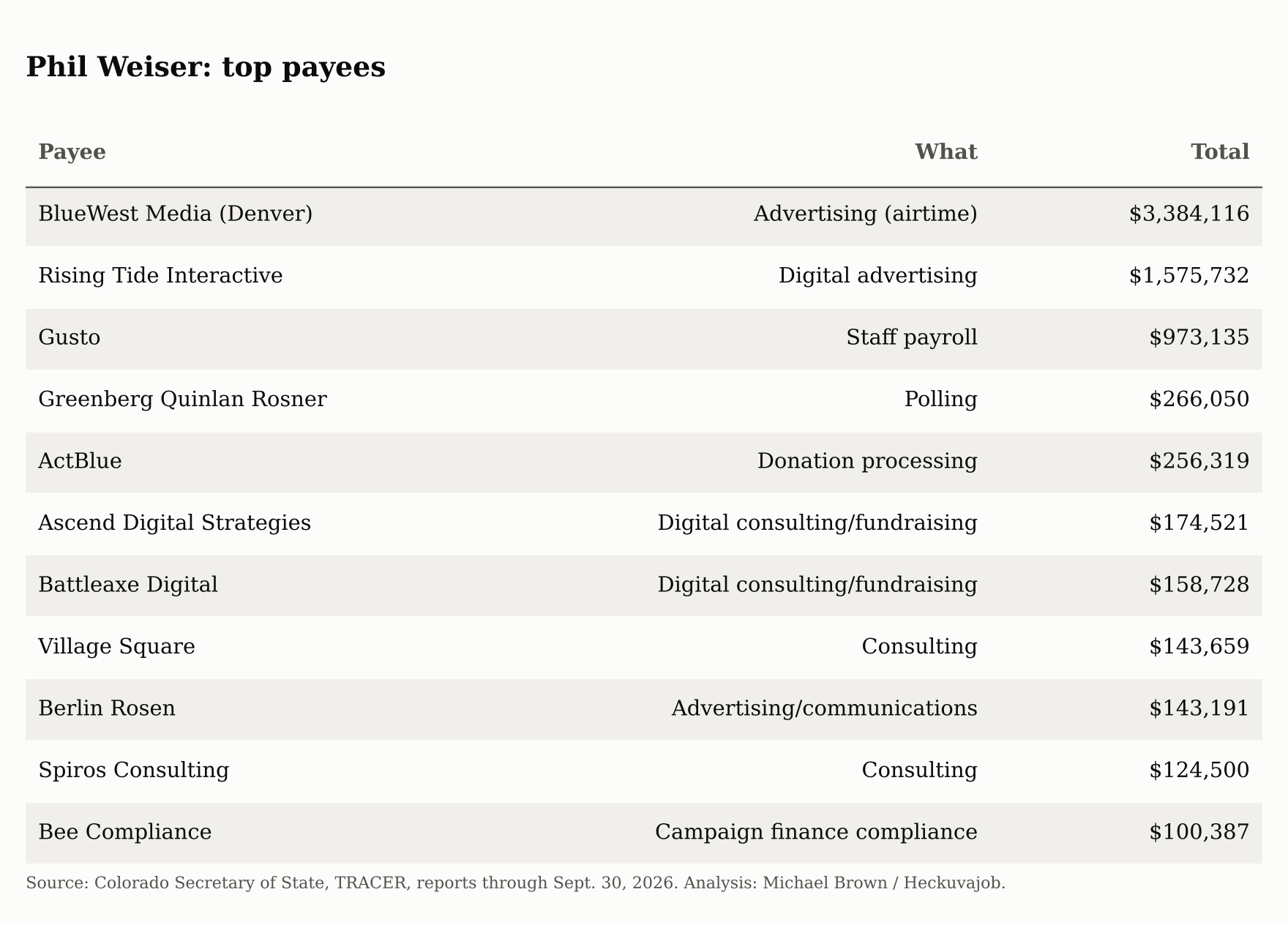
The Weiser campaign runs a payroll: $994,483 in staff wages, processed through the payroll company Gusto. It pays a voter-file vendor, NGP VAN. And it pays a professional campaign compliance firm, Bee Compliance, $100,387 to keep its books legal.
The Marx campaign reports no payroll at all. It has paid 350 people and companies, and its largest category of spending, $1,610,908.72, is consultants and professional services.
On October 2, a state administrative hearing officer recommended fining the Marx campaign $57,647.16 for accepting 200 contributions over Colorado’s $1,450 limit, plus ten cash contributions over the $100 cash limit. By most accounts it’s the largest campaign finance penalty in state history. The campaign calls it a “political penalty” and is appealing. In his decision, the hearing officer pointed to the inexperience of the campaign’s registered agent, Gregory Carlson, who by law files the campaign’s reports. He wrote that why “an experienced professional was not hired when the Marx Campaign carried a balance of ‘hundreds of thousands of dollars’ in its bank account was not explained.”
The filings show the campaign paid $25,000 to Gregory Carlson PRP LLC. The Weiser campaign paid its compliance firm four times that.
Here are the largest payees on each side.
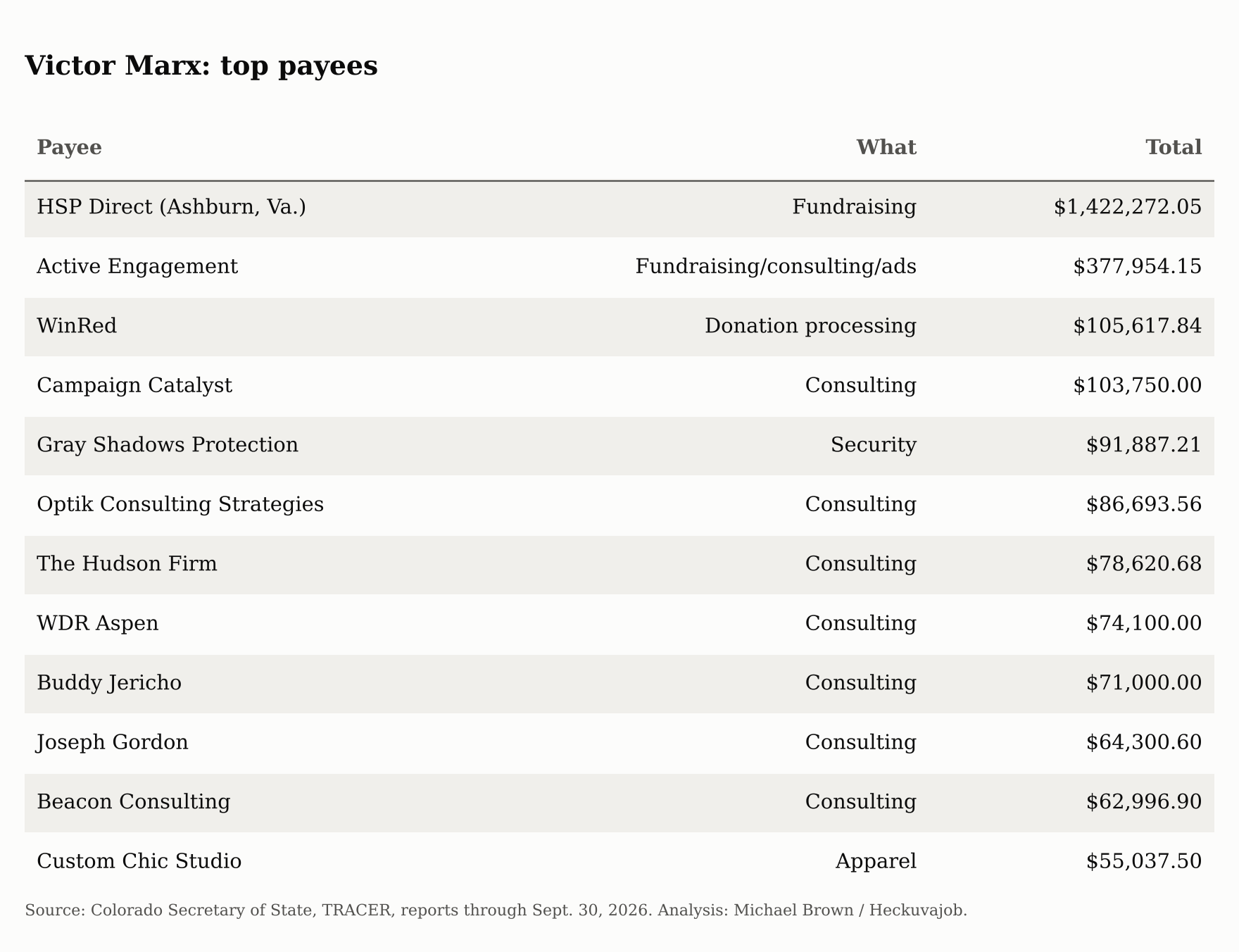
A few names on the Marx side tie back to the candidate’s family and his ministry, All Things Possible. Avery Jericho received $15,000. Brie Marx, the candidate’s daughter according to Colorado Pols, received $22,469.62. Colorado Pols also reported that Evan Brussel of Nashville, paid $35,942.30, lists his employer as Dangerous Gentleman, one of the Marx ministry brands. MinistryWatch, which reports on nonprofit tax filings, reports that Buddy Jericho was compensated as a board member of All Things Possible. Mr. Jericho has told The Guardian his board seat was unpaid.
I want to be precise here. I can tie some Marx payees to the family and the ministry. I can’t tie most of them, and the filings don’t say what most of the consultants did. I’m still checking names.
The super PACs went quiet, too
Both candidates had a friendly independent expenditure committee in the primary. Both have nearly gone dark.
• Fighting for Colorado (pro-Weiser) spent $2.77 million in total, mostly primary advertising placed through the media firm Waterfront Strategies. Since July 1 it has spent $56,215.
• Freedom IEC (pro-Marx) spent about $405,000 on primary advertising through MHB Media. Since July 1 it has spent $63,679, most of it on polling.
That means the difference you see on your television is mostly the candidates’ own money. One limit on my work: TRACER’s search tools don’t tag which candidate an independent expenditure targets, and its export of that data appears to cap out at 500 rows. I can’t rule out other outside groups in this race.
What the numbers can’t tell you, and what I think
Everything above is basic math. This section is my opinion, and I’m labeling it that way.
You should also know my history. Before a Republican primary debate in May, which I was set to co-moderate, I sent the Marx campaign a list of claims I wanted documented. Victor Marx called it “a staged ambush disguised as a debate” and skipped it. Weigh what follows with that in mind.
One fact bothers me more than any other.
A donor found in March is worth a lot to a campaign. You can ask him again in June, and his money can buy ads in October. A donor found at the end of September is worth almost nothing to winning. By the time his check clears, ballots are on the kitchen counter, and there’s no time left to turn his $50 into a vote. That donor is valuable only after November 3.
The Marx campaign paid HSP Direct $144,934 for September. In the last two weeks of the month, it raised $185,980.14 and spent $270,648.15.
Then there’s the merchandise store. This summer Marx told supporters they could buy unlimited merchandise from a separate website, victor2026merch.com, to help him. Packages ran as high as $1,299, and the top tier included a private group Zoom call with the candidate. When 9News asked where that money goes, the campaign did not answer. Whatever the answer is, that store collects names, addresses and payments outside the campaign finance reports I’ve been reading.
The Marx campaign would say Victor is a true believer. He won the primary with almost no advertising of his own. He believes he’s winning on his own terms, and true believers sometimes make poor campaign managers.
Maybe so. A candidate trying to win doesn’t spend the last two weeks of September paying to find new donors. He spends it putting his face in front of voters. Every campaign trying to win is doing that right now.
So here is where I land. Whatever Victor Marx intends, his campaign has operated as a list-building business, and the people on the list paid to build it. After November 3 that list will still be worth something. The people it will be worth something to are not Colorado’s voters.
Which leaves one question, and it can be answered in one sentence: On November 4, who owns the donor list?
Will it be rented? Sold? Kept by the mail house? Handed to the ministry, or to some new nonprofit? Will those 25,000 people start getting letters next spring asking for money for something else? I don’t know, and the filings don’t say. I would like to be proven wrong.
The state hearing officer seems to have worried about something like this, too. He ordered that any illegal excess contributions the campaign can’t return to donors must go to a charity, and it cannot be a charity with any ties to Victor Marx.
He felt he had to write that down.
What I’d do with $158,176.93 and 26 days
Lessons are only useful if they tell you what to do next. If I were running this campaign, conventional or not, starting today:
1. Shut off prospecting. Every dollar between now and November 3 goes toward a voter. Not another dollar goes to finding new donors.
2. Chase ballots. Colorado campaigns can learn which voters have already returned their ballots. Every Republican and right-leaning unaffiliated voter who hasn’t sent one back should hear from a volunteer this week. Volunteers are free, and this is the most valuable thing a campaign short on cash can do.
3. Take every free microphone. Marx has said he will do one debate, with no moderator. Do every debate. Sit for every interview, especially the hostile ones. For a campaign without money, earned media is the only reach it has left. My microphone is open.
4. Go where the persuadable Republicans and right-leaning independents live. Mesa County, Weld, Pueblo, El Paso. A rally at a county fairground costs a fraction of a week of television.
5. Buy the cheapest contact you can on short notice. Targeted digital to unaffiliated voters in those counties. Mail to Republicans who don’t usually vote, asking for a vote and only a vote.
6. Tell your donors what you’ll do with the list. Publicly commit that it will not be sold, rented or transferred after the election. It costs nothing and it would answer the question.
None of this is exotic. Most of it is what the Weiser campaign is doing right now.
The lesson
A campaign is a machine for turning money into votes. You can read how well a machine works by what goes in and what comes out.
Through September 30, about $4.1 million went into the Marx campaign, from more Coloradans than gave to his opponent. About 37 cents of every dollar raised went to the cost of raising it. Of every dollar spent, about 41 cents went to consultants and about 5 cents went to advertising. Over the same three months since the primary, his campaign spent more than Phil Weiser’s, and Phil Weiser is the one on television.
Republican primary voters chose this campaign in June. The warning signs were in the same public filings in May, when Jimmy Sengenberger laid them out in the Gazette. I talked about them on the air. The next set of filings, covering October 1 through 14, is due October 19. I’ll be reading it.
If you’ve given to any campaign this year, of any party, tell me in the comments what happened next. Did you get a thank-you, another letter asking for more, a call? Did you ever see the ad your money paid for?
ADDENDUM:
October 8, 2026: After this piece was published, CPR News reported several details that bear on it.
Shiloh Marx, paid $5,000, is the candidate’s son. Together, the candidate’s two children have been paid $27,469.62.
CPR counts the campaign’s total security spending at more than $150,000, well beyond the $91,887.21 paid to Gray Shadows Protection that I cited. CPR also reports that no other Colorado candidate in the past decade spent more than $5,000 on security.
CPR reports that the campaign itself labeled $792,861 in payments to HSP Direct and one other vendor as “prospecting.” In direct mail, prospecting means paying to find new donors.
Campaign manager Buddy Jericho told CPR: “No campaign donor data has been transferred to All Things Possible or any other outside organization.” That answers part of my question about the donor list. It speaks to what has happened so far. It does not say what happens to the list after November 3. I’ve put that question to the campaign directly, and I’ll report the answer.
One note on the numbers: CPR’s count of the Marx campaign’s advertising ($242,922) is slightly higher than mine ($211,136.59), because CPR classified a few more purchases as advertising. I used only what the campaign itself labeled advertising. The difference doesn’t change the comparison.
How I counted
• Source. Every figure comes from the Colorado Secretary of State’s TRACER system: the candidate committee summaries current as of the October 6, 2026 reports, plus complete exports of every itemized expenditure and contribution for Victor Marx for Governor (committee 20255051136), Phil Weiser for Colorado (20255047944), Freedom IEC and Fighting for Colorado. Pulled October 7 and 8, 2026.
• Reconciliation. Weiser: 916 expenditure lines totaling $7,820,220.96, exactly his reported total. Marx: 21,359 lines totaling $3,970,208.54, within $552 of his reported $3,969,656.48. Most of Marx’s lines are individual WinRed fees.
• Categories are the campaigns’ own labels. I didn’t reclassify anything except where noted. “Everything else” combines miscellaneous, travel, food, bank fees, rent, office and telephone.
• Cost to raise a dollar. The campaign’s own “fundraising expenses,” plus payment-processor fees booked under other categories (WinRed for Marx, about $12,800 in processing for Weiser), divided by total contributions. Marx: about 37.4 cents. Weiser: about 5.1 cents. Upper bounds, counting all of Active Engagement for Marx and two digital consulting firms for Weiser: about 46 cents and 8 cents.
• HSP by month. In July and August the report shows a payment, a reversal and a re-entry of the same amount, which looks like a filing amendment. I counted the net.
• Post-primary means expenditures dated July 1 through September 30, 2026.
• Donor counts are approximate. TRACER doesn’t assign donor IDs, so I matched donors by name plus city. That can merge two people with the same name or split one person who moved. “Small donor” means a donor whose total itemized giving is $200 or less. Totals exclude returned contributions. Marx returned $126,249 in contributions and Weiser returned $248,101.
• What I didn’t check: Meta and Google ad libraries; any station’s FCC political file; independent expenditure committees beyond the two named; what any consultant actually did.
Sourcing and Verification
Everything above is sourced below. Where a claim rests on one outlet or one side’s statement, I say so, and I’ve noted each outlet’s general lean.
Primary records - Colorado Secretary of State, TRACER: committee detail, October 6, 2026 reports, and expenditure and contribution exports for the four committees above - Colorado Secretary of State, Initial Decision in the Marx campaign finance case (October 2, 2026)
Reporting - Jimmy Sengenberger, “Victor Marx’s money matters, but just how much?”, Denver Gazette, May 8, 2026 (center-right; source of the Hudson quotes) - Colorado Politics, Marx fined (October 2) and Marx to appeal (October 5) (center-right) - Colorado Politics, Marx will do one debate, with no moderator (July 29) - Colorado Politics, Ballot mailing dates (October 2) - Cronin & Loevy, “Registered voters on the eve of the 2026 primaries”, Colorado Politics, June 21, 2026, citing Secretary of State figures - Colorado Sun, Marx fine (October 2) (center-left; quotes the Secretary of State calling it “one of the largest”) - 9News, Marx soliciting unlimited merchandise purchases (August) (mainstream local TV) - Colorado Pols, Marx consultant payments (August 10) (left-leaning and openly partisan; source for Brie Marx’s relationship to the candidate and for Evan Brussel’s listed employer) - Colorado Newsline, Fighting for Colorado(January 20) (center-left) - MinistryWatch, All Things Possible compensation data; The Guardian, Jericho’s statement that his board seat was unpaid (September 2026) - Mandy Connell’s Substack, October 2026, for the question that started this and the Weiser campaign’s stated ad timing
What I couldn’t verify, and said so: whether any Marx digital advertising runs through a consultant; what the Marx campaign’s consultants did; who controls the Marx donor list or the merchandise store’s data; whether WDR Aspen is connected to anyone else in this race; the full universe of outside spending in the governor’s race.
Okay here’s the problem. The next Colorado Governor will likely be Weiser. Based on his political history, current ads and a Democratic controlled House and Senate he will bring a financial and freedom disaster to Colorado. Taxes will be higher at all levels, housing more expensive, medical costs higher, business will leave and our freedoms reduced or worse completely removed.
And it seems Marx has no clue. What a horrible choice we face in Colorado this election. The only answer is to not vote for Weiser and then hope for the best.
Michael!
Katie Zacharia is no more a lawyer than Kim Kardashian.
Katie does attorney work, pushing papers and executing contract work, possibly illegally technically in California, by misrepresenting herself legally as a lawyer, not just an attorney; but she never practiced law in a court of law.
Malibu Katie never in any country passed a bar exam.
How did vetting not produce this fact?
Is she a liar?
Should she be fired?
At the lectern, Katie Bombshell stares at her notes with great discomfort.
Your thoughts?