

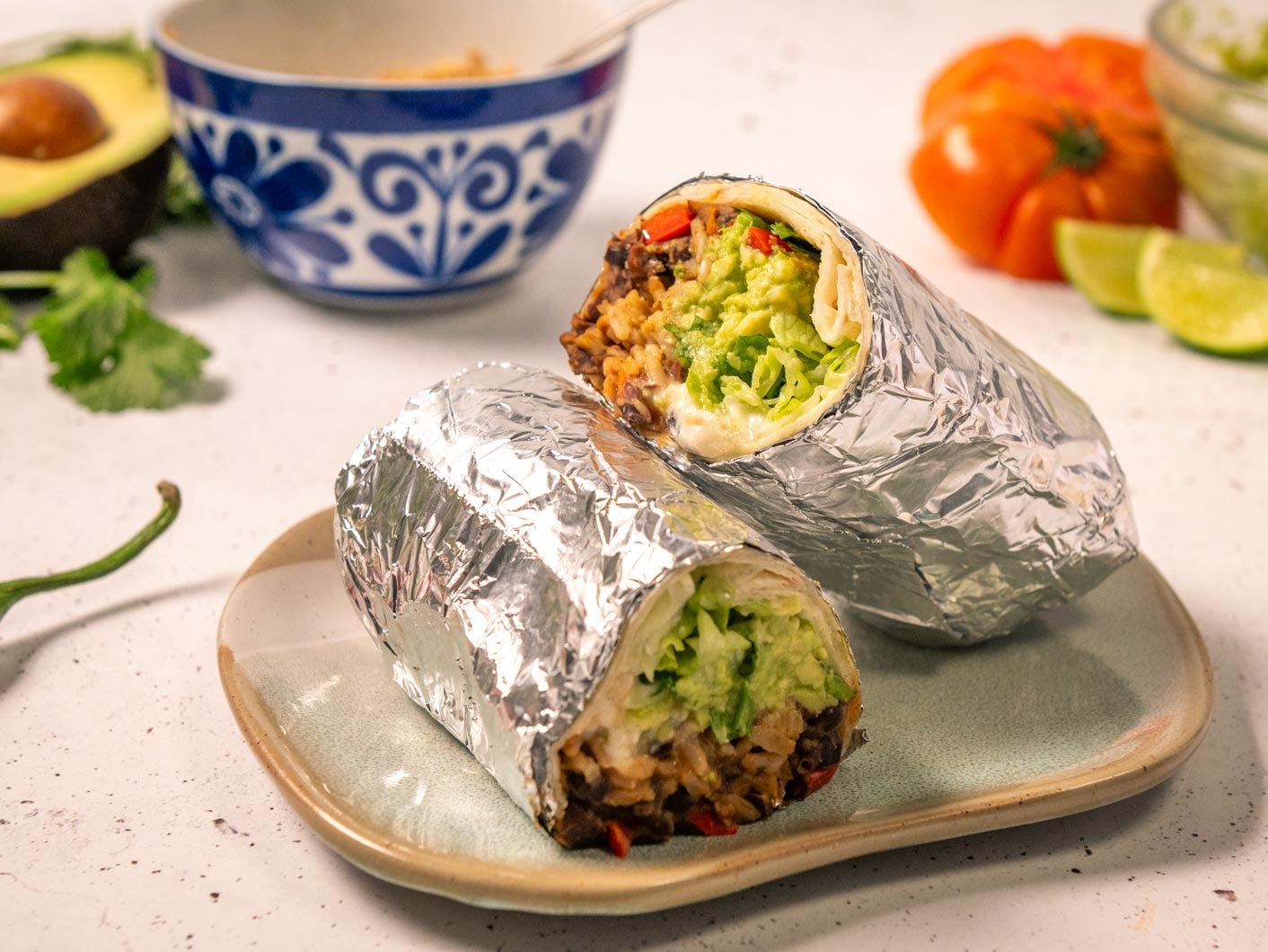
For about 48 hours this week, the American right conducted a full-scale public argument about a burrito, most only X.
I know how this sounds. But this really is worth your time, and not because of the burrito. It is worth your time because it is the clearest look I have seen in about a year at a fight the conservative movement is going to have to settle before November, and right now the wrong side is winning.
The sequence went like this. Monday, Matt Walsh posted that grocery prices are insane, that they are still climbing, and that this ought to be the top priority of every elected official in the country, because it is one of the reasons socialism keeps finding new customers. I actually retweeted Matt’s post. Andrew Kolvet at Turning Point USA quoted him and added something a college student had said to him. The student’s entire economic analysis was seven words long: “a burrito shouldn’t cost $20.
And that’s when the fight started.
Marc Thiessen of the Washington Post replied with four words that have now been read by several million people. Cry me a river. The burritos in the college cafeteria are included in your meal plan. Ben Shapiro followed with a version of the same: if you are paying twenty dollars for a burrito and you are not independently wealthy, you are doing life wrong. Congressman Dan Crenshaw told the kid to stop whining, get a job, and eat ramen with four roommates like everybody else did.
Then the Vice President of the United States showed up and made a fat joke about Thiessen.
That last part deserves a footnote, because it explains the temperature. Thiessen had just written a column in the Post going after Vance over the Iran negotiations. So this was never really an argument about food. It was a proxy war that happened to be fought over a tortilla. Which is worth knowing, because it means at least one participant was not arguing in good faith about prices at all, and it was the one with the biggest megaphone.
Anyway. Let me do something nobody in that X battle bothered to do and actually check the number.
The sticker
A chicken burrito at Chipotle averages $9.79. That figure comes from aggregated menu data across more than thirty-six hundred U.S. locations this month, so it is not a vibe. The cheapest one in America is in Lawrence, Kansas, at $8.30. The most expensive is in the Bronx at $12.10. Taco Bell will hand you a burrito for under $4.
So Thiessen is right. A burrito does not cost twenty dollars. He won the argument.
Except he did not, and this is where the whole thing turns.
The receipt
Nobody eats a naked burrito standing in a parking lot. You add guacamole, which is another $2.50-$3.00. You add chips. You add a drink. Chipotle’s own catering math prices one person’s meal, burrito plus chips plus drink, at thirteen to sixteen dollars a head.
Now order it the way a twenty-year-old in 2026 actually orders food, which is on his phone, without putting on pants.
Restaurants raise their menu prices 10-25% on DoorDash and Uber Eats, and they are not gouging you when they do it. They are trying to survive platform commissions that run 15-30% of the ticket. On top of the inflated menu price you get a delivery fee. On top of that, a service fee, another 10-15%. On top of that, the tip. Studies that measure the whole stack find fast-food delivery totals landing 69% to 92% above what the same food costs at the counter. One hundred-city study priced an order at $36.95 in the restaurant and $63.21 on DoorDash.
$10 burrito. $20 at the door. Not occasionally. Routinely. By a lot of people.
So which one of them is lying? Neither. Thiessen is quoting the sticker. The kid is quoting the receipt.
That gap, between what a thing costs and what you actually pay for it, is the entire affordability argument compressed into one lunch order. And every person who spent Tuesday and Wednesday ddunking on that college student was standing on the wrong side of it.
Is the kid soft?
Fair question. Let us answer it with data, not with contempt, which is apparently a novel approach on social media. Or maybe life in general.
June inflation came in at 3.5% year over year. That number sounds almost respectable, and if you stop reading there you will conclude the complaining is unearned. Keep reading. Energy is up 15.7% over twelve months. Gasoline is up nearly 27% on average sitting right around $4.08/gallon. Airline fares, up 26.5%. Shelter, 3.3%. Eating out, 3.4%.
A number actually exists that settles this.
Real average hourly earnings, meaning what your paycheck actually buys once you strip inflation out of it, are down about a tenth of a percent from January 2021 to January of this year.
Five years. Net zero.
That is not a recession and it is not a catastrophe. It is worse in a specific way: it is five years of doing everything right and ending up exactly where you started. In April, inflation outran wages for the first time since 2023. Over the year ending in June, wages beat inflation nationally by about three-tenths of a point, which sounds like progress until you look at the map and find that real wages went backward in forty-five states and the District of Columbia.
And then there is the Urban Institute report from last month, which I would put in front of every person who told that kid to eat ramen. Surveying seventy-five hundred working-age adults, they found that 63% had put groceries on a credit card in the past year. About a third of those paid it off in full every month. Roughly one in five carried the balance and made minimums. Nearly 9% could not reliably make even the minimum payment, up from 7.1% in 2023. Almost one in ten used buy-now-pay-later financing to buy food, and a third of those people missed a payment. One in five drew down long-term savings, the emergency money, to eat. About 5% used cash from a payday loan.
Nobody finances a cart of groceries at credit card interest because they are entitled. They do it because the money is not there on the first of the month, or the fifteenth, or whenever they get paid.
Why 3.5% feels like 30%
This is the part that “inside the beltway” Washington has never been able to explain. This is not complicated.
Inflation is a rate. Your grocery bill is a level. When the rate falls, prices do not fall. They just stop climbing quite so fast. Groceries are up something like 32% over five years. Announcing that the rate has cooled to 3.5% is like telling a man treading water that the tide is now rising more slowly.
He is still treading water.
And no household in America compares this month to last month. People compare right now to the last time they felt comfortable, and for most of them that was somewhere around 2019. Every economist in the country can tell you that is analytically sloppy. Every economist in the country is also wrong about why it matters, because voters are not writing a paper. They are remembering. They are paying the bills.
It was never about the burrito
Break down cumulative inflation since March of 2020 and roughly half of it is shelter. Another quarter is services, not counting food, energy, or housing. Core goods account for about thirteen percent. Food, sixteen.
So the affordability crisis is a housing crisis hiding behind food. That is not a rhetorical flourish, it is the math, and it means the burrito was always a symbol standing in for the mortgage or the rent.
Even inside the food number the split tells you something. Groceries up 2.7% over the year. Restaurants up 3.4%. Full-service restaurants, 3.7%. Since January of last year, groceries have risen about 3.2% while eating out has risen nearly twice that.
That divergence is not corn and it is not beef. Ingredients are the cheap part, and you can prove it in about four minutes at any King Soopers or Trade Joe’s. Ground beef runs around $6.83 a pound. Rice, $1.09. Beans, a $1.63. Cheddar, just under $6.00. Tortillas about $3.00, sour cream under $2.00, an avocado at Walmart $0.87. You might feed a family of four for roughly what one delivered burrito costs.
Everything above that raw ingredient cost is labor, rent, energy, and regulation. Which means the kid complaining about his burrito is actually complaining about a commercial lease, a mandated wage schedule, a utility bill, and a diesel invoice. He does not have that vocabulary yet. He is twenty. Supplying it was supposed to be our job. Another example of where economic and political education has failed. Screw it, education itself has failed.
And then there is the pump
The single largest mover in this year’s inflation numbers is energy, and gasoline up 27% in twelve months is not a mystery. That is the Iran war.
Sean Davis raised exactly that point in the thread and Thiessen brushed it aside, and Thiessen is wrong to have done it. Energy is not a line item on the household budget. Energy is an input to everything else on the household budget. It is in the produce truck, the packaging, the walk-in cooler, the distribution center, and the commute to the job that pays for all of it. Spike energy and you spike the whole basket, with a delay.
You can support the policy and still tell the truth about what it costs at the register. Refusing to is not loyalty. It is just a bad habit that voters can price.
The evidence nobody used
Here is the item that should have ended this argument on this morning, and nobody in the thread picked it up.
Chipotle’s chief executive told investors earlier this year that roughly 60% of the company’s core customers earn more than a $100,000 a year, and that this was precisely why the company felt comfortable raising menu prices again in 2026 even while lower-income customers were visibly pulling back.
Read that again. A chain built on being the affordable, fresh, everyday option has publicly repositioned itself toward the six-figure household, and said so out loud, on a call, to shareholders.
The kid is not imagining that he is being priced out of Chipotle. He is being priced out of Chipotle on purpose. It is a stated business strategy.
And to be clear about where I come down: that is Chipotle’s right and I do not want one politician anywhere near what they charge for their burritos. But it is about as clean a piece of proof as you will ever get that telling that young man he is doing life wrong is not an answer. He is doing exactly what he was told to do. The menu moved.
My verdict
Thiessen, Shapiro, and Crenshaw won an argument nobody was having. They were right about the sticker and badly, expensively wrong about the country.
When a twenty-year-old tells you basic things cost too much and your response is cry me a river, you have not refuted him. You have confirmed him. You have informed a kid whose entire adult working life has produced zero real wage growth that his own math is a character defect. And he will remember that, because people remember being told their experience is fake far longer than they remember any policy argument.
William Wolfe put his finger on the structural problem better than anyone in the thread. When somebody complains about prices, the left answers with a solution. Their solutions are terrible, statist, and would make everything worse, but they are answers. The free-market right increasingly answers with a posture: suck it up, your feelings are stupid. One of those is a losing hand and it is not the one with the bad economics.
The bill is already arriving. Polling from Heartland and Rasmussen has 74% of young Americans, including 70% of the ones who call themselves conservatives, saying housing costs have hit crisis levels. 56% of those young self-described conservatives say they would support expanding government housing and a nationwide rent freeze.
That is what eat ramen buys you. It buys you young conservatives voting for rent control, and then it buys you a decade of explaining why rent control did not work.
There is a right answer
Somebody in that thread actually found it, and it got about a hundredth of the attention the fat joke got. James Lindsay wrote that the American spirit is not complaining about a $20 burrito. It is making a $14 burrito down the street and getting rich.
That is the whole conservative case, and it fits in a sentence. Not a subsidy. Not a lecture. Supply.
Zone for housing so a young couple can buy something instead of renting forever. Produce energy so the pump stops eating the raise before it clears the bank. Get the regulatory load and the mandated cost structure off the neighborhood restaurant so it can charge less and still make payroll. Let competitors in and let them undercut the incumbent, which is the only mechanism in human history that has ever reliably lowered a price.
The public is already there, incidentally. Navigator Research found 70% of voters, including 72% of self-described MAGA Republicans, would rather government focus on lowering costs than on raising nominal wages. That is a supply-side electorate sitting there waiting for somebody to talk to it. Instead it got a fat joke.
And yes, cooking at home is dramatically cheaper and always has been, and there is nothing wrong with saying so. Just do not lead with it, and do not deliver it as an insult, because the man who cannot afford the burrito also cannot cook his way out of a rent check, a car insurance premium, or a deductible.
The pundit class spent two days arguing about whether a $10 burrito costs $20. It does not. It costs $20 by the time it reaches the door, and that gap is the whole ballgame.
The party that explains that gap honestly, and then does something about the supply side of it? That is the party that will win in November. The party that tells voters their own receipts are a character flaw is going to lose, and rightfully so.
The kid was right. He just could not tell you why. And the people whose actual job it is to know why spent the week fat-shaming each other instead.
Sources: BLS Consumer Price Index Summary, June 2026, and Real Earnings, April 2026. Urban Institute, “Many Families Rely on Credit and Savings to Afford Groceries,” July 2026. USAFacts wage-versus-inflation series. Chipotle menu pricing aggregated across 3,646 U.S. locations, August 2026, and company remarks from the Q4 2025 earnings call. FinanceBuzz and Self Financial delivery-markup studies. AAA national fuel average. Navigator Research and Heartland/Rasmussen polling. Ingredient prices and the post-2020 inflation decomposition as compiled by Tiana Lowe Doescher in the Washington Examiner, August 5, 2026. July CPI publishes August 12 and may move the energy figures.
I'm old enough to remember double digit inflation, high gas prices, lines at the pumps, and 10% mortgage rates during the Carter administration. I remember every economical bump and twist from there to here. The costs of inflation never goes down, but wages will eventually catch up. It takes years, not months. The government can cause inflation, but they can't lower prices. Trump, and others, were wrong to indicate prices would drop. The thing for consumers to do is work hard, manage their money, and be patient - things will get better. What the government can do is shut up, get out of the way, and work on de-regulation and pro-business policies, and not spend money they don't have to.
I've been dying to hear your thoughts on this. Happy to see we agree since so many conservatives are completely missing the mark.