

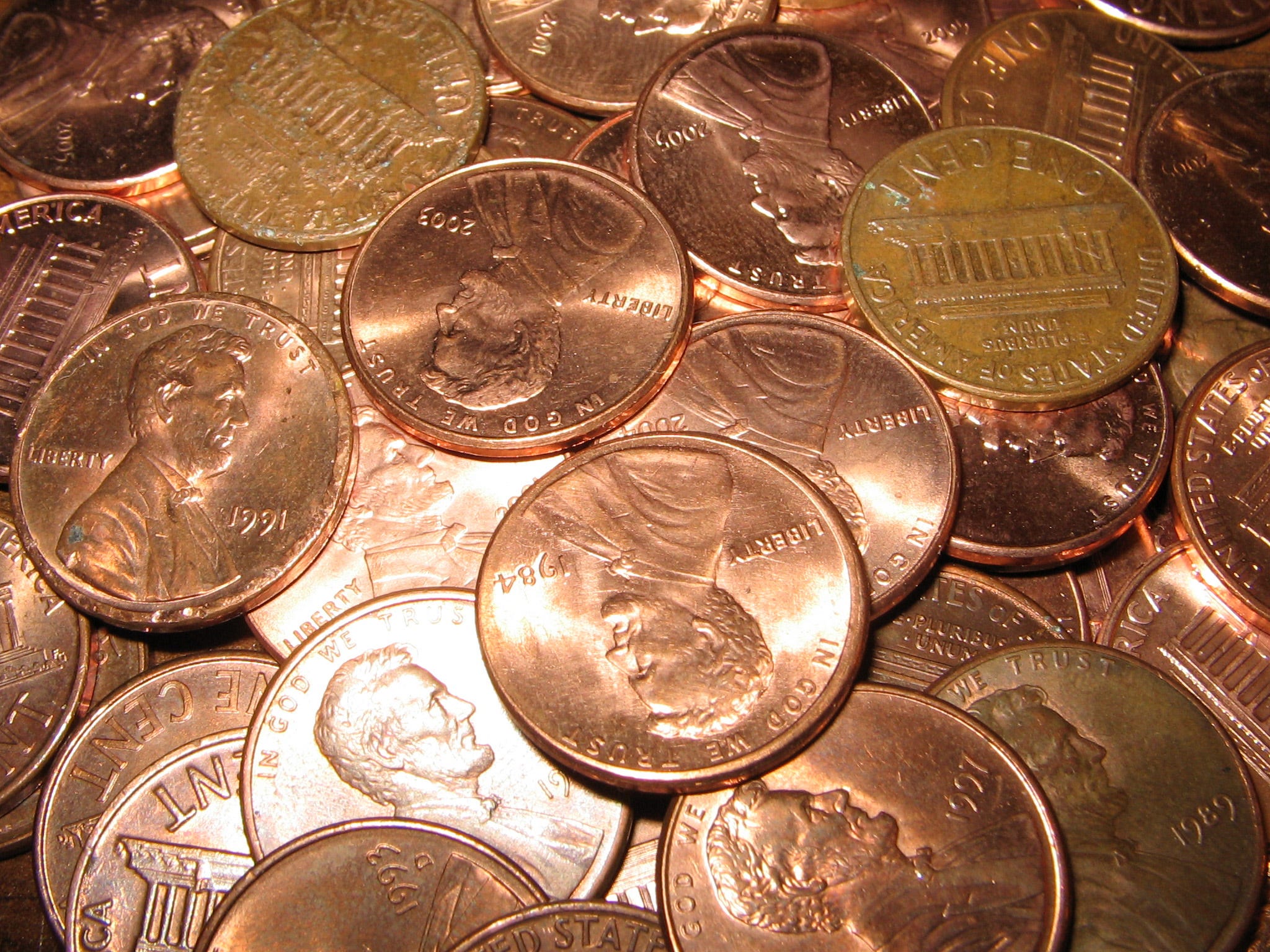
Hammad Warraich runs River Road Mart in Milwaukie, Oregon. Earlier this year, a customer bought a 99-cent item at his counter and needed a penny back.
Warraich didn’t have one.
“I’m like, ‘Bro, I don’t have pennies,’” he told Oregon Public Broadcasting in February. “It’s really hard to get them.” He says he was even threatened with a lawsuit.
A lawsuit. Over one cent.
According to the Treasury Department, roughly 300 billion pennies are still in circulation in the US. Divide that by the population and it comes to nearly 900 pennies for every man, woman and child in the country. Warraich couldn’t find one. Neither could thousands of other store owners last winter.
Where did they go? Into our kitchens: the coffee can on the closet shelf, the cup holder in the truck, the dish on top of the dryer, and the dark space under the couch cushions where loose change goes to retire.
We are the penny shortage.
How a coin that had been in American pockets since 1793 ended up at the center of a convenience-store standoff is a story about money. It is also a story about who gets to make a decision like this, and that part is what made the lawyer in me write about this.
The math is simple and makes the case
The case against the penny was always simple arithmetic.
According to the Treasury, making and distributing a single penny cost 3.69 cents in 2024, up from about 1.3 cents a decade earlier. The Mint struck 3.2 billion of them that year anyway. Every penny lost money before it left the building. Treasury estimated that stopping production would save $56 million a year.
The Mint’s own annual report for fiscal 2025 put the cost a little lower, at 3.02 cents. That was the 20th straight year the penny cost more to make than it was worth.
Twenty years.
Washington knew. Rep. Jim Kolbe, an Arizona Republican, introduced bills to retire the penny in 1989, 2001 and 2006. None became law. The presses kept running.
Killed by a social media post
On Sunday night, Feb. 9, 2025, President Trump was leaving New Orleans after watching the first half of the Super Bowl. On his way out of town, he posted on Truth Social:
“For far too long the United States has minted pennies which literally cost us more than 2 cents. This is so wasteful! I have instructed my Secretary of the US Treasury to stop producing new pennies.”
He finished with a line that has been quoted in nearly every penny story since: “Let’s rip the waste out of our great nation’s budget, even if it’s a penny at a time.”
New Orleans has been the backdrop for some memorable federal decisions. I would know.
There was no executive order and no vote. There was a social media post.
Treasury placed its final order for penny blanks in May 2025 and ran the presses until the blanks ran out. According to The Philadelphia Inquirer, the last pennies struck for circulation left the Philadelphia Mint in July.
Then, on Nov. 12, 2025, US Treasurer Brandon Beach stepped up to a machine in what used to be the penny room of the two-block-long Philadelphia Mint on Independence Mall and pushed a button. The press struck the last handful of copper-clad, mostly zinc, one-cent coins. Treasury Secretary Scott Bessent was supposed to be there. Travel delays from a speech in New York kept him away.
Beach called it a historic moment, and he had history on his side. The last time the US retired its smallest coin was the half-cent, in 1857.
A month later, on Dec. 12, Stack’s Bowers Galleries auctioned 232 sets of those final pennies, each stamped with a tiny omega. The number 232 matches the years the penny was in production, 1793 to 2025. The Mint’s acting director, Kristie McNally, had guessed the first and last coins might fetch around $100,000. The top set, holding the last Philadelphia and Denver circulation pennies and a gold omega penny, plus the canceled dies that struck them, sold for $800,000. The whole sale brought in more than $16.76 million.
A coin worth one cent, which cost the government nearly four cents to make, went out the door at $800,000 a set.
The lawyer’s question
The Constitution gives Congress the power “To coin Money, regulate the Value thereof.” That is Article I, Section 8, the list of powers belonging to the legislative branch.
Congress, in turn, handed the day-to-day work to Treasury. Federal law, 31 U.S.C. § 5111, says the Secretary “shall mint and issue coins described in section 5112 of this title in amounts the Secretary decides are necessary to meet the needs of the United States.” Section 5112 lists the coins. The one-cent coin is on the list.
The administration’s position was simple. The statute lets the Secretary decide how many coins the country needs. The Secretary decided the country needed zero pennies.
The other side’s position is just as simple. The statute says “shall.” Congress put the penny on the list. An “amount” assumes there is some amount. If “how many” can mean “none,” then a Cabinet secretary can repeal a coin Congress created without asking Congress.
I think the administration’s reading is defensible. I don’t think it’s airtight. As far as I can find, nobody ever challenged it in court, so we will never know which reading a judge would have chosen.
Untested authority has a weakness every lawyer recognizes. What one Treasury Secretary decides by memo, the next Treasury Secretary can undo by memo.
A year without a plan
The bigger problem was practical. The presses stopped before anyone decided what a store should do when the pennies ran out.
The Federal Reserve, which distributes coins on behalf of the Mint, suspended penny deposits at some of its commercial coin locations, citing “local inventory constraints.” Banks rationed. Some stores started rounding. Others put up signs asking for exact change. Some customers took to social media to say they felt scammed, even if it was only a penny or two at a time, according to the Associated Press.
On Jan. 8, 2026, the Fed reversed course and said it would resume accepting pennies from banks and credit unions starting Jan. 14. Austen Jensen of the Retail Industry Leaders Association told Axios the move “should not be viewed as a solution to the broader circulation problem.”
Meanwhile, the states improvised. By July, 20 states had passed laws allowing stores to round cash sales. Arizona required it. The others left it up to the store. The rules on taxes, signage and rounding direction varied from one state line to the next.
Colorado took the administrative route. The Office of the State Controller issued guidance, effective March 1, 2026, telling state agencies how to round cash transactions. By its own terms, that guidance covers state agencies. A Colorado hardware store or taco stand got no safe harbor from it.
The legal exposure was real. Oregon law, for example, requires cash and card customers to be treated the same way, which made rounding cash sales a legal risk. “We do think that there are real liability concerns,” Amanda Dalton of the Northwest Grocery Retail Association told OPB. The National Restaurant Association estimated that inconsistent rounding rules could cost restaurants up to $168 million a year. That is an industry estimate, and industries have every reason to make those numbers big.
That is how a store clerk in Oregon ended up threatened with a lawsuit over one cent.
Congress shows up
Congress finally acted this summer, and the two parties actually agreed.
Rep. Lisa McClain, a Michigan Republican, and Rep. Robert Garcia, a California Democrat, wrote the House bill. Sen. Cynthia Lummis, a Wyoming Republican, and Sen. Kirsten Gillibrand, a New York Democrat, led in the Senate, joined by Sen. James Lankford of Oklahoma and Sen. Ron Wyden of Oregon.
The House passed its version on July 14 by voice vote, with no recorded tally. The Senate passed its own version on Aug. 7 by unanimous consent, meaning no senator objected. The trouble was that the House and Senate had passed two different bills with two different numbers, so neither one could go to the President.
Two bills. Neither one could become law.
McClain and Garcia filed a consolidated version, H.R. 10167, on Aug. 27. The House passed it Sept. 14. The Senate passed it Monday, Sept. 28. As of this writing, the Common Cents Act is waiting for President Trump’s signature, and he is expected to sign it.
The heart of the bill is the cash register. When a store can’t make exact change, the Act sets one national rounding rule:
• Totals ending in 1, 2, 6 or 7 cents round down to the nearest nickel.
• Totals ending in 3, 4, 8 or 9 cents round up to the nearest nickel.
• Rounding applies to the final total, after sales tax.
• Card, check and electronic payments are never rounded. You pay to the penny.
• A cash total of 1 or 2 cents rounds up to a nickel.
Rounding is optional. A store that still has pennies can keep making exact change. A store that follows the rule is protected from claims under federal, state, local or tribal law. Retailers lobbied hardest for that safe harbor, and it is the provision that would have protected Hammad Warraich.
An employer who pays wages in cash and lands on an odd amount must round up, in the worker’s favor.
Beyond the register, the Act writes the end of the circulating penny into federal law. The Mint can keep making collector pennies, and it is selling some this year for the 250th anniversary, dated “1776 ~ 2026.” Treasury gets authority to try a cheaper nickel with a zinc core and nickel outer layers. The Federal Reserve must report on penny distribution, and the government must study how shortages and rounding affect low-income Americans, older Americans and people without bank accounts.
The provision I like best got almost no coverage. Before Treasury discontinues any circulating coin in the future, it must give Congress 60 days’ notice.
Think about that in light of how the penny died. Congress agreed with the President’s decision, then made sure the next coin can’t be retired with a post on Super Bowl night. The legislative branch took back a small piece of the power it lets slip away every year.
Is rounding a tax?
The penny’s defenders have one serious argument, and it deserves a hearing: rounding will cost consumers money.
The argument goes back to Penn State economist Raymond Lombra, who estimated in 2001 that eliminating the penny would impose a “rounding tax” of about $600 million a year, falling hardest on low-income people who pay cash. Prices tend to end in 9, the argument goes, so more totals round up than down.
It is worth knowing who promoted that argument. Americans for Common Cents, the pro-penny lobby, has been funded mainly by the zinc industry, chiefly the company that sold zinc penny blanks to the Mint. Its executive director, Mark Weller, once said, “We make no secret that one of our major sponsors is a company that makes the zinc ‘blanks’ for pennies.”
Then the evidence came in.
In 2007, Wake Forest economist Robert Whaples found that once sales tax is added, which scrambles the final digit, rounding comes out roughly neutral.
In July 2025, economists Zhu Wang and Russell Wong at the Federal Reserve Bank of Richmond studied real payment diaries from about 4,700 consumers. They found Lombra had a point: totals do land on 3, 4, 8 and 9 a little more often. The cost of that tilt is about $6 million a year, nationwide. Spread across roughly 340 million Americans, it comes to less than 2 cents per person per year.
Canada dropped its penny in 2013. A 2018 study by Christina Cheung in the Atlantic Economic Journal found that rounding moved about 3.27 million Canadian dollars a year from shoppers to grocery stores, roughly $157 per store.
The rounding tax is real. It comes to about a dime for every dollar Treasury says it saves by not making pennies.
The nickel is next
That brings us to the coin nobody wants to talk about.
According to the Mint’s annual report, a nickel cost 13.31 cents to make in fiscal 2025. Like the penny, it has cost more than its face value for 20 straight years. The Mint loses about 2 cents on every penny it makes. It loses more than 8 cents on every nickel.
Rounding means every cash register in America now leans on the nickel. More nickels change hands, which likely means the Mint has to make more of them. Nobody has published an estimate of how much nickel demand will rise, so I can’t tell you how much of the penny savings the nickel will eat. I can tell you which direction it goes.
The Richmond Fed economists ran one more scenario. If the nickel goes too and stores round to the nearest dime, the rounding cost to consumers jumps to about $55.6 million a year, nine times the penny-only figure. That is almost exactly what Treasury says it saves by killing the penny.
That is why the cheaper-nickel provision matters, and why the 60-day notice matters even more. The next coin fight will be bigger, and Congress made sure it gets a say this time.
What to do with your jar
Your pennies are still legal tender. Nobody is recalling them. Spend them, roll them, or take them to the bank. Every penny that leaves a jar and goes back into a cash drawer helps a store like River Road Mart make change.
Don’t melt them. Since 2007, a Treasury regulation has prohibited melting or mass-exporting pennies and nickels, with penalties of up to $10,000 and five years in prison.
The penny lasted 232 years. It survived the Civil War, two world wars and a year, 1943, when the country needed copper so badly the Mint made pennies out of steel. What finally ended it was arithmetic and a Truth Social post, with Congress arriving last.
Ending the penny was the right call. The order of operations hurt people. The President stopped the presses first, and Congress didn’t pass rules for the cash register until more than a year after the last circulating penny left the Mint. In between, a clerk in Milwaukie, Oregon, stood at his counter explaining to a customer why he couldn’t produce one cent.
Somewhere in your house, there’s a jar. Take it to the bank.
Tell me in the comments what you found in yours.
Sourcing and Verification
The receipts are here. Go check my math.
Hammad Warraich and River Road Mart. Oregon Public Broadcasting, “A lack of pennies has Oregon store owners asking the state to allow them to round prices to the nearest nickel,” Feb. 27, 2026. Quotes from Warraich and Amanda Dalton are from that story. (OPB is public radio, generally center-left.)
300 billion pennies in circulation. Treasury figure, as reported at the time of the final strike in November 2025. Other published estimates run lower, around 114 billion. The “nearly 900 per person” figure is my arithmetic, using roughly 340 million Americans.
Production cost and savings. 3.69 cents per penny (2024) and $56 million in annual savings: Treasury statements reported by Reuters and the Associated Press, May 2025. 3.02 cents per penny and 13.31 cents per nickel, 20th consecutive year above face value: US Mint fiscal 2025 annual report, as quoted by Greysheet, Sept. 10, 2026.
Jim Kolbe’s bills. 1989, 2001 and 2006, per the Wikipedia entry “Penny debate in the United States,” which cites the congressional record.
Trump’s post. Truth Social, Sunday, Feb. 9, 2025, posted while leaving New Orleans after the first half of the Super Bowl; reported by the Associated Press (via Boston.com) and quoted by Newsweek.
Final orders, the July departure and the Nov. 12 ceremony. The Philadelphia Inquirer, Nov. 12, 2025; Bessent’s absence and McNally’s $100,000 estimate per AOL/USA Today Network coverage the same day.
The omega auction. Greysheet and CoinWeek reports on Stack’s Bowers Galleries’ Dec. 12, 2025, sale: 232 three-coin sets, top lot $800,000, total over $16.76 million.
Constitutional and statutory text. US Constitution, Article I, Section 8, Clause 5; 31 U.S.C. § 5111(a)(1) and § 5112.
The Federal Reserve suspension and reversal. Federal Reserve Financial Services press release, Jan. 8, 2026; Axios, Jan. 8, 2026 (Jensen quote).
State rounding laws. National Conference of State Legislatures (May 2026); Associated Press (March 2026); 20 states by July 2026, with Arizona mandating, per Wikipedia’s summary of state action. Colorado: Office of the State Controller, “Cash Transaction Rounding for Pennies,” effective March 1, 2026.
Restaurant estimate. National Restaurant Association, as reported by The Lobby News. Industry figure, not independently verified.
The Common Cents Act. H.R. 10167, 119th Congress. Bill history: CoinWeek (Sept. 15, 2026), The Shelby Report (Sept. 17, 2026), Payments Dive (Sept. 29, 2026), ABA Banking Journal (Sept. 29, 2026), ABC News/AP (Sept. 29, 2026). Senate sponsors per Sen. Lankford’s office one-pager. The 60-day notice provision per ABA Banking Journal and Newsweek.
Rounding studies. Raymond Lombra (2001) and Robert Whaples (2007) as summarized by the Federal Reserve Bank of Richmond, Econ Focus, 2020. Zhu Wang and Russell Wong, Richmond Fed Economic Brief No. 25-27, July 2025. Christina Cheung, “Eliminating the Penny in Canada,” Atlantic Economic Journal 46(2), 2018.
Americans for Common Cents funding and the Weller quote. Wikipedia entry “Americans for Common Cents,” citing lobbying disclosures and press coverage.
Melting ban. US Mint press release, April 17, 2007; 31 C.F.R. Part 82.
Signature status. As of Sunday morning, Oct. 4, 2026, I found no report that the President had signed the bill.
I have a plastic tub full of pennies from 2024 when I worked at a restaurant and received tips. I also have pennies in my billfold as change I have received in the last month or two. I live in Ohio so there's no apparent shortage here.
I've worried about trying to take that tub of pennies to a bank wandering if they will still be accepted. Guess I'll have to do it after all.
Why not do the rounding on shelf prices rather than the total sale. If one item at 94 cents is marked 90 cents and one at 96 cents is marked one dollar the total is a buck ninety either way.