

There is a receipt at the center of this story, and the receipt says what it says.
United Airlines eTicket, issued November 8, 2025. One passenger: George Robert Teal. Domestic segment: first class. International segment: Polaris business. Fare class: refundable. Total: $17,091.00, charged to a Douglas County purchasing card four days before Commissioner Teal boarded a plane for the Dubai Airshow.
That is the whole opening argument, and it comes straight off the receipt. No editorializing required. One passenger. One seat. Seventeen thousand and ninety-one dollars in taxpayer money.
Because I am mildly obsessed with primary sources, I read the Douglas County travel policy next. The policy — the one the commissioners themselves adopted, and the one they expect their own employees to live by — is not subtle on this point. Travelers may be reimbursed at the lowest available coach class fare. If a traveler wants to fly business or first, the traveler pays the difference personally. The policy also asks travelers to book as far in advance as possible to obtain the lowest fare. A refundable Polaris business-class ticket, purchased four days out, is roughly the mathematical opposite of that instruction.
So on the merits, before anyone got creative, we already had a problem: a county commissioner’s purchase that the county’s own written policy said should not have happened.
Then, in December of 2025, a Denver television station aired a report about it. And this is where the story gets interesting — because the paper trail did not stop at the receipt. It kept going.
The bailout
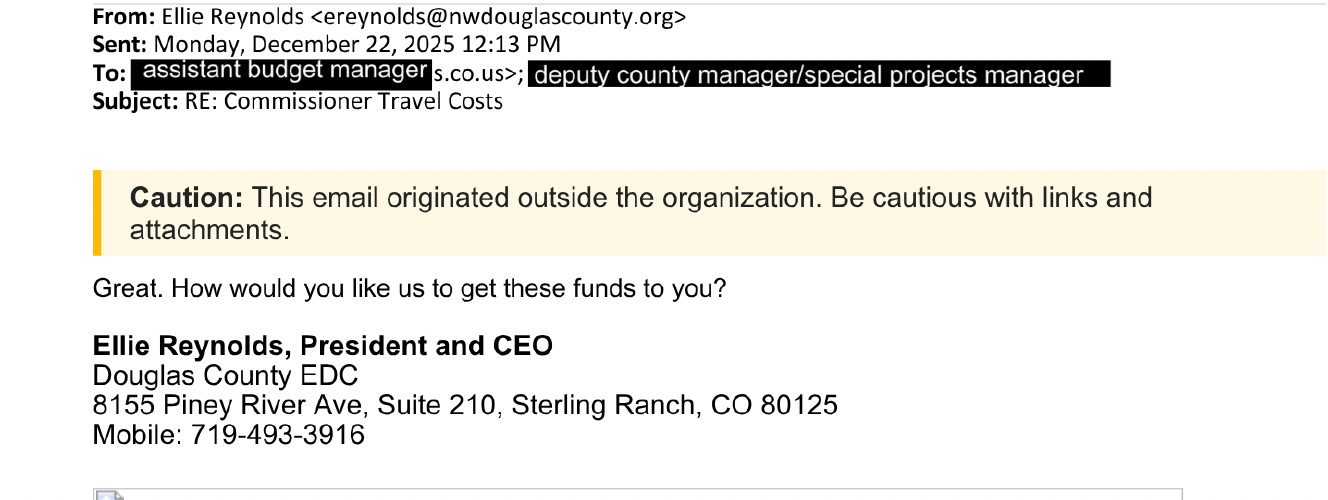
Inside a week of the television story, an internal email chain begins. Douglas County’s deputy county manager writes to Ellie Reynolds, the CEO of the Douglas County Economic Development Corporation — a nonprofit that receives the overwhelming majority of its funding from Douglas County — and asks, in effect, whether the EDC would be willing to absorb “approximately $25,000 in travel costs” associated with Commissioner Teal’s Dubai trip.
Ms. Reynolds replies:
“Great. How would you like us to get these funds to you?”
I have been reading government emails for a long time. That is not the language of an independent, arm’s-length nonprofit weighing a request on its merits. That is the language of a vendor being told where to send the money. It is not the language of due diligence. It is the language of how may we assist.
An invoice follows. Invoice #13524. Description line: TEAL DUBAI TRVL REIMBURSEMENT. Amount: $19,211.08. Not $25,000. Not $17,091. The invoice covers the flight, a stay at the JW Marriott Marquis in Dubai, Ubers, checked bag fees, and — because we all deserve one small human detail in an accountability story — the commissioner’s in-flight Wi-Fi.
The EDC then cuts check #2695, drawn on FirstBank, in the amount of $19,211.08, payable to the Douglas County Treasurer.
The check is dated January 13, 2026.
Why that date matters
January 13, 2026 was the day George Teal became Chair of the Douglas County Board of County Commissioners.
Same day. Not the day before. Not the week after. The check that made the county whole for the Chair’s non-compliant airfare was cut the day the Chair took the gavel.
I am not going to tell you what to think about that. I am telling you the two dates match, and that they match because someone wrote them down on documents that are now public.
Why “the EDC paid us back” is not the exculpation people think it is
Here is where the story stops being about one seat on one plane and starts being about how public money moves in Douglas County.
The Douglas County Economic Development Corporation is a private nonprofit in the technical, filing-your-990 sense. In the functional sense — the sense that matters to a taxpayer — it is a county-funded operation. The CORA production includes county checks made out to the EDC. A $150,000 check dated May 14, 2024, described on its face as “2024 CONTRIBUTION,” bears George Teal’s own signature as one of the two required county signatories. The 2025 contract between the county and the EDC obligates the county to a further $937,500 payment schedule, on top of a separate $100,000 payment reflected in the file. The EDC’s own budget request from the county for 2025 was approximately $1 million.
And who sits on the EDC’s board as the county’s designated representative? Per the county’s own website — Commissioner George Teal.
Follow the circle. The county pays the EDC. The commissioner signs the checks that pay the EDC. The commissioner sits on the EDC’s board. The commissioner charges a non-compliant ticket to a county p-card. The EDC “reimburses” the county for the non-compliant ticket. And the check that closes the loop is dated the day the commissioner becomes Chair.
That is not a reimbursement in any meaningful sense. It is a bookkeeping entry. The money moved in a circle, and the taxpayer was on both ends of it.
The two questions the documents do not answer
I am going to end this by doing something that will feel unsatisfying, because it is unsatisfying. I am going to ask two questions I cannot answer from the documents in the CORA file. I am going to ask them out loud, in public, in writing.
Question one. The United ticket purchased was “refundable.” That is a big part of why it cost $17,091 instead of the several-thousand-dollar coach fare a taxpayer might have expected. After the EDC reimbursed the county for the ticket, was the ticket ever separately refunded — by United, to any account, to any card, to any person? If it was, the county was made whole once by the EDC and once by the airline, and the question of who benefited from the second refund is no longer a policy question. It is a question a district attorney asks.
Question two. The county’s own email says “approximately $25,000 in travel costs.” The invoice came in at $19,211.08. That is nearly a $6,000 gap. What was in the $25,000 estimate that fell out before the invoice was cut? Per diems? Registration fees? Something someone did not want on paper?
I do not know the answers to either question. I am not going to pretend I do. The commissioner has, per the reporting I have seen, declined to answer questions like these when they have been asked publicly.
He is welcome to email me his answers anytime. My iHeart email is public, but so is the email for this Substack. I will publish any answer he provides. And taxpayers should demand that he provide answers.
What accountability looks like
None of this requires a partisan lens. You do not have to be a conservative to think a $17,091 first-class ticket violates a written travel policy, or that a nonprofit whose paycheck the commissioner signs should not be the entity making him whole, or that a check dated the day the gavel changes hands looks like something. You just have to be a taxpayer who reads.
Attached to this piece you will find two things. The first is the fact sheet — a plain, sourced summary of what the documents show, with citations to each exhibit. The second is the exhibit packet itself: the ticket, the travel policy, the email chain, the invoice, the EDC check, the county’s checks to the EDC, and the 2025 EDC-county contract. I did not paraphrase them. I did not spin them. I put them in one document so you can read them and decide for yourself.
Douglas County residents deserve two answers this week. So do the rest of us — because if a circle like this works in Douglas County, it can be drawn anywhere.
The receipt says what it says. So does the calendar.
The documents cited above were produced under Colorado Open Records Act requests filed by Emily Suyat of the Red County, Blue State Substack, who first made them publicly available. I downloaded each document from the Google Drive links in her three-part series, and you can download them, too.

The primary source documents cited in this piece were produced under Colorado Open Records Act requests filed by Emily Suyat of the Red County, Blue State Substack, (https://esuyat.substack.com/) who first made them publicly available. Those are indexed in search engines I use and you can independently reach each document from the Google Drive links in her three-part series and reviewed the underlying records independently before writing this piece.
Hi. So many things to say about this article. I'll keep it civil.
#1 My County Commissioners should not be spending $1,600+ on hotel rooms and $16,000 on airfare.
#2 There is no business at the Dubai airshow for Douglas County, Colorado.
#3 His card has a single day limit of $10,000, how did $16,000+ get charged to the card?
#4 He traveled. There was no refund eligible from the airline.
#5 Rules do not apply to our County Commissioners.
I'll stop here.