

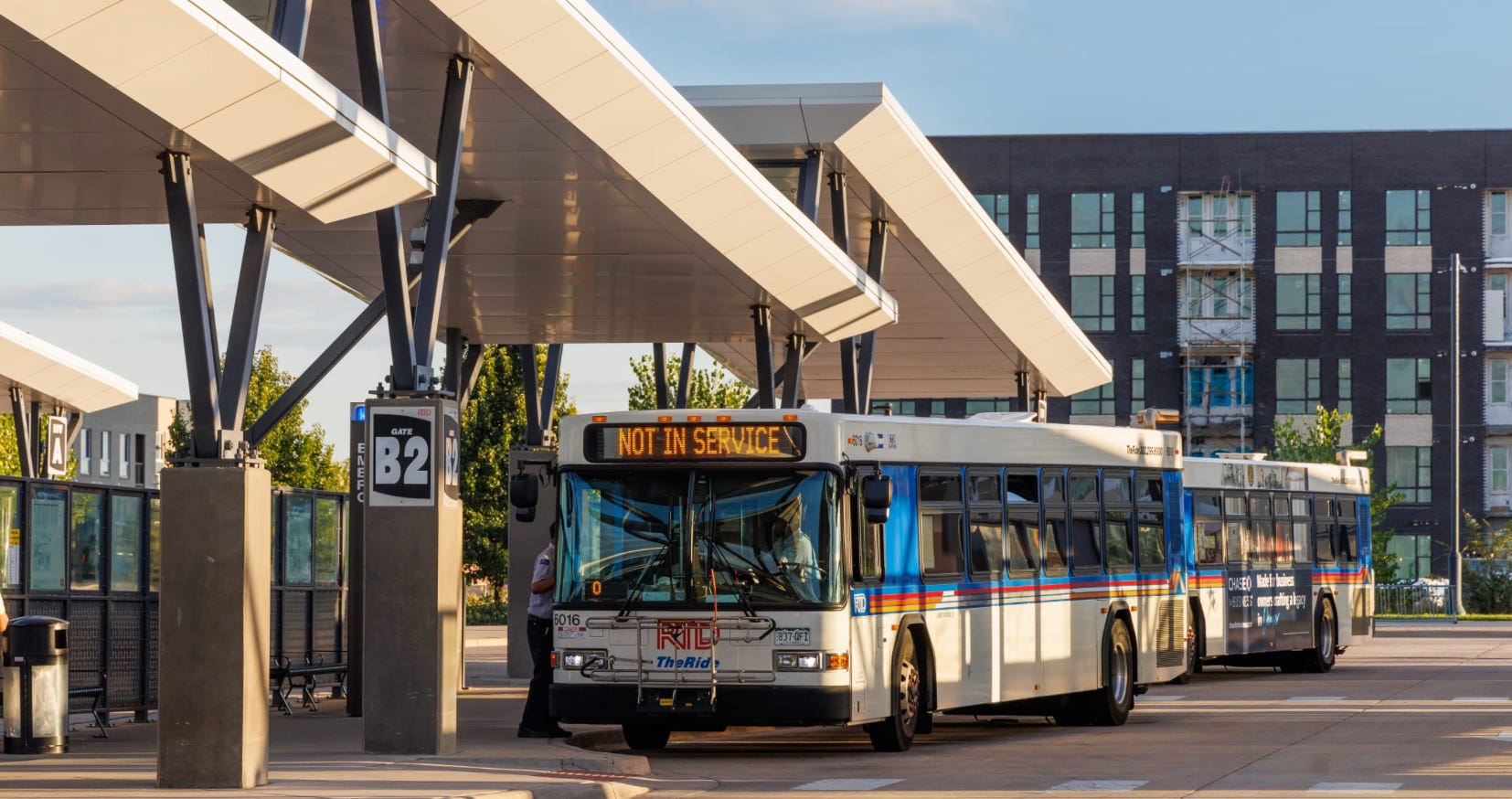
Last Thursday morning, the Denver Post put a number at the top of its story about RTD.
$3.7 billion.
The headline read: “RTD generates $3.7 billion economic and community impact, agency study finds.”
That’s a number built for a ballot ad. Two years from now some county commissioner will repeat it at a Rotary lunch meeting, and everybody at the tables will nod.
I did what I do with a number like that. I read the study: 28 pages from a Boston consulting firm called EBP. The study is called “Economic Impact of Denver Regional Transportation District.” I read through every table and, more importantly, every footnote.
The $3.7 billion isn’t in there. RTD’s own press release doesn’t use it either.
I walked through the core of this on air this morning. This is the full version: every line item, the numbers I checked, the ones I couldn’t, and what an honest study would look like before RTD asks voters for more money. You can check every number. The page references are at the bottom.
What $100,000 buys
The Regional Transportation District commissioned the study and paid for it. The Denver Post reported the price at roughly $100,000. Kiernan Maletsky, RTD’s long-range planning director, told the Post the agency wanted to put numbers on the value RTD brings to the region. The Post also reported that agency leaders hope the study makes the case for more funding.
RTD claims they need more of your tax dollars. According to the agency’s draft 2027 budget, RTD plans to spend $148 million more next year than it expects to take in, and that’s after the cuts. The board ordered $20 million in service reductions without naming the routes. Board members have talked about asking voters for more money in 2028.
Nine days before the study came out, voters in the Front Range Passenger Rail District approved Issue 7A, a new 0.333% sales tax for the Colorado Connector train, known as CoCo. It passed 55% to 45%. Under a preliminary term sheet, RTD is on the hook for up to about $156 million, nearly half the construction cost of the first leg.
That’s the setting. This study is the Exhibit 1 in a campaign that hasn’t even been announced yet.
RTD General Manager and CEO Debra Johnson made the pitch in a statement: “RTD is not just moving people. It is helping power the regional economy.”
Now. How did the consultants get to where they are?
Two boxes the Denver Post put into one
The study produces two headline numbers. They come from two different sets of books.
$2.1 billion is “gross regional product,” the economists’ measure of the region’s economic output. It’s the slice of the metro economy the model ties to RTD and says is at risk if RTD disappeared.
$1.6 billion is what the consultants call “social benefits.” That covers money riders don’t spend on cars and cabs, crashes avoided, pollution avoided and time saved. Much of the social benefit is figured with “willingness to pay,” a method for putting a price tag on things that never change hands.
EBP keeps those two numbers in separate boxes on purpose. RTD’s press release keeps them separate too. The Denver Post added them together.
They can’t be added together because they overlap.
The $2.1 billion includes about $367 million in wages the model says transit commuters would lose if RTD vanished (Table 4, page 15). The $1.6 billion includes the very same $367 million, relabeled as the value of “enabled work trips” (page 16).
Same money. Counted twice.
The Post did report the $100,000 price tag and the funding motive. Its headline went with the bigger number.
What kind of study is this?
This matters more than anything else in the report, and it’s the point the defenders will raise first, so I’ll raise it myself.
This is an economic impact study. It measures how much money moves through the regional economy when RTD spends its budget, and how much would stop moving if RTD vanished.
A cost-benefit analysis asks a different question: was the money worth spending? It puts the costs on one side of the ledger, the benefits on the other, and asks which is bigger.
RTD commissioned the first kind of study. It is being marketed, by RTD and by the headline, as the second kind of study. Keep that distinction in mind. Almost every problem below flows from it.
The empty bus
Take the $2.1 billion apart. It’s two pieces with almost nothing in common.
Piece one: about $1.04 billion and 9,300 jobs. That’s RTD spending its own budget. RTD pays drivers and mechanics and buys parts, diesel and electricity. Those workers and suppliers spend their paychecks around town, and the model counts that ripple too.
The model behind that number, a standard tool called IMPLAN, run through the American Public Transportation Association’s “My Economic Impact Tool,” asks one question: how much did RTD spend? It never asks whether anybody rode.
Picture a 40-foot bus pulling out of a suburban Park-n-Ride at 11 o’clock on a Tuesday night. Every seat is empty. The driver gets paid, the diesel gets burned, and a mechanic waits back at the garage. Under this method, that empty bus produces exactly the same economic impact as a full bus.
Then ask where the money came from. RTD’s draft 2027 budget expects about $940 million from sales and use taxes paid by you and about $66 million from fares paid by riders. Roughly 6% of RTD’s revenue comes from the people who actually ride. Roughly 94% comes from you and me, people spending their hard-earned money on groceries, gas, appliances, anything that gets a sales tax attached to it.
The sales tax comes out of the same eight-county economy. Every dollar RTD collects at a checkout counter in Thornton or Highlands Ranch is a dollar that family did not spend on a dinner out or braces for the kid. That dollar would have rippled through the local economy too. The study counts RTD’s ripple and ignores the one it displaced.
Spending is a cost. This study books it as a benefit.
I’m not the only one who noticed. Kathleen Chandler represents District F on the RTD board, which covers most of Aurora, and her term runs through 2028. She’s a friend of mine and a former staffer at the Independence Institute, the free-market think tank in Denver, so weigh her words with that in mind. She speaks for herself, not for RTD.
RTD presented the study at a breakfast panel. According to Ms. Chandler, RTD CEO Debra Johnson moderated, an author of the study presented it, and the panel included a speaker from Denver International Airport who talked about the thousands of workers RTD carries to the airport every day. Nobody on that stage, as she describes it, was there to check the math.
Afterward she texted me:
“I went to a breakfast and listened to the RTD study. It was pitiful. I asked one of the authors… did you consider the money you ‘stole’ from taxpayers?”
“Stole” is her word, in her quotation marks, not mine.
I asked her what he said. She doesn’t remember his name. She remembers the answer:
“The guy I spoke to didn’t even consider the opportunity cost of all taxpayers. Even the person who rides RTD pays the tax. So, that person pays the paltry fare and is taxed every time they purchase anything in the district boundaries.”
Her last point deserves a second look. The line cook from Aurora pays his fare. Then he pays RTD’s sales tax again on a pair of work shoes or a burger on his day off, every time he buys something anywhere in the district. The rider is a taxpayer too.
I don’t know which EBP author she spoke with, and his side of that exchange isn’t here. If EBP wants to answer the opportunity-cost question, I’ll publish the answer.
The day RTD vanished
Piece two: about $1.09 billion and 8,172 jobs. This comes from a scenario.
The consultants imagined that one morning RTD simply ceased to exist, every bus and every train gone overnight. Then they modeled the people who’d lose their way to work. The model converts lost work trips into lost jobs at 500 trips per job per year and lands on about 4,500 direct job losses. Add the ripple from those lost paychecks and the total passes 8,000.
Nobody is proposing that. I’m certainly not.
The study’s own fine print says the scenario “reflects short term impacts expected in the first year without transit, rather than long term changes” (page 12). In real life, people adjust. They carpool, buy a used car or change shifts. A hotel that needs dishwashers at 6 a.m. finds a way to get them there.
A one-year shock from a disaster nobody proposes is being sold as RTD’s contribution to the economy every year.
Then there’s a choice buried in a footnote. The study estimates that without RTD the region would add 24,074 cars, at a cost of $211 million a year. The consultants then say you can’t count both the cars and the lost jobs, because the guy who buys a car keeps his job (footnote 2).
Reasonable. Which one stayed in the total?
The lost jobs: $367 million in wages instead of $211 million in cars.
When they had to pick, they picked the bigger number.
The line-item audit
Here’s every piece of the $1.6 billion in social benefits, where it comes from, and what I found.
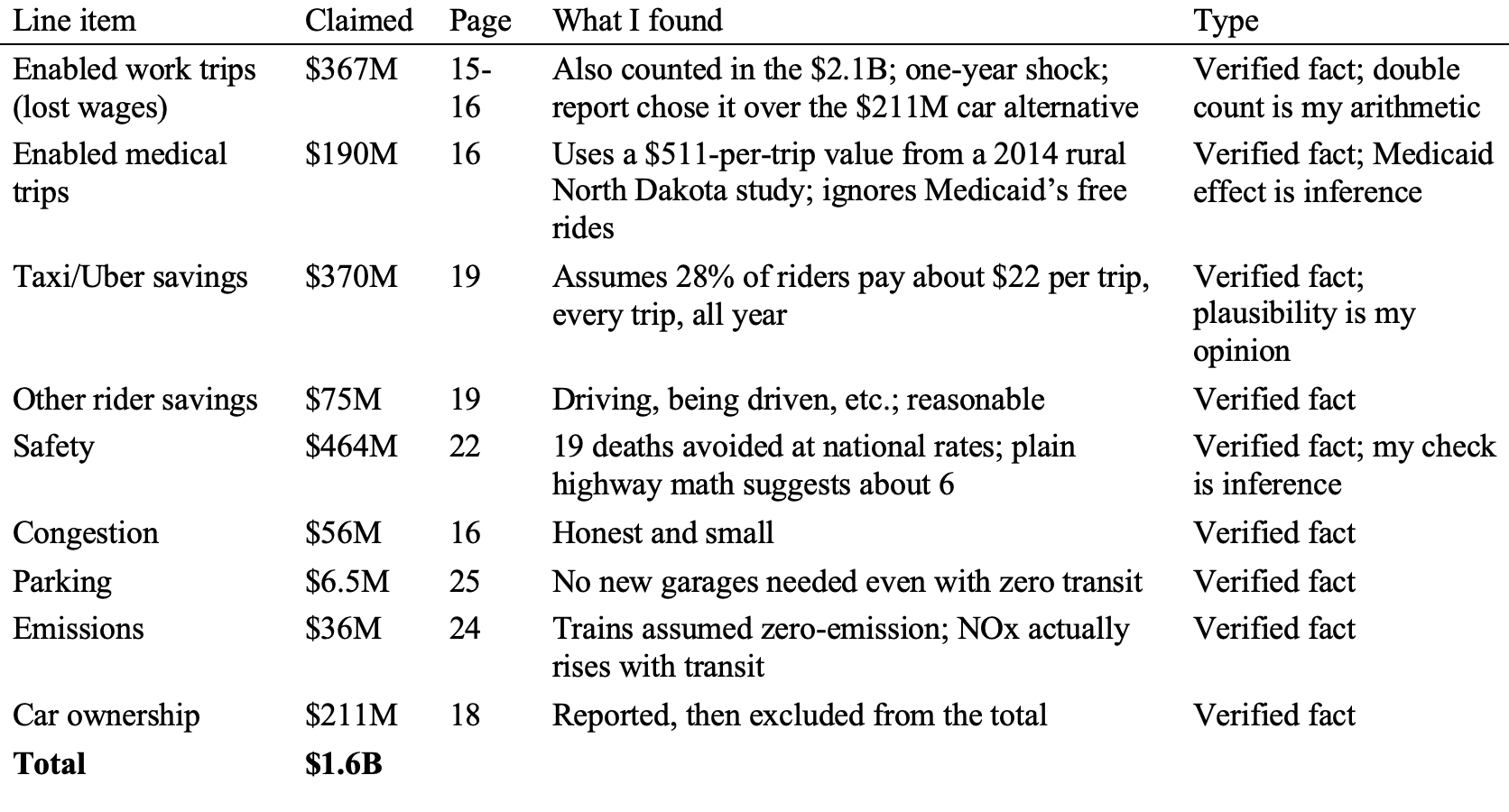
The first four rows are where the money is. I’ll take them, plus a few more, one at a time.
Six things that didn’t fit on the radio program
1. The Uber riders
RTD asked riders how they’d make their trip without RTD. About 28% said they’d take a taxi, an Uber or a Lyft. The study took them at their word, every trip, every day of the year. For a bus rider, the consultants priced the replacement ride at $19.68 against an average bus fare of $0.89 (Table 6).
That single assumption is worth $370 million, more than a fifth of the entire $1.6 billion.
These riders already looked at a $20 Uber and an $0.89 fare and chose the bus. Telling a survey taker you’d grab an Uber costs nothing. Actually paying $40 a day, every working day, for a year, is another matter. The same study has these riders buying 24,074 cars, which apparently sit in the driveway while their owners take Lyfts.
If those riders paid what the study says driving costs instead of what Uber costs, the line drops from $370 million to about $75 million. That’s my math, using the study’s own per-trip figures.
2. The North Dakota number
The study values every medical trip transit makes possible at $511 (footnote 10). The source is a 2014 North Dakota State University study of transit in rural areas and small towns.
Rural North Dakota, applied to metro Denver. Yes, I have a hard time wrapping that one around my head, too.
That figure becomes $190 million a year. The report never mentions that Colorado’s Medicaid program, Health First Colorado, already provides free non-emergency rides to medical appointments for members with no other way to get there, through a broker covering all nine Denver metro counties. Take RTD away and many of those trips wouldn’t vanish. The bill would move to Medicaid.
3. The 19 lives
The safety line claims RTD prevents about 19 traffic deaths a year, valued at $264 million, using national crash rates.
I ran a rough check. The study says losing RTD would add about 464 million vehicle miles a year. The National Highway Traffic Safety Administration put the 2024 national fatality rate at 1.19 deaths per 100 million vehicle miles. Multiply those and you get between 5 and 6 deaths.
That’s a rough check, and I’m labeling it as one. The study also counts riders who’d switch to walking or biking, which are riskier per mile, and it works per trip instead of per mile. Those could close part of the gap. Closing all of it, from about 6 to 19, takes a lot. EBP should publish the calculation, and I’ll publish the answer if I get it.
4. Counting boardings as jobs
The job-loss model divides lost work trips by 500 to get jobs (page 14). Those trips are counted the way the National Transit Database counts them: one per boarding (page 11). A commuter who catches a bus and transfers to the train boards twice each way, four times a day, and gets counted as two jobs.
The report waves at this in a parenthetical, saying “it is likely” each transit commuter represents more than one job (page 15). Maybe some hold two jobs. Every transfer, though, pushes the count the other way, and the report doesn’t measure either effect.
5. Trains with no tailpipe
On emissions, the report says RTD’s commuter rail and light rail “are electric and assumed to have no emissions” (page 23). The trains run on grid power. The plants generating it burn fuel.
The report’s own Table 14 shows transit producing more nitrogen oxides than the no-transit scenario. The carbon value comes from 2024 federal guidance that the report says is “not included in more recent guidance.”
The whole emissions line is $36 million, so this barely moves the total. It does tell you which way the assumptions lean.
6. The “18 percent return”
The report says every $1 invested “generates $1.187 in regional business sales, representing an 18 percent return on investment” (page 7).
The arithmetic doesn’t match the label. The study’s business sales figure, $1.56 billion, divided by its $880 million in spending is $1.77. The $1.187 matches gross regional product divided by spending: $1.04 billion over $880 million.
It isn’t a return on investment in any sense a banker would recognize, either. The $1 is spent. The $1.187 is the model’s estimate of the activity that spending touches, the original $1 included.
What’s left when you lean on the assumptions
What happens to the $1.6 billion if you make a few skeptical but reasonable changes? This is an illustration, not a re-estimate. The assumptions are mine, they’re labeled, and you’re welcome to argue with them in the comments.
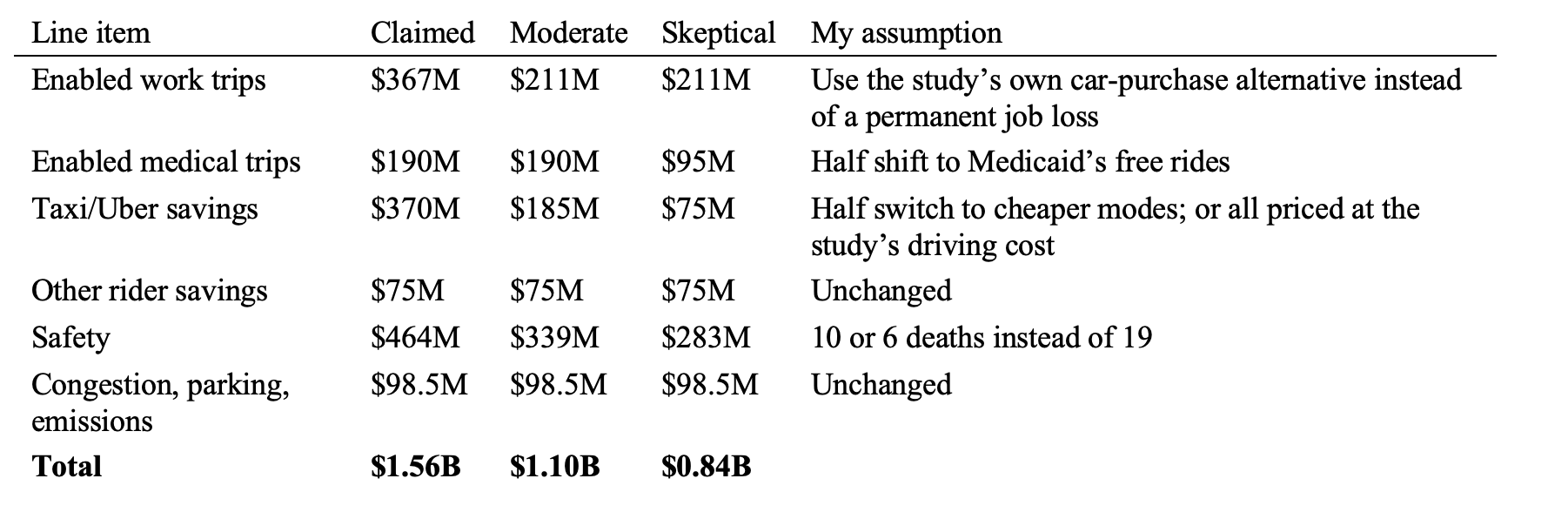
Now set that against the cost of running RTD.
The study divides by $880 million a year, the 2022-2024 average of operating and capital spending. As best I can tell from its inputs, that excludes debt service. RTD’s own budget book shows $1.04 billion in 2025 operating expenses, plus debt payments of $190.6 million in the 2026 budget and $253 million proposed for 2027, most of it for FasTracks rail bonds.
Benefits of roughly $0.84 billion to $1.10 billion. Annual costs of roughly $0.88 billion to $1.23 billion.
Those ranges overlap. Under skeptical assumptions, RTD’s social benefits land somewhere around its cost. That doesn’t prove RTD is a bad deal. It proves this study can’t tell you whether RTD is a good deal at the margin, and the margin is the only thing voters will be asked about in 2028.
What RTD’s defenders get right
Here’s the strongest case on RTD’s side, and it comes straight from the same study.
Picture a line cook at a downtown hotel. His shift starts at 6 a.m. He doesn’t own a car, or the family’s one car is needed elsewhere. He rides the bus in from Aurora.
The study’s data backs him up. In this region, 17% of people who commute by transit work in hotels, restaurants and entertainment, against 9% of all commuters (Figures 6 and 7). About one RTD trip in five, 21%, would not happen at all without RTD.
That’s real. For a lot of people the bus is the difference between a paycheck and no paycheck, and I’m not going to pretend otherwise. RTD and the transit advocates will say that’s why the system is worth every dollar.
The line cook is the best argument there is for a lean, focused bus network that gets working people to work on time. He’s a poor argument for a sprawling rail network that cost billions and, by the study’s own admission, carries fewer riders than the forecasts promised (page 3). The study lumps the two together and never asks which one we’re paying for.
Sixteen dollars
The study never gives you this number. I worked it out from RTD’s own budget book.
In 2025 RTD spent $1,040,509,000 to operate the system and recorded 65,046,014 boardings.
That’s about $16.00 per ride.
The study tells you the average rider pays about $1.13 and that driving the same trip would cost about $5.38 (Table 6). The picture it wants you to see is a rider saving money, and he is. What it never sets beside those numbers is the other $15 or so we all pay through the sales tax every time somebody boards.
That $5.38 driving cost leaves out car payments and insurance. Even so, $16.00 a ride to save a rider about $4.25 is a gap worth asking about.
Look at the trend underneath it. In 2019 RTD carried about 105.8 million boardings. In 2025 it carried about 65 million, a drop of roughly 38%.
Then look at congestion, the benefit everybody assumes. The study puts RTD’s entire congestion-relief value at $56 million a year. Its own scenario says losing RTD would add about 464 million vehicle miles a year. The Denver Regional Council of Governments estimates this region drives about 85 million miles every day. Do the division, and RTD is holding back about 1.5% of our driving.
The study even asked whether downtown would need new parking garages without RTD. Its answer was no. It cites a garage running well below half full at peak (page 25).
Who built the calculator
The spending numbers come from APTA’s “My Economic Impact Tool” (page 4). The American Public Transportation Association is the transit industry’s trade association in Washington, and its work includes lobbying for more transit funding.
EBP, the firm RTD hired, also prepared APTA’s own national report, “Economic Impact of Public Transportation Investment,” published in February 2026. APTA promoted it as a new independent economic study, and RTD’s report cites it (footnote 9).
When Mass Transit magazine wrote up the RTD study, the only source quoted besides RTD’s CEO was APTA. RTD paid APTA’s go-to consultant to run APTA’s calculator, and APTA showed up as the outside expert.
Then there’s the proofreading. Table 10 says the commercial land near RTD stations in six metro counties covers 58.8 million square miles. The entire land surface of Earth is about 57.5 million square miles.
According to this study, the office parks along RTD’s lines are bigger than the planet. I’ve sat in traffic on Arapahoe Road long enough to almost believe it.
It’s a units typo, and I make typos every day. When a $100,000 study has train stations bigger than Earth and nobody catches it, you’re entitled to wonder how hard anybody checked the multipliers.
Who covered it, and how
Here’s every piece of coverage I could find from Thursday through Monday afternoon, with each outlet’s general lean.
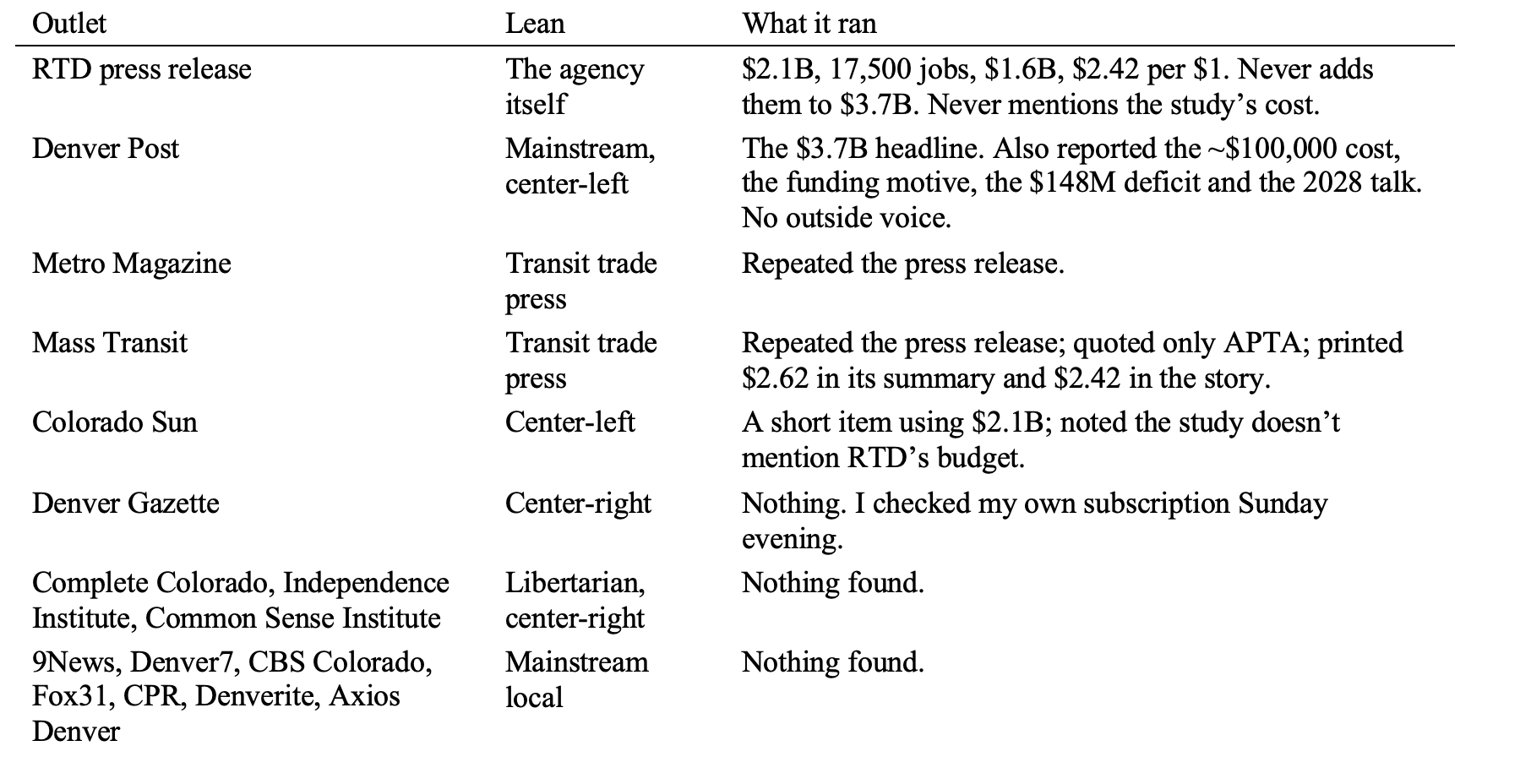
Across the whole spectrum, nobody had asked an independent economist to look at the math. My business, and I include myself, is a sucker for a big round number with a dollar sign in front of it. The study lands with a press release, the number goes in the headline, and the questions come later, if they come at all.
What an honest 2028 study would show
In 2028 nobody is going to ask you whether RTD should exist. They’re going to ask you for more of your money, on top of what you already pay, and on top of the CoCo tax voters just passed.
The question on that ballot will be what the next dollar buys. A study worth $100,000 of our money would answer it. Here’s what it would include:
1. Cost per boarding, route by route and mode by mode: bus, light rail, commuter rail and paratransit, from RTD’s own data.
2. Marginal scenarios. What a 10% bigger budget buys in riders and service hours, and what a 10% smaller one costs.
3. Net effects, with the household spending displaced by the sales tax subtracted out.
4. The full cost, with debt service included in the “per $1 invested.”
5. The rider survey disclosed: the year, the sample size, the response rate and the questionnaire. The report never says when the survey was taken.
6. Colorado crash data and a published fatality calculation.
7. An independent review by an economist RTD didn’t hire, released with the study.
Until RTD puts that in front of us, I can’t see a reason to hand them one more dollar.
Questions for your RTD director
RTD is governed by a 15-member elected board. RTD’s website lists every director and a district map. If you want to ask your director something, start here:
• When was the onboard survey taken, and how many riders answered it?
• Why does “every $1 invested” leave out debt service?
• What is the cost per boarding on each rail line, compared with RTD’s busiest bus routes?
• How much of RTD’s CoCo commitment comes from money that could otherwise run buses?
• Will RTD commission an independent review of this study before any 2028 ballot measure?
Tell me in the comments
If you ride RTD, tell me your route, and tell me the truth: would you make that trip if it cost what it actually costs to run? If your bus is packed every morning, tell me that too. I want to hear from the line cooks as much as the critics.
If you think my skeptical column is too skeptical, show me which assumption is wrong and why.
Sourcing and Verification
Every number in this story comes from one of the sources below. Where a number is my own arithmetic, I’ve said so in the text and show it here.
The study. EBP, “Economic Impact of Denver Regional Transportation District,” November 2026, 28 pages, commissioned by RTD. - $2.1 billion GRP, 17,500 jobs and $2.42 per $1: page 1. - Spending impact of $1.04 billion and 9,300 jobs: Table 1, page 8. - Job loss of 4,498 direct and 8,172 total, $367 million labor income, $1.09 billion value added: Table 4, page 15. Conversion at 500 trips per job: page 14. Unlinked-trip weighting: page 11. - First-year-only caveat: page 12. - 24,074 cars and $211.1 million: footnote 2 and page 18. - 28% taxi/TNC: Table 2. $19.68 vs. $0.89 bus figures: Table 6. Taxi savings of $369.8 million: Table 8. - $511 medical value from the North Dakota State University 2014 rural/small-urban study: footnote 10. $190 million: page 16. - 17% vs. 9% hospitality: Figures 6 and 7, pages 12-13. 21% of trips not made: page 2. - Congestion $56 million; 464 million VMT: pages 12 and 16. - Safety $464 million, fatalities $264 million: page 22. - Emissions method, rail “assumed to have no emissions,” carbon guidance note, and NOx increase: pages 23-24, Table 14. - “18 percent return” and $1.187: page 7. - Garages below half full: page 25. - Table 10, “Millions of Sq Mi,” 58.8: page 21. - APTA tool: page 4. APTA/EBP report: footnote 9. - Ridership short of forecasts and FasTracks 75% complete: page 3. - The report contains no mention of Medicaid or a survey date (text search of the full report).
RTD’s budget. RTD FY2027 Proposed Budget Book (draft, October 2026). - 2025 operating expenses of $1,040,509,000 (page 47); 2025 boardings of 65,046,014 (page 19). - Debt service of $190.6 million (2026 adopted) and $253.0 million (2027 proposed) (pages 26 and 47). - Sales and use tax of $939.8 million; fares of $65.9 million, about 6% of revenue (pages 47 and 54-55). - My arithmetic: $1,040,509,000 ÷ 65,046,014 = $16.00 per boarding.
RTD press release, November 12, 2026: figures and Debra Johnson’s statement.
Reporting. - Denver Post, Katie Langford, November 12, 2026: headline, ~$100,000 cost, funding motive, deficit, 2028 discussion. - Denver Gazette and Denver7: 2027 budget and $148 million deficit. - Denver Gazette, June 2025: 2019 boardings of 105.8 million. - KUNC: Issue 7A result. - Denverite and Denver Gazette: RTD’s up-to-$156 million CoCo share under the preliminary term sheet. - Mass Transit and Metro Magazine: trade coverage. - Colorado Sun, “What’s Working,” November 14, 2026.
Other sources. - APTA, “Economic Impact of Public Transportation Investment,” February 2026, prepared by EBP. - National Highway Traffic Safety Administration: 2024 fatality rate of 1.19 per 100 million vehicle miles. My arithmetic:464 million × 1.19 ÷ 100 million ≈ 5.5. - Denver Regional Council of Governments, 2024 congestion report: about 85 million daily vehicle miles. My arithmetic: 464 million ÷ (85 million × 365) ≈ 1.5%. - Colorado Department of Health Care Policy and Financing: non-emergent medical transportation for the nine Denver metro counties.
Kathleen Chandler [PENDING]: text message to the author, November 16, 2026, quoted with her permission. Ms. Chandler is an elected RTD director (District F) and a friend of the author, and she speaks only for herself.
Still open. - RTD has not disclosed the onboard survey’s date or sample size. - EBP has not published its fatality calculation. - I could not determine how much federal pandemic relief money, if any, is in the 2022-2024 spending base the study uses.
I’ll post an addendum if any of these come in.
Corrections and tips: michaelbrown@iheartmedia.com
you gotta hand it to theses asshats. saying that workers at Denver Airport ride the rtd to work.. what abundant horseshit. even a dolt like me knows they'd drive themselves. liars figure and figures lie…no truer words were ever written…god bless you Michael…
Perhaps you can post a clip of a wolf killing a calf. Hopefully our 1st man animal lover can be educated on the violent horrible painful end to an innocent calf's life !