

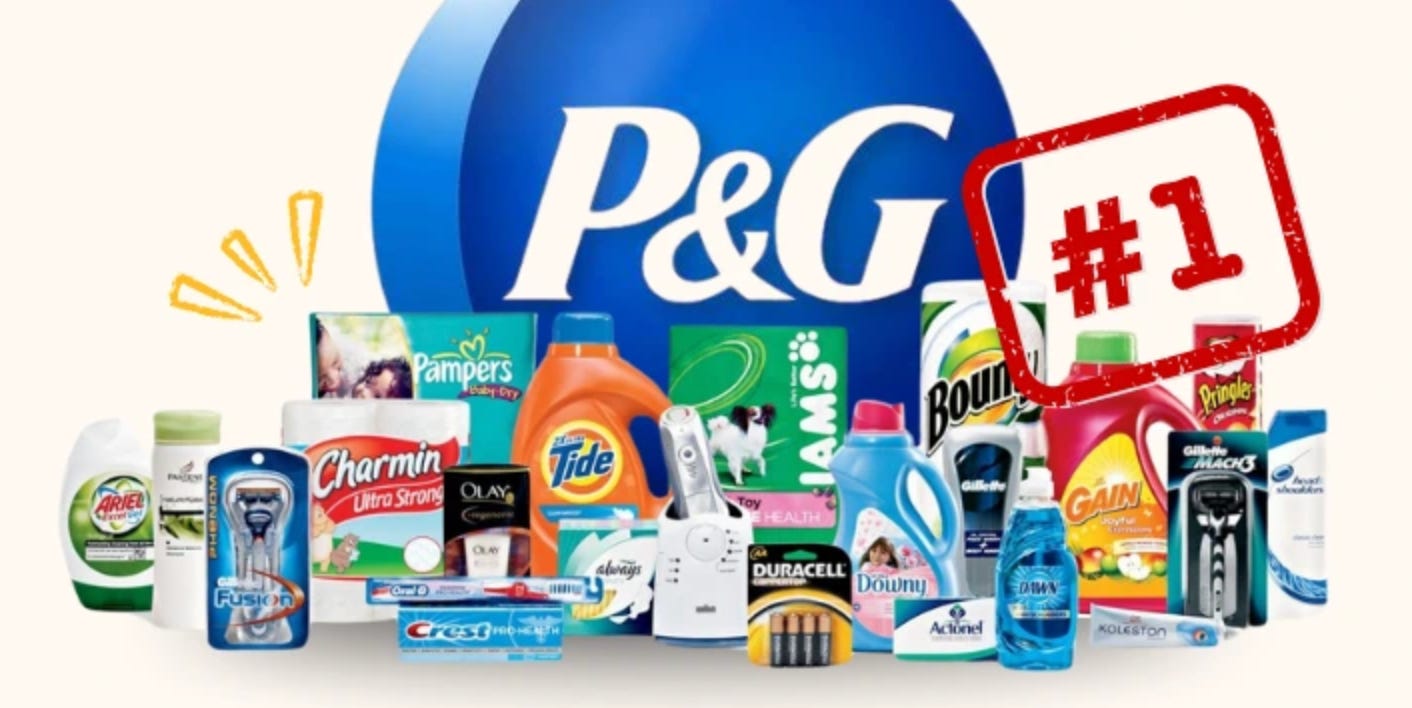
A company that already controls about sixty percent of its entire market just spent more than a decade — and a meaningful chunk of a two-billion-dollar-a-year research budget — reinventing a product that already worked perfectly well. And then it had the nerve to charge you nearly double for the new version.
Your gut says that’s insane. Or worse, that it’s a con. I’m going to argue it’s neither. It may be the single smartest thing happening in American business right now. And once you see how the machine actually works, you will not walk down the detergent aisle the same way again.
The company is Procter & Gamble. The product is Tide. The new thing is a laundry tile — a flexible three-inch white square that feels like a little pad of fabric, called Tide evo. And here’s the detail that ought to make every Coloradan sit up: they test-marketed this thing right here, starting in 2024. You and I were the lab rats. We just didn’t know it.
First Let’s Defend P&G
I want to steelman P&G before I lay a glove on them, because their case is genuinely strong — stronger, frankly, than the cynics in the comment section give them credit for.
P&G teaches every new hire a single mantra on day one: if anybody is going to disrupt a business we’re in, it had better be us. This isn’t some recent MBA-deck slogan. The grandson of one of the founders ran the company a hundred years ago and said the same thing about soap — that if somebody was going to replace the soap business, it had better be Procter & Gamble, because the competition was working hard to do it and P&G needed to get there first.
And they have lived it. In 1946, as they were about to launch the original Tide, somebody warned the CEO that the new product might cannibalize sales of the company’s own two existing detergent brands. His answer was two words: Go ahead. They knowingly ate their own lunch. Over the next ten years, their earnings tripled.
Underneath all of it sits a theory I find genuinely fascinating. P&G’s chief innovation executive — a man who’s been there nearly forty years — describes every consumer product as riding an S-curve: introduction, growth, maturity, decline. He says most products peak around fourteen years and then begin to die. Which means even a product selling beautifully is already on the clock. A dominant brand isn’t a fortress. It’s a melting ice cube.
Listen to how this man thinks. He says if P&G were in the chocolate business, they wouldn’t just hand you a low-sugar candy bar. They’d invent a “cocoa chewable gummy you never thought was possible.” Read that twice. He is not trying to satisfy a demand that exists. He is trying to manufacture a desire you do not yet have.
How? Here’s the part that’ll stay with you. At P&G’s research campus in Mason, Ohio, there are rooms with two-way mirrors, and researchers in lab coats sit behind the glass and watch people in bathing suits take showers — counting how many pumps they take from the shampoo bottle, watching how they react to the suds. They have studied human beings doing laundry so closely that they have catalogued more than fifty separate steps a person goes through to wash a single load.
Fifty steps. To do laundry. Somewhere there is a scientist with a doctorate and a parking space who owns step number thirty-one.
So that’s the defense, and it’s formidable. These are not fools chasing a gimmick. This is the most sophisticated persuasion operation on the face of the earth, and it is pointed directly at your hamper.
But Let’s Ask Questions
Because there’s a question P&G’s own people can’t quite answer. A consultant quoted in P&G’s own coverage — someone who openly admires the engineering — admits she can’t figure out what problem the tile actually solves. It isn’t obvious, she says, which unmet need it uniquely fixes. Especially at roughly double the price of pods.
Double. Let’s do the arithmetic, because I’d rather have a real number than a feeling. A box of 42 tiles runs $19.99 — about 47 cents a load. A tub of 42 pods runs $12.99 — call it 31 cents. You are paying a fifty-percent premium for the privilege of washing your clothes with a square instead of a blob.
And what did the earliest customers ask for? Go read the reviews. They are begging for perforations — so they can tear the tile and use less. Sit with what that means. For seventy years, liquid detergent gave you the one thing the pod and the tile quietly take away: control. You decide the dose. Big load, more soap. Light rinse, less. The great forward march of innovation handed you a fixed portion and called it progress.
And the green pitch — the lighter cardboard box, the smaller footprint, save the planet? A sharp-eyed customer noted the tiles are still made of the same polyvinyl alcohol as the pods, the stuff most water-treatment plants can’t actually break down. Into the waterways it goes, tile or pod.
So by now you’re sure you’ve caught them. It’s a racket. Marketing in a lab coat.
And here’s where I surprise you
It isn’t.
The research firm tracking the Colorado rollout found something it called “highly incremental.” In plain English: people didn’t switch from pods to tiles. They added tiles. They kept the liquid for the everyday wash and bought the tile for the curtains and the couch cushions. The market didn’t shift from one product to another. It grew. P&G didn’t carve a bigger slice out of the pie. They baked a bigger pie.
Nobody got tricked. P&G manufactured a desire that did not exist on Monday, and by Friday enough of us had decided it was real that there was suddenly a brand-new market worth millions. That is not fraud. That is the engine of a free economy doing precisely what it was built to do — and doing it better than anyone else alive.
This is the part the “what a scam” crowd and the “tax the greedy corporations” crowd both miss, and they miss it for the same reason: they assume that if a company profits from a desire, the desire must be fake and the customer must be a victim. But nobody held a gun to a single Colorado shopper. The people who bought tiles looked at 47 cents a load, looked at the convenience, and decided — freely, individually — that the trade was worth it to them. The ones who didn’t, didn’t. The market is just the running tally of millions of those private verdicts. No central planner could have told you in advance whether the laundry tile would live or die. Only we could. And we did it one cart at a time.
What Does It Mean?
The wheel did not need reinventing. It rolled fine. It rolled fine for seventy years. And we went out and bought the new one anyway — at 47 cents a load — because the best-funded, most patient, most scientifically rigorous persuasion operation on planet Earth spent ten years and a slice of two billion dollars a year quietly deciding that you and I needed something we never once asked for.
And the kicker — the genius of it — is that you’ll only ever discover your detergent needed improving because they told you so.
So before you file this under “soap” and move on, go look at the rest of your house. The toothpaste with the new microbeads. The razor that somehow grew a fifth blade. The phone that is mysteriously new every September. The car trim package you didn’t know was a tier until the salesman named it. Same machine. Same fourteen-year clock. Same relentless, brilliant, faintly unsettling engine, humming away behind every ordinary object you own.
It was never really about the laundry.
Heckuvajob is reader-supported. If this made you look sideways at your own pantry, forward it to the person in your life who reads detergent labels.