

Leash the Dog. Holster the Gun
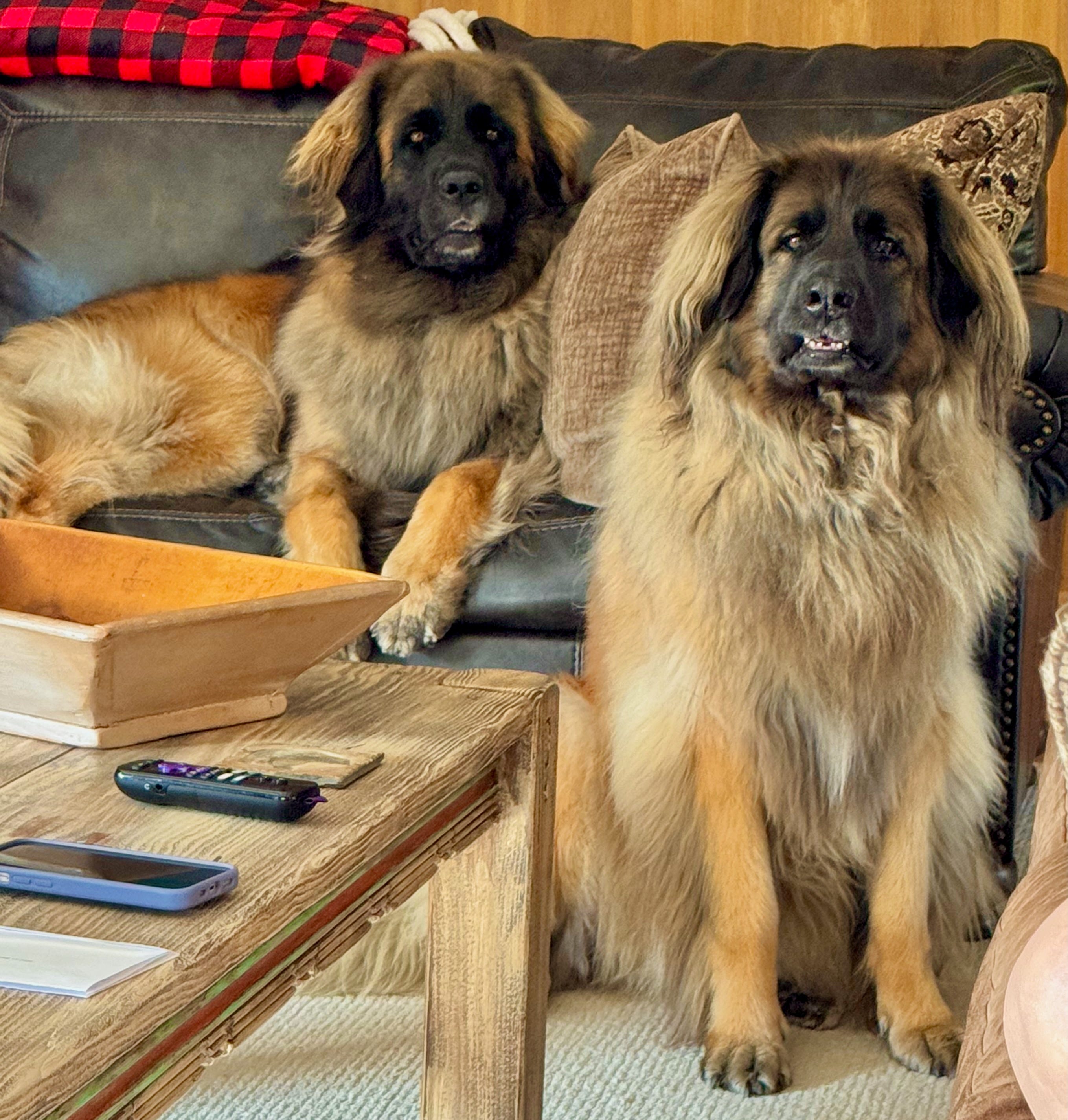
Lina (left, the teenager) and Greta, (right, the matriarch). My two Leonbergers.
It was a Saturday afternoon in late June 2019, in Loveland.
Wendy Love and Jay Hamm deliver firewood for a living. They pulled their truck into an empty business parking lot because the icebox was acting up. Their three dogs could use a few minutes out of the cab.
Bubba, 16 years old, does what 16 year old dogs do. He stretched out on the pavement and did nothing. The life of a 16 year old dog.
Herkimer was a pup. 14 months old, a Staffordshire bull terrier and boxer mix. He was resting in the truck.
The owner of the business called the police. There was a truck in his lot after hours, and he wanted somebody to check on it. Loveland Police Officer Mathew Grashorn rolled up, parked several yards away, and stepped out of his car.
Bubba heard the door. The old dog got up and started toward the stranger. Officer Grashorn drew his gun and pointed it at him. Ms. Love and Mr. Hamm called Bubba back.
Bubba did exactly what you want a dog to do. He turned around. He went back to his people.
The commotion woke the pup. Herkimer came out of the truck, darted toward Bubba, and then ran toward the officer. The lawsuit says his tail was wagging. City of Loveland claims “he charged.”
He only got within a few feet. Officer Grashorn fired twice. One round hit Herkimer in the head. The other hit him in the body.
Stand where Wendy Love was standing. Your dog is down. He’s paralyzed. The man who shot him is screaming at you.
“Get back to the truck.”
“Please let me see him.”
“Get back to the truck.”
She went to her pup anyway and cradled him on the asphalt. The officer warned her, “He will bite you, he’s hurt.” Video never shows Herkimer biting anyone.
When Mr. Hamm demanded to know why, Officer Grashorn said he had “no way of knowing” whether the dog was friendly and that he “wasn’t in the business to get bit,” according to the lawsuit.
Herkimer lived 4 more days, in intensive care. Then his owners made the decision nobody who has ever loved a dog wants to make.
Then the system went to work on Mr. Hamm. He got a ticket for owning a dangerous dog, the pup. Yes, the DA wisely dismissed that charge. Why it was brought in the first place, I don’t know. Nobody was cited for trespassing. Nobody was charged with anything. The Loveland Police Department reviewed itself and found the shooting justified.
Case closed.
Or so the city thought.
A doctrine you won’t find in the Constitution
In 2021, Ms. Love and Mr. Hamm sued. Their theory was straightforward. When a police officer shoots your dog, the government has seized your property. The Fourth Amendment requires that seizure to be reasonable.
Officer Grashorn answered with the standard defense of qualified immunity. Lawyers know the doctrine well. Most everyone else learns about it the hard way. Judges created this doctrine. It appears nowhere in the Constitution and nowhere in the civil rights statute Congress passed after the Civil War. It essentially claims that a government employee cannotdd be sued personally unless the right he violated was “clearly established.” In practice, if no court has told police that this particular conduct is illegal, the officer walks.
A federal judge in Denver watched the body camera video and refused to let him walk. A jury, the judge said, could find Officer Grashorn was in no real danger and had time to consider non-lethal options.
Officer Grashorn appealed to the United States Court of Appeals for the Tenth Circuit, which sits in Denver. On April 22, 2025, a three-judge panel affirmed. Judge Robert Bacharach wrote that “common sense should have alerted police officers that they couldn’t shoot a pet dog in the absence of an immediate danger.”
Officer Grashorn took it to the Supreme Court of the United States. In January of this year, the justices declined to hear it.
This past June, the City of Loveland agreed to pay $675,000. Sarah Schielke, the couple’s attorney, says that is the largest settlement in Colorado history for a police killing of a pet. Every active Loveland officer must now take dog-encounter and de-escalation training every three years. State law, according to reporting on the settlement, otherwise requires that training only once. Ever.
A word of precision, because I’m a lawyer and can’t help myself. No jury ever found Officer Grashorn liable. The case settled. The city admitted nothing, and its statement still says the dog charged.
The ruling will outlast the check. A published Tenth Circuit opinion binds the federal courts in Colorado, Wyoming, Utah, Kansas, Oklahoma, and New Mexico. An officer in any of those states who shoots a dog posing no immediate danger will have a hard time telling a judge nobody warned him.
The footage belongs to whom?
Now go east. In October 2024, Lydia Nikac, a professional dog trainer in North Carolina, caught a man breaking into her car and called 911. Her two Belgian Malinois, Bonnie and Clyde (I love that naming protocol as I once had two St. Bernards named Abercrombie & Fitch), demonstration dogs for her training business, had the suspected car burglar, down in her yard and were circling him.
North Carolina State Highway Patrol Trooper Justin Maness arrived. The dogs barked at him. Court records, as described by the Raleigh News & Observer, say Ms. Nikac asked him to stay off her property until she could call the dogs to her. He told her to control them. On the dash camera, according to the paper, he says that if a dog comes over to him, he’s going to shoot it. Ms. Nikac says Clyde trotted toward him. The trooper opened fire and killed both dogs.
The North Carolina State Highway Troopers Association calls it justified self-defense.
You’d think this is where it becomes Loveland all over again. The camera rolled. Let everybody see.
Not in North Carolina. Under a 2016 state law, police body camera video isn’t a public record. You need permission from a judge. A judge let Ms. Nikac see the footage of her own dogs being killed and then ordered her not to share it. Earlier this month, the North Carolina Court of Appeals unanimously upheld that order. She’s free to talk about what’s on it, the court said. She just can’t show you what’s on it.
She posted it anyway, on YouTube. That may put her in contempt of court. She did it anyway. And knowing the risks of contempt, I say good for her. The North Carolina legislature needs to repeal that law hiding body cam footage from the public without the permission of a judge.
In Colorado, the body camera is the very reason Ms. Love and Mr. Hamm won. Every judge who touched the case watched the same footage. In North Carolina, the state shot the dogs, owns the camera, and decides whether you ever see what it recorded. We were told body cameras were there to protect us. In North Carolina, the footage belongs to the people who fired the gun and not the people who pay for the body cam and the footage. That is just wrong.
The part dog owners would rather skip
Now let me say the thing half of you are already typing in your head.
Where was the leash? Why weren’t any of these dogs leashed?
Fair question. Look at Loveland again, this time from the officer’s side of the lot.
A business owner calls about a truck in his parking lot after hours. That’s somebody else’s private property. The officer arrives to check it out, and an unleashed dog is coming at him. The owners call it back. Good. Then a second unleashed dog he hadn’t seen comes out of the truck and keeps coming while the owners are calling.
Larimer County’s animal control ordinance speaks to exactly that. A dog off its own owner’s property is “at large” unless it’s on a leash, or it’s with a person and it “at all times immediately” responds to that person’s command. Immediately. At all times. Sixteen year old Bubba met that standard. Solely on the officer’s account, Herkimer the pup didn’t.
Officer Grashorn’s lawyers made that argument. Herkimer wasn’t leashed and didn’t obey, so he was at large, so this one is on the owners. The Tenth Circuit didn’t decide thatd. On that kind of appeal, the court had to take the facts as the trial judge found them, and the trial judge found the owners were right there and had just called off one dog. A jury, the court said, could conclude Herkimer wasn’t at large at all.
That’s the legal answer. Here’s mine.
I own two Leonbergers. If you’ve never met one, picture a lion that decided to become a golden retriever and overshot the size by a wide margin. They are gentle, goofy, and enormous. I also know exactly what one of them looks like galloping toward a stranger. It looks like a hundred-plus pounds of trouble, no matter how hard the tail is wagging.
Every dog owner in Colorado has heard it on a trail. A dog comes barreling around a bend, and from somewhere far behind, a voice yells, “He’s friendly!” Maybe he is. The jogger has no way of knowing, and neither does the mom pushing a stroller or the mail carrier halfway up your driveway. A police officer walking into a strange parking lot on a trespass call has even less reason to assume the best.
The Centers for Disease Control and Prevention has long estimated that dogs bite about 4.5 million Americans a year, and that roughly 800,000 of those bites need medical care. Every one of those dogs had an owner.
So yes. Ms. Love and Mr. Hamm let three dogs out, unleashed, in somebody else’s parking lot. That was a choice, and it had a cost.
Ms. Nikac’s case is different, and the difference matters. Her dogs were in her own yard, holding a man who had just broken into her car, and she was the one who called for help. Even so, two trained Malinois working a suspect are a lot for an armed stranger to walk into. She was telling him to stay back. He was telling her to get her dogs. Then the shooting started.
Here’s where I land, and it’s where the law lands too.
An owner who lets a dog run loose has broken a rule. In Larimer County, the first-offense penalty for a dog at large is $40. Herkimer’s penalty was two bullets.
The Fourth Amendment doesn’t ask whether the owner was careless. It asks whether the officer faced an immediate danger when he pulled the trigger. A loose dog raises the odds of a bad encounter. Whether the shot was justified still turns on what that dog was doing in the few seconds before it was fired.
Personal responsibility runs both directions. Leash your dog. And if you carry a badge and a gun on the public’s behalf, get trained, learned to read a dog.
Three seconds and “no way of knowing”
Officer Grashorn’s lawyers made the point 14 times in their brief to the Tenth Circuit. He had 3 seconds. Three seconds to decide whether the animal headed his way was a goofball or a biter. Police organizations from California to Michigan filed a brief urging the Supreme Court to take the case and side with him. The trial judge even noted that Herkimer looked like a pit bull, a breed widely perceived as dangerous, though the parties dispute what he was. He was a full-grown dog. No calendar puppy.
I take that seriously. I’ve been on the government side of the table, and I know what it feels like to have a few seconds of decision-making picked apart for years by people who weren’t there.
But listen to what the officer said that day. He had no way of knowing.
That’s the problem in four words. Knowing is the job. Reading a dog is a skill, and skills can be taught. Colorado was one of the first states to require dog-encounter training for officers, and Texas followed in 2015. The Animal Legal Defense Fund, which lobbied for the Texas law, says police shootings of dogs there fell by more than 90 percent afterward. That’s an advocacy group grading its own homework, and a 2017 Austin American-Statesman report found no official statistics behind it. Cut the claim in half and it still tells you something. Most of these shootings are training failures. Fixable ones.
And the 3 seconds? The trial judge called it “debatable” whether Officer Grashorn had enough time to respond differently. The plaintiffs argued he could have stepped back into his patrol car. He had two owners standing right there, one dog that had just obeyed, and a young dog its owners say was wagging its tail. The Tenth Circuit said a jury could weigh all of that and conclude he wasn’t in danger. That’s a jury question. Juries exist for exactly that.
Nobody is counting
Step back from that one parking lot. The visible villain in this story is one officer. The predicate problem is that nobody is counting.
How many dogs do police shoot in America each year? Nobody knows. No federal law requires reporting. There’s no national database. The figure you’ll see everywhere, 25 to 30 dogs a day or roughly 10,000 a year, traces back to an estimate from a single specialist in the U.S. Department of Justice’s Office of Community Oriented Policing Services. Not a study. An estimate. It might be low. It might be high. Your government can tell you how many miles of highway it repaved last year. It can’t tell you how many family dogs its own officers shot.
And when it goes wrong, who pays? Loveland paid. Which means Loveland taxpayers paid. $675,000 of your money, if you live up there. Officer Grashorn’s own wallet, so far as anyone has reported, stayed closed.
The city has been here before. In 2021, Loveland paid $3 million to settle with Karen Garner, a 73-year-old woman with dementia who was taken to the ground and arrested by Loveland officers in 2020 after walking out of a Walmart with $13.88 worth of merchandise she hadn’t paid for. Her lawyer? Sarah Schielke.
Follow the chain. No count means no pattern. With no pattern, every department treats every shooting as a one-off. A one-off never justifies recurring training. Qualified immunity keeps the officer’s own money out of it. The taxpayers write the check. Nobody in that chain has a reason to change anything until a lawyer drags it through five years of litigation.
I’ll own something
For years, a lot of us heard “cop shoots dog” and turned the page. Sad. Just a dog. Cops have hard jobs. Next story.
Which side of the line
Ms. Love says the fight was always about protecting other dogs. I believe her. Nobody spends 5 years in litigation over a 14-month-old dog for the money.
Here’s where things stand. In Colorado and the rest of the Tenth Circuit, an officer who shoots your dog without an immediate danger can be held to account. In the Fifth Circuit, which covers Texas, Louisiana, and Mississippi, the New York Sun reports that a New Orleans officer kept his immunity this summer even after a jury found he violated the Constitution by shooting a 16-week-old puppy named Apollo. In North Carolina, you may not even be allowed to show anyone what happened.
Same Constitution. As Ms. Schielke put it, your dog’s protection depends on which side of a state line you’re standing on.
Go back to that parking lot one more time. An old dog came back when his people called him. A young one didn’t. That part is on the owners. A man with a gun had three seconds and used them to fire. That part is on him. Then he told a woman holding her dying dog to get back to the truck.
Leash your dog. And expect the officer to know the difference.
Tell me in the comments, and explain why: when a loose dog and a police officer meet, how much of what happens next belongs to the owner, and how much belongs to the badge? And if you’ve lost a dog this way, tell me what happened.
Sourcing and Verification
• Court record: Love v. Grashorn, No. 23-1397 (10th Cir. Apr. 22, 2025), opinion by Judge Robert Bacharach, joined by Judges Matheson and Federico. Facts about the after-hours call, Herkimer’s approach, the “three seconds” claim, the “debatable” finding, the pit bull note, and the at-large argument come from the opinion. ca10.uscourts.gov/sites/ca10/files/opinions/010111223552.pdf
• Supreme Court: certiorari denied, Grashorn v. Love, No. 25-216 (Jan. 12, 2026). Amicus brief by police organizations supporting Officer Grashorn is on the Supreme Court docket.
• Scene details (”Get back to the truck,” “Please let me see him,” “He will bite you, he’s hurt,” shots to the head and body, no bite on video, fourteen references to three seconds in the officer’s brief): Colorado Politics and the Denver Gazette, Sept. 30, 2022, and Apr. 22, 2025, reporting from the court record.
• Officer Grashorn’s statements and Herkimer’s death four days later: the lawsuit as reported by Reason, Aug. 27, 2021, and June 16, 2026.
• Settlement: $675,000, finalized June 2026, with recurring dog-encounter training. Reason; Police1 citing CBS Colorado and the Loveland Reporter-Herald.
• Dangerous-dog ticket and dismissal; Colorado’s one-time training requirement; the Fifth Circuit “Apollo” ruling: New York Sun, Oct. 2026.
• Larimer County Animal Control Ordinance, Secs. 6-1 (”at large” and “under restraint” definitions), 6-76 (dogs at large), and 6-151 (penalties), as posted at larimer.gov. The Tenth Circuit noted the county ordinance but said the case did not involve its enforcement.
• Nikac case: Reason; WRAL; News & Observer, October 2026.
• Dog-shooting estimate: the Justice Department’s Community Oriented Policing Services specialist’s estimate, as reported by Police Magazine, Criminal Legal News, and others. No official national count exists.
• Texas training claim: Animal Legal Defense Fund. Counterpoint: Austin American-Statesman, Mar. 17, 2017.
• Dog-bite estimate: Centers for Disease Control and Prevention, dog bite prevention guidance.
• Karen Garner settlement: Loveland’s $3 million settlement, 2021, as reported in Colorado coverage.
• Corrections and tips: michaelbrown@iheartmedia.com
You know something, I have had enough of police and law enforcements militia style tactics in policing our communities. This is a horrific story. Out of curiosity, what is the demographic of these officers involved in this type or any shooting? Ahh, I can answer that without any further research. I can tell you this, any engagement with law enforcement should be, I do not make statements without my lawyer present, even for a traffic stop. Remember, these agencies often implore the public for help. Really? The problem is not the dog, but this machismo and superiority complex of police and the municipalities that keep bailing them out. I have an alcohol license and drive a lot. I do not get stopped much at all, once in the last 10 years., twice in 20 years. First question from the stopping officers, have you been drinking? That says it all. Police are on the HUNT, my dogs and I will not be HUNTED.
Definitely sad experiences here. I can emphasize with both sides believe it or not. I definitely agree with dog owners keeping their dogs leashed. But, that's not the total answer. I'll tell you why.
I have lived in apartments most of my adult life. And, within the last 15 years there have been very disturbing changes and problems occurring in these communities. And, I have lived in both low income abd "luxury" style communities. One change has been landlords allowing large breed dogs to reside in the communities. Another major change has been the increase in the use of cannabis.
Many of these dogs owned by tenants are kept cramped up in a barely 500sqft apartment. Some have a balcony. If the tenant works, as many do, that dog only sees the outside for maybe 3 minutes, maybe 5, twice a day. Or, if the owner decides the dog is being a nuisance it gets stuck out on the balcony. There's no daily walks even if there's nice open fields nearby. Not even on the owner's days off or on holidays. The owner's then sit on their butts smoking cannabis watching a flat screen, playing video games or on the internet. This is their idea of having a pet. There's also no training that the dog is enrolled in.
Over and over and over and over again I have seen and been terrified of extremely vicious dogs within these communities owned by such tenants. Only once have I seen a well-behaved dog. That was back in 2020. It was a large black Labrador. It could actually sit outside unleashed with its owner and not move a muscle if someone walked nearby. However, that is not the case of virtually every dog I have encountered in these communities.
I can understand why the police can be very leery of unleashed dogs. Every time I have to call the police about something the one question the dispatcher will ask is "Are there any large dogs?". And, after all these years of what I have experienced myself I can understand why.
But, yes, shooting a dog that is clearly acting friendly is horrible to hear about much less for its owner to witness.
My take is not only should dog owners keep their dogs leashed when outside but get it trained and for crying out loud get off your butts, air out your frickin apartments, and get your dog some exercise.
As for the picture of your dogs, Michael, they could be unsettling to encounter at first. But, they look in this picture much like that black Labrador I mentioned. They're relaxed but alert, too.