

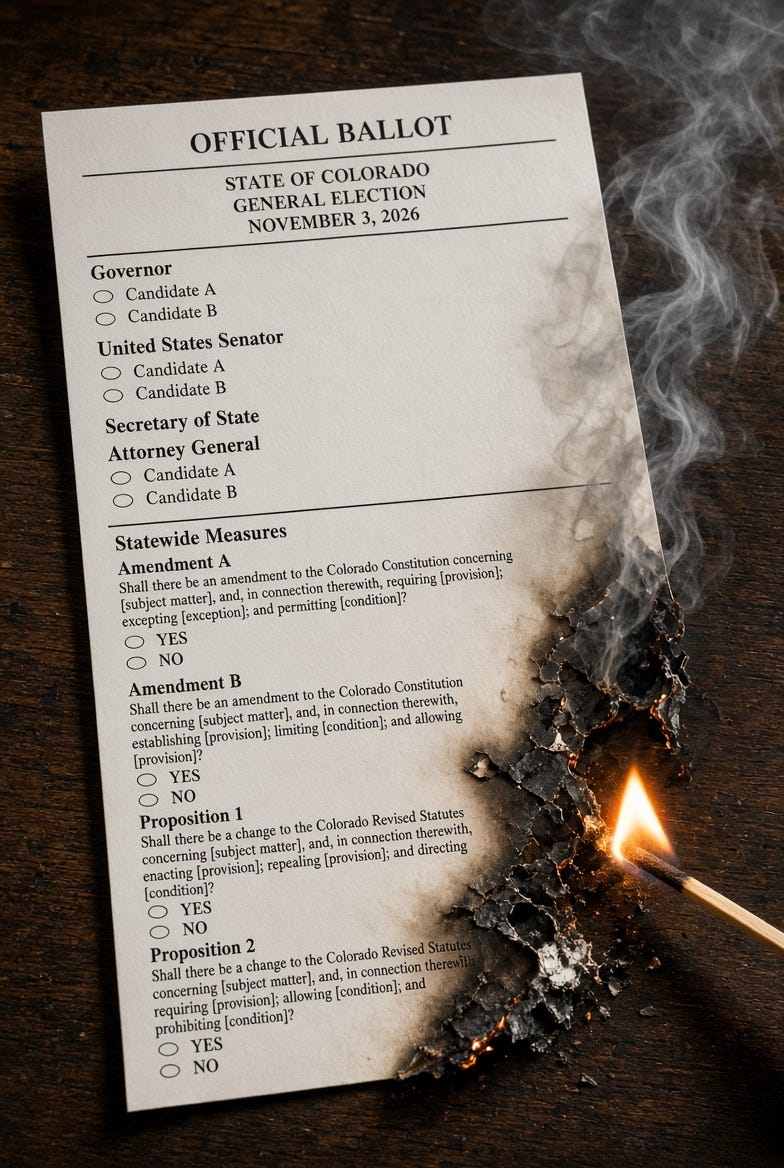
Fourteen statewide measures. That ties the Colorado record. Add a U.S. Senate race, eight congressional seats, attorney general, secretary of state, treasurer, and a pile of local questions long enough to make you miss the one-page ballot.
Mandy Connell sat down and worked through all of it. Every statewide measure. Every race that matters. She linked each measure to its source so you can check her work instead of taking her word for it. Then she did something I wish more people writing voter guides would do. She told you, right at the top, that you might not agree with her.
I don’t. On a few.
On the rest, and that’s most of it, she saved me a weekend. I probably owe her lunch.
Read her guide here: Mandy Connell 2026 Election Guide. Read it on her page. Subscribe to her Substack while you’re there. She asked people to share it, and I’m doing my part. Wait, maybe she owes me lunch for that ask (but then I’d have to be seen in public with her, and might gain some fans, or stalkers, or both!)
Where I part company, and where I pile on
She invited it right at the top of her guide. That’s the right spirit, so I’m borrowing it.
Four items. One where we split outright. One where we vote the same way for different reasons. Two where I’d go further than she does.
Amendment 83: Yes. Nose held.
Mandy and I end up in the same place on this one. We come in through different doors.
I hunt. I fish. I wrote a whole piece on this amendment, The Racket I’m Voting For, and I’m still voting yes. I’m also still holding my nose.
Here’s where Mandy and I split. She says it leaves all the current rules and regulations in place. I’m less certain. The amendment protects hunting by “traditional methods” and never says what that means. In 1996, Colorado voters banned leghold traps, body-gripping traps, snares, and poison, and they wrote that ban into the Constitution. Amendment 83 drops a second line into the same document pointing the other way. A leghold trap is about as traditional as it gets. Which line wins? A judge decides.
Follow the money. The dollars come out of Wisconsin, and the man running the campaign says the real power of these amendments lies in the case law they create. You create case law by litigation. That’s the objective of the financial backers of this amendment. The receipts are in my earlier piece.
So why yes? Because the next governor appoints the Parks and Wildlife Commission, and everyone expects that governor to be Phil Weiser. I’d rather have a speed bump that might not hold than no speed bump at all.
Governor: No pick. Vote anyway.
Mandy isn’t endorsing. Neither am I. She’s right about Weiser. She’s also right that when this goes badly for Victor Marx, the finger-pointing will aim everywhere except Marx’s own mirror and the party’s.
I’d add one thing. Don’t skip the race. We all know who wins it. The number at the bottom of it is what matters.
Go back to 2010. The Republican nominee was Dan Maes, a first-time candidate who came out of a messy primary and then watched his own party walk away from him. Tom Tancredo ran on the American Constitution Party line and pulled 36%. Maes finished with about 11%.
Eleven.
Under Colorado law, a party stays a major party only if its candidate for governor pulls at least 10% of the vote. Fall below that and the party gets demoted to minor-party status, and it stays there until the next governor’s race. During that campaign, Maes told Colorado Public Radio he flatly refused to believe any Republican could fall under 10%.
He was right. By about a point.
Eleven percent was a warning. The party filed it and moved on.
Sixteen years later, we nominated another first-time candidate out of another fractured primary. He won it with less than 40%, a plurality. The runner-up, Barbara Kirkmeyer, said before the votes were counted that she wouldn’t support him. He skipped the first debate. The state elections division wants to fine his campaign over violations it calls “unprecedented.”
Now, what would demotion actually do? I’ve heard people say it would end the Republican primary. It wouldn’t. I checked the statute. A minor party still holds a primary when more than one candidate qualifies for an office. When only one qualifies, the assembly’s pick goes straight to November.
The real change is who gets to vote. A major party has to let unaffiliated voters into its primary. That’s Proposition 108, and the Colorado Republican Party has spent years in federal court trying to get out from under it. A minor party can close its primary to unaffiliated voters. By statute. No lawsuit required.
That’s the upside, and it’s real.
So is the price. Every Republican on every ballot would carry the minor-party label through 2028 and 2030. Major parties also get a guaranteed role in choosing election judges. For a party that has made election integrity its calling card, giving that up would be an ugly trade. And this spring a federal judge struck down the 75% vote the party needed to opt out of the primary altogether. That door may already be open, no demotion required.
So here’s where I land. I am not rooting for 9%. I’m rooting for a number low enough that nobody at GOP headquarters can call it a fluke, and a party honest enough to ask why.
Whoever you pick, pick someone. A blank line doesn’t count, and I want this count to be honest.
U.S. Senate: Mark Baisley.
This is where I really part company with Mandy.
She’s voting for Bob Chew of the Forward Party. I’m voting for Mark Baisley. Mandy thinks Baisley can’t win statewide, and she’s probably right. John Hickenlooper is going back to Washington, unfortunately, and nobody on either side seriously believes otherwise.
I’m voting for Mark anyway. He’s a friend and a good man. He did the unglamorous thing. He ran as a Republican, took the nomination, and put his name on a race he knew the math on.
Bob Chew may be a fine candidate. If he wanted my vote, the Republican primary was right there. A third-party run in a race Hickenlooper was always going to win splits the people who ought to be rebuilding the party together.
Yes, I see it. I just told you I reward candidates who run as Republicans, a few paragraphs after telling you I want the Republican nominee for governor to post a number that scares the party. Guilty on both counts. The label matters to me. I want it to mean something again.
State House and Senate: Straight Republican.
Mandy says vote Republican in every legislative race. This is the one place I’d go further than she does.
I have two Leonbergers. They’re huge, hairy, gentle, and completely indifferent to fiscal policy. If either one ran for the Assembly as a Republican, that dog would get my vote. If the other ran as a Democrat, it would lose my vote and the good spot on the couch.
Now the serious part. Democrats have held both chambers of the General Assembly since January 2019. Eight straight sessions. The House has been theirs for fourteen. In that time, your cost of living hasn’t gone down once because of anything that came out of that building, and Mandy’s right that it won’t. The fix is balance, and the only way to get balance is to vote for it, one seat at a time.
That’s the list.
Four items out of more than two dozen. Everything else, read her reasoning and decide for yourself. That’s exactly what she asked you to do.
Don’t wait on this one. Mandy’s right. This ballot takes time.
Tell me in the comments where you land, and why. And if you think Mandy’s right and I’m wrong, say so. She’ll enjoy that more than I will.
Sourcing and Verification
I keep verified fact, attributed claim, and my own inference separate, and I don’t ask you to take my word for anything you can check yourself.
Mandy’s guide. Mandy Connell 2026 Election Guide, published September 27, 2026.
Fourteen measures, a tied record. Colorado Politics, Sondermann, Sept. 19, 2026.
Amendment 83. My full analysis and sources: The Racket I’m Voting For. The 1996 trap ban is Article XVIII, Section 12b of the Colorado Constitution.
Major-party status. C.R.S. 1-1-104(22): a party’s candidate for governor must receive at least 10% of the total gubernatorial vote. Colorado Secretary of State, Major Political Parties FAQ. Minor-party status applies to every candidate on the ticket and lasts until the next gubernatorial election: Governing.
2010. Hickenlooper 51%, Tancredo 36%, Maes about 11% (Governing; official canvass from the Colorado Secretary of State). Maes’s remark about the 10% line: Colorado Public Radio, 2010 interview.
Marx. Won the nomination with 39.9%; Kirkmeyer’s pre-result statement that she would not support him: Colorado Newsline, July 9, 2026. The first debate without Marx (Aug. 27) and the proposed fine for “unprecedented” violations (Sept. 4) were reported by Colorado Newsline and 9News.
Minor-party nominations. C.R.S. 1-4-1304(1.5): minor parties may nominate by assembly, must hold a primary when more than one candidate qualifies, and may bar unaffiliated voters from that primary. Statute text; Secretary of State, Primary Elections FAQ, which also states major parties must admit unaffiliated voters.
The GOP’s primary lawsuit. Colorado Republican Party v. Griswold. In March 2026, Judge Philip Brimmer held the 75% central-committee opt-out requirement unconstitutional; in April he denied the party’s emergency request to keep unaffiliated voters out of the 2026 primary. Colorado Sun; Denver Gazette. Both outlets agree on the facts.
Election judges. Major parties are entitled to participate in election judge selection: Secretary of State, Major Political Parties FAQ.
The Legislature. Democrats flipped the state Senate in 2018 and the 72nd General Assembly convened with Democratic majorities in both chambers on January 4, 2019. The House flipped to Democratic control in the 2012 election. Ballotpedia.
My inference, labeled as mine. That a blank governor line doesn’t count toward the 10% math is my reading of the statute’s “votes cast” language. That litigation is the campaign’s objective is my reading of its manager’s own words. That a scare will push the party to restructure, and that the Legislature has not lowered anyone’s cost of living, are my opinions. Corrections and documents are welcome at michaelbrown@iheartmedia.com.
I will hold my nose and likely vote for Marx, no other reason than to keep the GOP a majority. GOP will likely keep their status by a mouse squeak.