

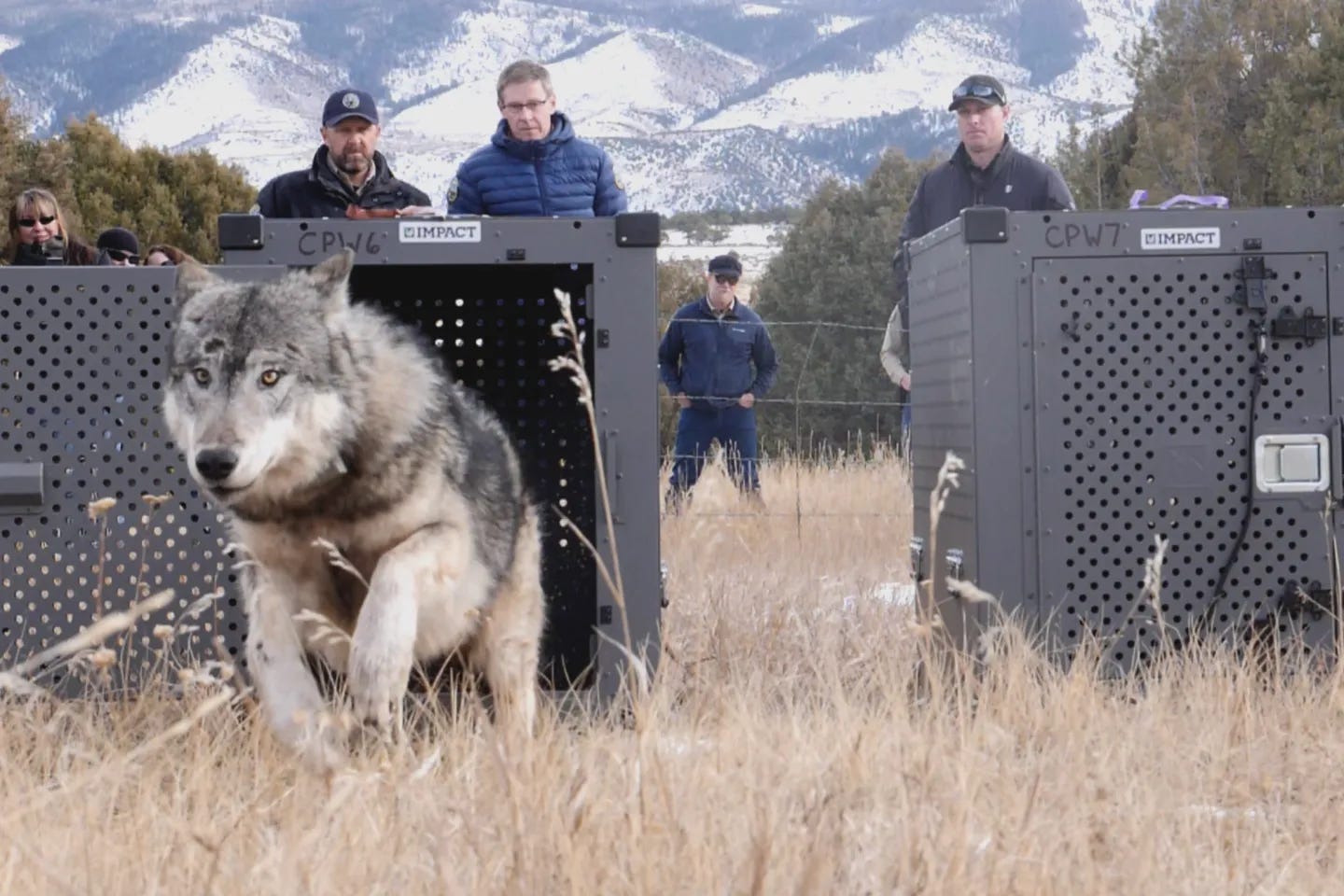
Wildlife officials release five gray wolves on public land in northwestern Colorado on
December 18, 2023. Jerry Neal/Colorado Parks and Wildlife
On January 28, a Colorado Parks and Wildlife crew went up after a wolf pack in the snow of Routt County. Routine job. The GPS collars on the pack’s two breeding adults had low batteries, and if you can’t track a wolf, you can’t manage a wolf.
They caught the mother. They caught one of her pups. Then they caught the father.
The father was 3 years old. The state had flown him in from Oregon two winters earlier, in the very first batch of reintroduced wolves. On paper he was wolf 2305. In practice he was the reason the King Mountain pack existed at all. He found a mate, fathered 4 pups, and made Colorado’s whole experiment look like it might work.
During the capture his body temperature climbed. The crew tried to cool him down. He died.
The state’s press release called it a “routine collaring operation.”
That left the mother to raise 4 pups alone. She went where the food was easy. According to a letter Susan Nottingham sent to the US Fish and Wildlife Service, the mother and her pups moved onto the hay meadows of Ms. Nottingham’s ranch, one of the largest in Colorado, spread across Eagle and Routt counties. That is where she calves 1,100 cows.
Ms. Nottingham says she had already lost calves she believes wolves killed and the state refused to confirm. The state did confirm 3 Routt County calves killed by wolves that fall. Each claim settled for $2,899.
In March, according to Ms. Nottingham’s account, one of her ranch hands saw the wolf running at cows with calves at their sides. He fired 2 warning shots. The third killed her. The shooting is under federal investigation. I won’t tell you whether it was legal, because nobody knows yet.
What do we know? The King Mountain pack lost both breeding adults in 6 weeks. One died at the hands of the state’s own capture crew. The other died on a calving ground. Four orphaned yearlings are still roaming Routt County together.
That is how a wolf pack ends in Colorado in 2026.
The newest problem
KUNC reported on November 8 that state biologists are watching wolves in 2 packs in northwest Colorado lose their hair, caught mostly on trail cameras. The state wildlife veterinarian, Dr. Peach Van Wick, looked at the photos and told KUNC the condition “does certainly look like it could be sarcoptic mange.” It is not confirmed.
Mange is a mite that burrows into the skin. The hair falls out. A wolf facing a Colorado winter without its coat is a wolf in trouble.
Confirming it requires capturing the wolves or getting good samples, and one of the packs is in remote country. Treating it is another matter. No drug is labeled for mange in wolves, so anything the state tries would be off-label, and officials haven’t yet decided whether treatment is possible or even necessary.
Notice the trap. The way to diagnose the problem is to capture and handle wolves. That is the same procedure that killed the King Mountain father in January.
The mange itself isn’t the state’s fault. KUNC reports the mite is already endemic in Colorado, and Yellowstone’s wolves have lived with it since about 2007. They’re still there.
The difference is margin. Yellowstone had hundreds of wolves to absorb a hit like that. Colorado has 45, and 20 of them were born this spring. Colorado Parks and Wildlife itself expects that count to fall by March. No new wolves are coming.
That is why a skin mite is news.
The number on the brochure
In the fall of 2020, every voter household in Colorado got the Blue Book, the ballot guide written by the Legislature’s nonpartisan staff. It tells you what each measure does and what it will cost.
For Proposition 114, the Blue Book told voters to expect this:

The same fiscal analysis added a line almost nobody read: “actual state spending will depend on the details of the plan.” Colorado Parks and Wildlife quoted that line back to its own commission in July 2025, in the same meeting where it showed how much the program had actually cost.
Here is what it had actually cost.
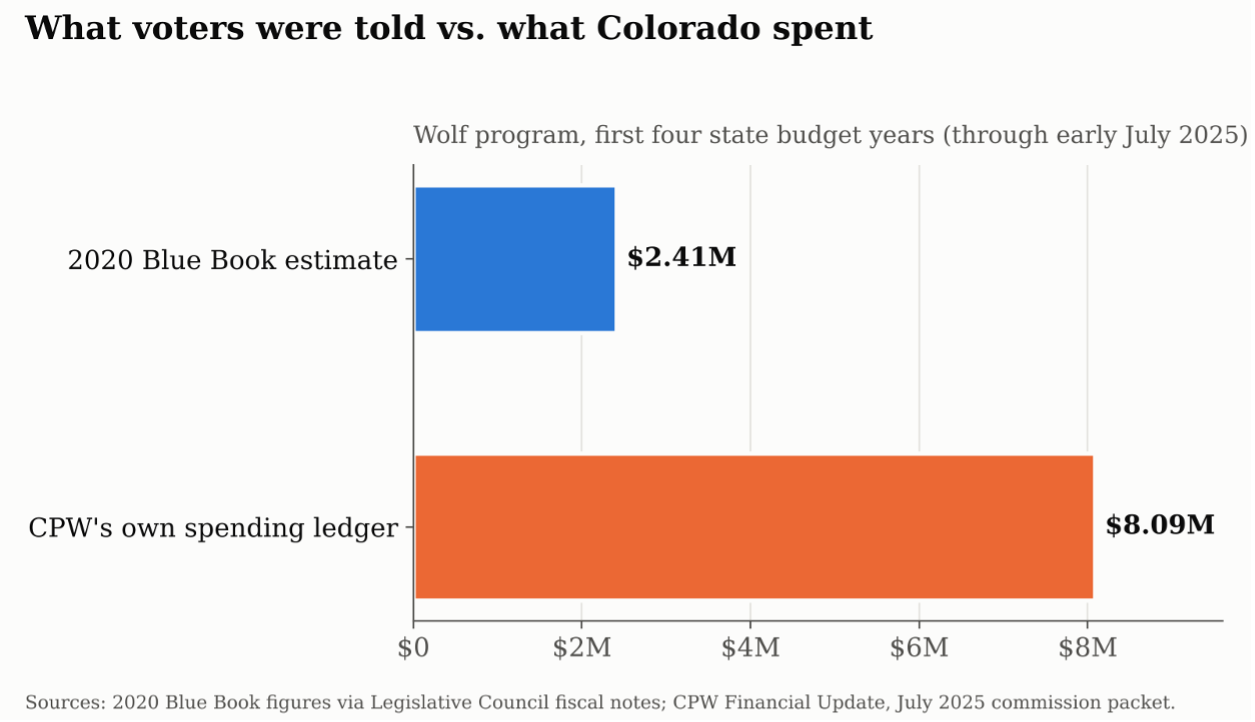
According to the agency’s own financial update, Colorado had spent $8,086,941.41 on the wolf program by early July 2025. The Blue Book estimates for those same four budget years add up to $2,411,851. That is about 3.4 times what voters were told.
The state now appropriates $2.1 million a year for wolves, up from $1.1 million at the start, raised after spending outran it. That is more than 2.5 times the promised $800,000, every year, and it doesn’t include most of what ranchers get paid for dead livestock.
How much has it cost in total? The state hasn’t published a current figure. By my math, using its own numbers, the total through June 2026 is roughly $10.9 million:
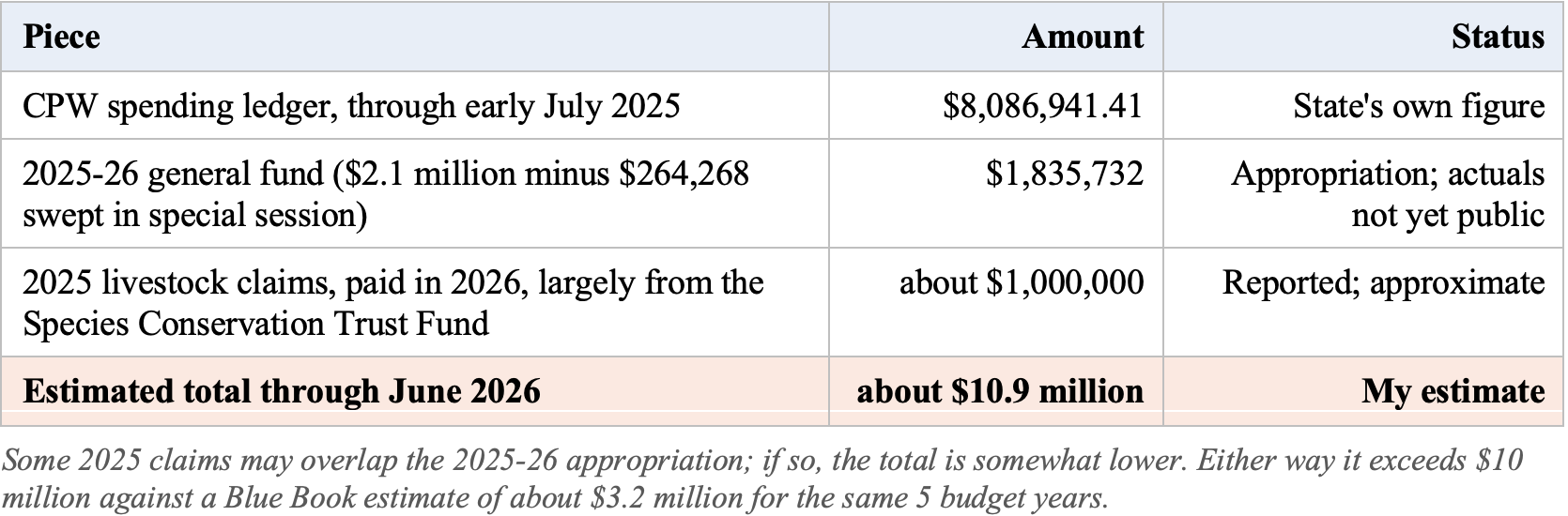
That is an estimate. The final numbers for the 2025-26 budget year should surface when the Joint Budget Committee’s staff briefs lawmakers on wolf spending this winter. Colorado Politics has independently projected more than $10 million over the program’s first 6 years. If I’m off, I’ll publish an addendum.
Where the money went
You’d expect dead cattle to be the big expense. They aren’t. The biggest line in the agency’s own ledger is payroll.
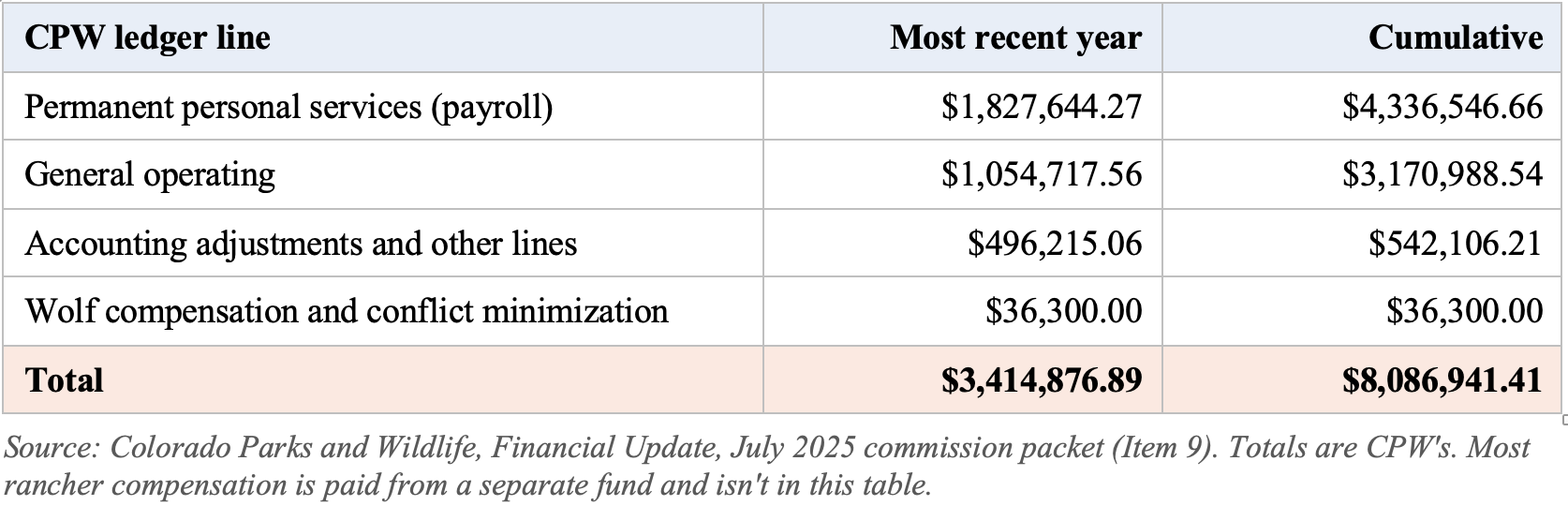
Staff costs came to $4.3 million by last summer, 54% of everything spent. The Blue Book assumed 3 new positions plus some seasonal help.
Three.
The agency has an explanation. The Parks and Wildlife Commission chose a much bigger plan than the Blue Book assumed: more public outreach, conflict-prevention staff, a range-rider program, and richer compensation rules. The agency lists those changes in the same financial update. Every one of them was a choice made after the vote, and voters never saw the new price.
One Democrat noticed. State Senator Dylan Roberts of Frisco told a legislative hearing in June 2025 that the spending seemed “out of control.”
The Legislature’s own budget staff recommended giving the wolf program its own line in the state budget “for increased transparency.” Lawmakers said no. Rep. Kyle Brown, a Louisville Democrat, said he didn’t see what they would gain. The wolf money lives in a footnote to the Department of Natural Resources budget. Footnotes, the Colorado Sun notes, aren’t legally binding.
The fund that beat the lawsuit
Proposition 114 promised ranchers “fair compensation” for livestock killed by wolves. The Legislature set up a compensation fund that receives $350,000 a year.
In December 2023, days before the first wolves came out of their crates in Grand County, two cattle groups sued to stop the release. A judge refused. According to High Country News, part of the reason was that compensation fund. It shielded ranchers, the court found, from irreparable harm.
Here is how that fund has held up.
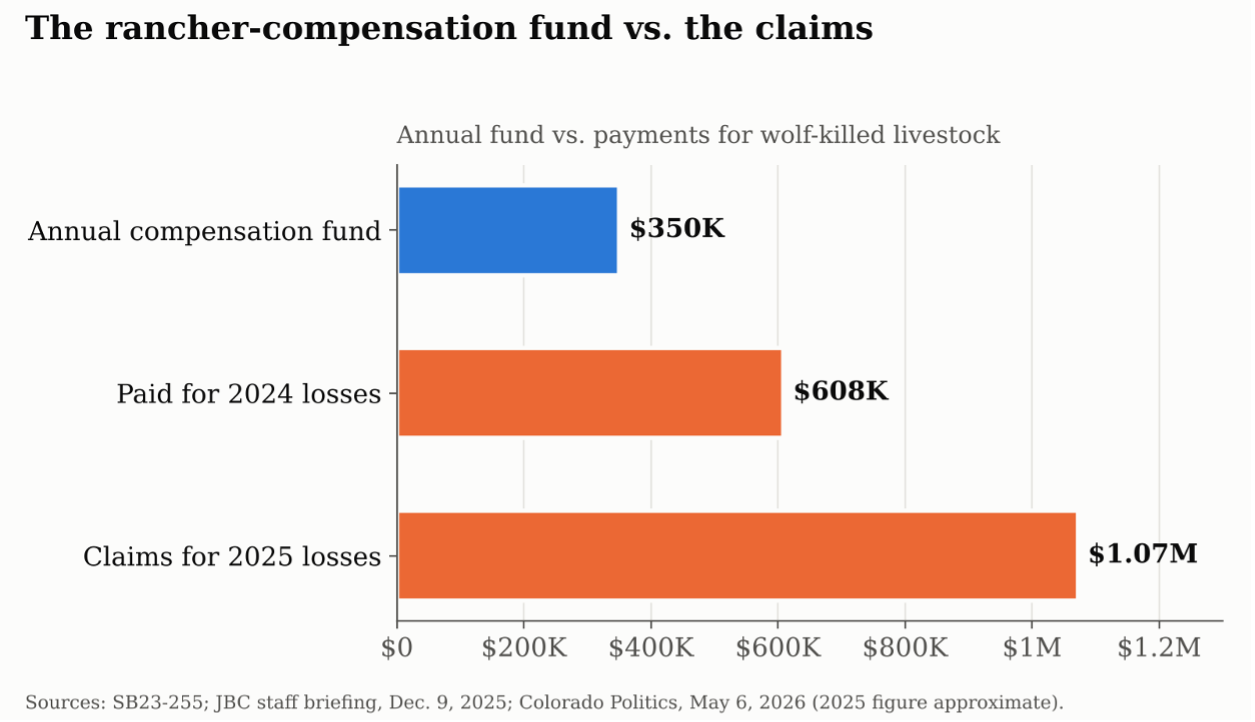
Payments for 2024 losses came to about $608,000 for 13 producers. Claims for 2025 losses came to about $1.07 million, according to Colorado Politics, though the paper’s own figures don’t fully reconcile. Call it $1 million, roughly 3 times the fund. The shortfall is being paid out of the Species Conservation Trust Fund, money meant to protect other wildlife.
A note on accuracy, because the other side will check: Colorado Politics described payouts as “nearly five times” the budgeted amount. That compares 2 years of claims against 1 year of the fund. Year against year, it’s about 3 times. Three times is bad enough.
Why are the claims so large? Colorado pays up to $15,000 per animal killed, plus a ratio payment for missing animals once a wolf kill is confirmed, plus claims for indirect losses: lower conception rates and lighter calves at sale. The indirect losses drive the big checks. One Grand County rancher, Conway Farrell, filed for about $422,000 for 2024 alone: 27 cattle killed, more than 100 missing, and more than 1,500 cows with lower birth rates and weights.
The wolf advocates now say compensation is too generous. Nineteen advocacy groups petitioned the state in February 2026 to cut it, arguing the program pays for losses beyond what wolves verifiably caused.
Remember that the generous rules were the price of ranchers’ cooperation. Now one side wants to renegotiate them after the wolves are on the ground.
Twenty-five wolves
Colorado’s management plan called for releasing 30 to 50 wolves over 3 to 5 years. The state has brought in 25: 10 from Oregon in December 2023 and 15 from British Columbia in January 2025, at a capture-and-transport cost of about $257,000 for the Canadian group.
Thirteen of the 25 are dead, according to Denver7’s running tally. Colorado Politics had to correct its own count from 14 to 13, which tells you how hard this is to track.
How they died:
• One was shot by a hunter who mistook her for a coyote. He was cited and not charged further.
• One was killed by federal Wildlife Services agents in Wyoming for killing sheep. Others wandered into Wyoming and died there.
• One died in a legal foothold trap.
• Some were killed by mountain lions. At least one was hit by a car.
• The Copper Creek pack’s original male died of a gunshot wound suffered before the state captured the pack in 2024.
• One died in the January collaring operation. One died on the Nottingham calving ground.
• Several deaths remain under investigation.
On top of those 13, the state has killed 5 young wolves born in Colorado since April 1 of this year for repeated attacks on livestock.
The state’s plan includes a tripwire. If wolf survival falls below 70%, the agency reviews its protocols. Adult survival for the year ending March 31, 2026, came in at 61%.
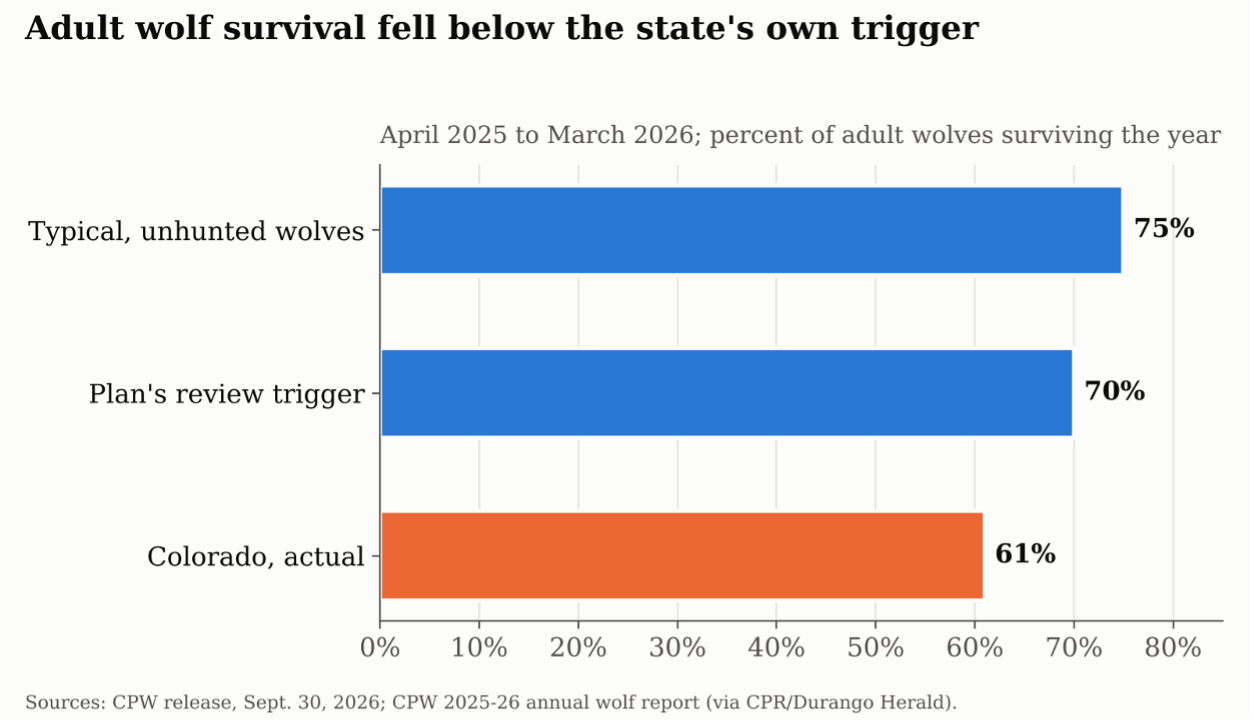
The agency reviewed its capture, transport and release procedures and concluded that none of the deaths traced to them and further review “was not warranted.”
That is their rule. They wrote it.
The agency’s answer is that translocated wolves behave like young dispersers striking out on their own, and those wolves die at high rates everywhere in the West. Maybe so. But that was known when the plan was written. The 70% trigger was supposed to account for it.
No more wolves
Last winter, for the first time, Colorado brought in no wolves at all.
Montana, Idaho and Wyoming declined to provide wolves back in 2023. Oregon, which supplied the first 10, has since said no. Washington State’s wildlife commission rejected Colorado’s request in November 2025. The Confederated Tribes of the Colville Reservation in eastern Washington opted out after tribal nations in Colorado objected. By Colorado Politics’ count, 5 of the 6 states in the federal sourcing region have refused.
Then came Washington, DC. In October 2025, US Fish and Wildlife Service Director Brian Nesvik barred Colorado from sourcing wolves outside the northern Rockies, which paused the state’s contract with British Columbia. On December 18, he threatened to revoke Colorado’s authority over its wolves entirely unless the state produced a full accounting of its program within 30 days. Colorado complied. In April 2026, the Service opened a formal review in the Federal Register.
Here is the part wolf advocates are right about. The Colorado Sun obtained a February 2024 letter showing the Fish and Wildlife Service, under the Biden administration, had approved Colorado’s plan to get wolves from Canada. The Trump administration reversed that position. The goalposts moved.
That doesn’t rescue the program. Montana, Idaho and Wyoming said no before anyone in the current administration was in office. A program that depends on neighbors who don’t want to give you wolves was always going to run short of wolves. That was knowable in 2020.
None of that stopped the agency from asking the Legislature in March 2026 for $450,000 to acquire more wolves, double the prior year, with no source identified. Lawmakers answered with yet another footnote barring tax dollars for new wolves in the 2026-27 budget.
Meanwhile, the agency’s director, Jeff Davis, left in early 2026 to become deputy director of Wyoming Game and Fish. The wolf program’s manager, Eric Odell, announced his retirement effective the end of July.
The last promise
When the state wrote its wolf plan, it made ranchers a deal. Use the nonlethal tools: range riders, fladry, guard dogs, hazing. If a wolf keeps killing your livestock anyway, the state will remove it.
That deal is what got a lot of ranchers to grit their teeth and live with wolves.
On September 30, 2026, Colorado Parks and Wildlife suspended it. The agency cited possible disease, low adult survival, and no source of new wolves. It will now judge lethal-removal requests “on a more conservative basis” until new guidance is written, due by the end of March 2027. At the November 4 commission meeting, Director Laura Clellan said the suspension doesn’t mean lethal removal is “off the table.”
Colorado Politics reported 57 livestock killed by wolves in 2026 through September, 14 of them in September alone.
The agricultural groups, including the Colorado Farm Bureau and the Colorado Cattlemen’s Association, condemned the decision. Congressman Jeff Hurd put it plainly: ranchers “should not be expected to absorb repeated losses while the state changes the rules.”
Translation: the population is now too fragile for the state to keep its word.
Who voted for it
Proposition 114 passed by 56,986 votes out of more than 3.1 million cast on the question, 50.9% to 49.1%. It carried 13 of Colorado’s 64 counties.
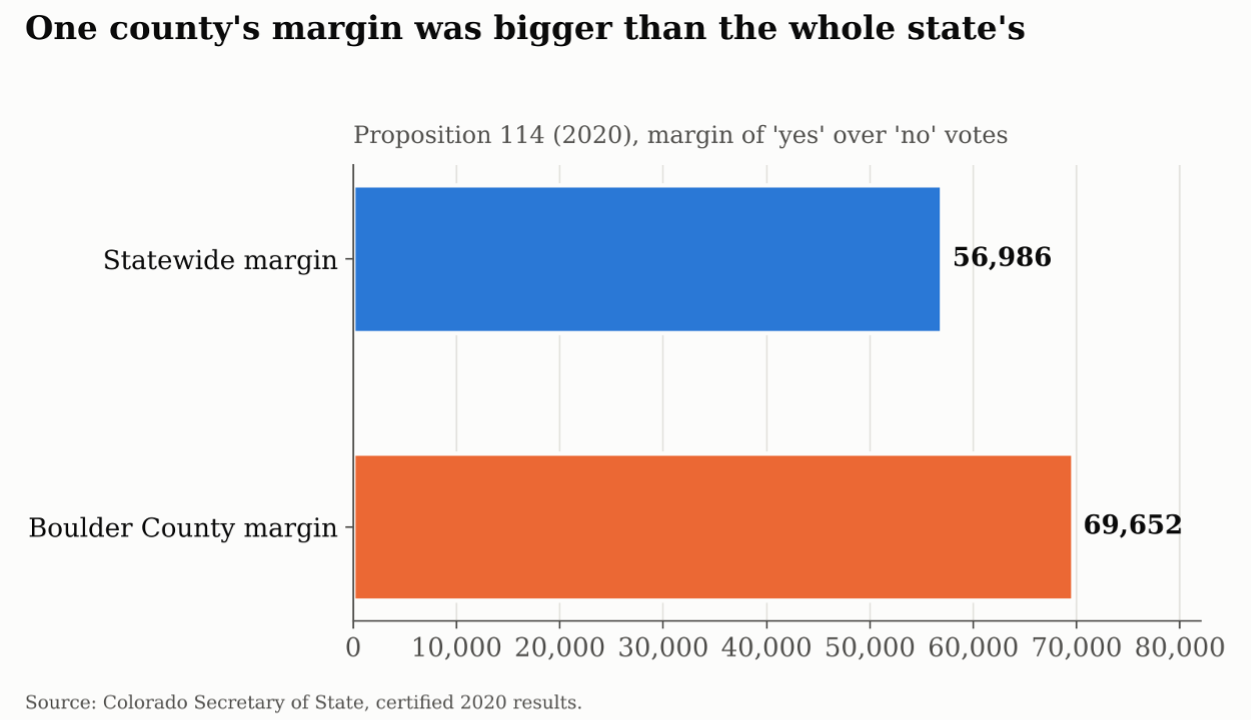
Boulder County’s “yes” margin alone was 69,652 votes. Take Boulder’s margin away and the measure fails.
The counties where the wolves actually live voted the other way:
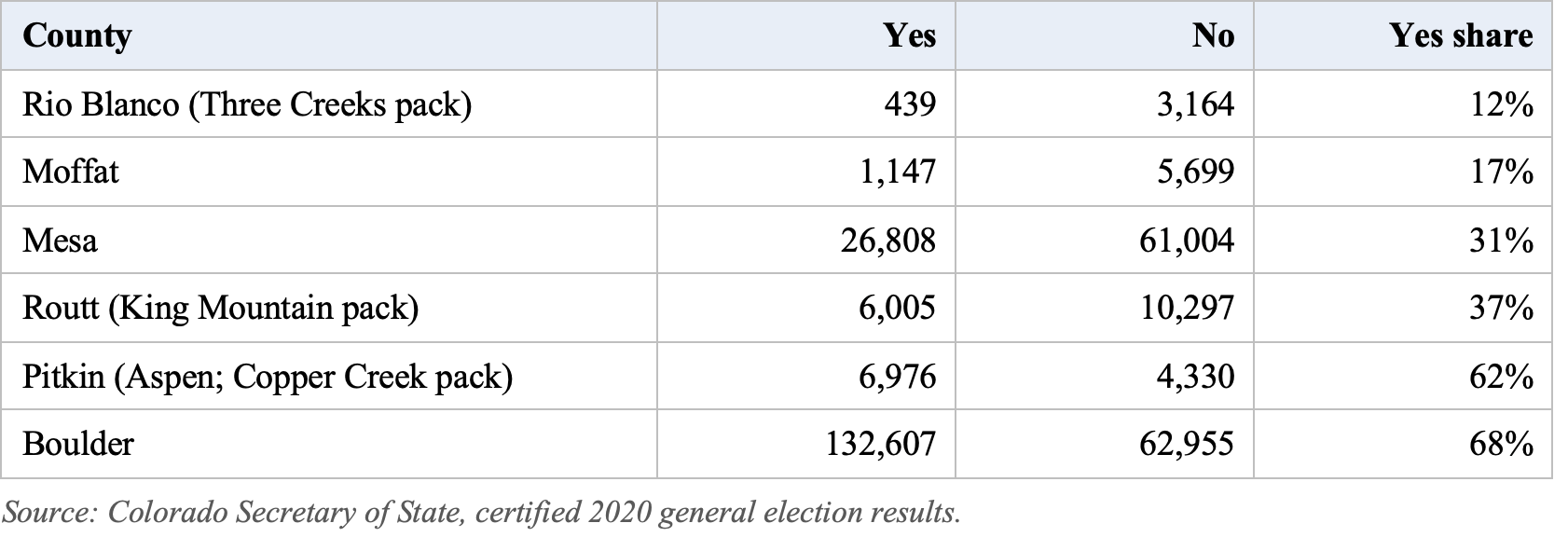
There is one exception worth savoring. Pitkin County, home of Aspen, voted 62% yes. The Copper Creek pack now lives in the Roaring Fork Valley, around Aspen. On September 8, 2026, the state killed a Copper Creek yearling in Pitkin County after 4 confirmed attacks on cattle there.
Aspen voted for wolves. Aspen got wolves. Pitkin County ranchers are paying for them.
What the other side says
Wolf advocates have answers to all of this. Here they are, and here is why they come up short.
“Voters decided. It’s the law.” True. Voters decided on an $800,000-a-year program with stated goals. Holding the state to its own Blue Book doesn’t overturn an election. It’s reading the receipt.
“It’s pocket change.” About $2.1 million a year works out to roughly 35 cents per Coloradan in a budget of tens of billions. That’s accurate. Now look at the size of the miss. A state that misses by 3.4 times on a small program deserves skepticism on the big ones. Lawmakers don’t treat this as pocket change either. In an August 2025 special session they swept $264,268 out of the wolf budget to help cover health insurance, while staring at budget gaps estimated between roughly $850 million and $1.5 billion.
“High mortality is expected.” Then the plan shouldn’t contain a 70% survival trigger that the agency waives the moment it’s tripped.
“The Trump administration sabotaged it.” Partly true, and I’ve laid that out above. It doesn’t explain the states that said no in 2023.
“It’s working biologically.” Colorado has 4 breeding packs, and 82% of last year’s pups survived their first year, well above the 50% to 60% that’s typical. That’s real, and it’s the best news in this story. Those pups are also nearly half the population, the state expects the count to fall by spring, and some of them may now be carrying mange into winter.
What should happen now
I’ll own something first. I’ve made plenty of hay out of Boulder voters putting wolves on ranches they’ll never see. The county map backs me up. It also lets the people responsible off the hook.
The voters didn’t write this budget. They didn’t set a survival trigger and waive it. They didn’t suspend the removal policy, or ask for $450,000 to buy wolves from nobody. The state did that, and the Legislature let it.
Here’s the fact most Coloradans don’t know: Proposition 114 is a statute. It isn’t in the Colorado Constitution. It sits in the Colorado Revised Statutes at section 33-2-105.8. The General Assembly can amend or repeal it by simple majority in any session, and it already amended it once, in 2023 (Senate Bill 23-256).
Instead, lawmakers manage it with footnotes that don’t bind anyone.
Here is what I want. I want our legislators to vote, on the record, with their names attached.
Either fund the wolf program in daylight: its own line in the budget, an honest price tag, a compensation fund sized to the actual claims, and a real plan for where the wolves are supposed to come from.
Or pause it, and send it back to the voters with a Blue Book that tells the truth.
The brochure said $800,000. The bill is past $10 million. Show the voters the bill and let them decide.
If you voted yes in 2020, tell me in the comments: would you vote yes again today, knowing what it costs? Explain why.
The timeline
• Nov. 2020: Proposition 114 passes by 56,986 votes.
• 2023: Montana, Idaho and Wyoming decline to supply wolves. The Legislature amends the law (SB23-256) and creates the $350,000-a-year compensation fund (SB23-255).
• Dec. 2023: A judge denies cattle groups’ bid to stop releases. The first 10 wolves, from Oregon, are released in Grand and Summit counties on Dec. 18.
• 2024: Wolves begin killing livestock in April. The Copper Creek pack is captured in September after repeated attacks in Grand County; its male dies of a gunshot wound.
• Jan. 2025: The Parks and Wildlife Commission rejects a 26-group agricultural petition to pause, 10-1. The 15 British Columbia wolves are released days later.
• Aug. 2025: Special session sweeps $264,268 from the wolf budget to health insurance.
• Oct.-Dec. 2025: The Fish and Wildlife Service bars Canadian wolves, then threatens to revoke Colorado’s authority. Washington State says no. Director Jeff Davis departs for Wyoming.
• Jan. 2026: No releases this winter. The King Mountain breeding male dies in a collaring operation on Jan. 28.
• Mar. 2026: The King Mountain breeding female is shot on the Nottingham ranch (under federal investigation). CPW asks for $450,000 to buy wolves with no source.
• Apr. 2026: Federal review opens in the Federal Register.
• Aug.-Sept. 2026: The state kills yearlings from the One Ear, Copper Creek and Three Creeks packs.
• Sept. 30, 2026: CPW suspends its lethal-removal directive. 45 known wolves, 20 of them pups.
• Nov. 8, 2026: Possible mange reported in 2 packs.
ADDENDUM
Addendum, November 13, 2026
Since this story published, Colorado Parks and Wildlife has reported another death. Wolf 2516, a female brought from British Columbia in January 2025, died in Utah. CPW confirmed a mortality signal from her collar on November 7. According to the agency, she had traveled more than 9,000 miles across Colorado and neighboring states in the 18 months since her release.
The cause of death has not been released. The US Fish and Wildlife Service is investigating with Colorado Parks and Wildlife, the Utah Department of Natural Resources and local law enforcement in Utah.
Here is what it changes above:
Transplanted wolves: 14 of the 25 that Colorado brought in are now dead, using the same Denver7 count as the story. That’s 8 of the 15 from British Columbia.
Known population: 44, down from the 45 the agency counted in September.
The running total: The Colorado Sun counts 20 wolf deaths since reintroduction began in December 2023, including Colorado-born wolves the state killed for preying on livestock. The Aspen Times reports this is the 9th death among Colorado’s wolves in 2026.
Different outlets count differently, mainly over whether wolves born here are included. Where the counts conflict, I’ve used the narrower one.
As of this writing, the state still has not announced where it would get more wolves.
When will we shut down this boondoggle? Wasted enough of the taxpayers money.
My dad raised cattle in Nebraska. Any predator was killed on site. He always had a rifle and a shotgun in the pickup. If only the voters had any idea what dead cattle mean to a rancher. Not only the initial value, but long term herd management.