

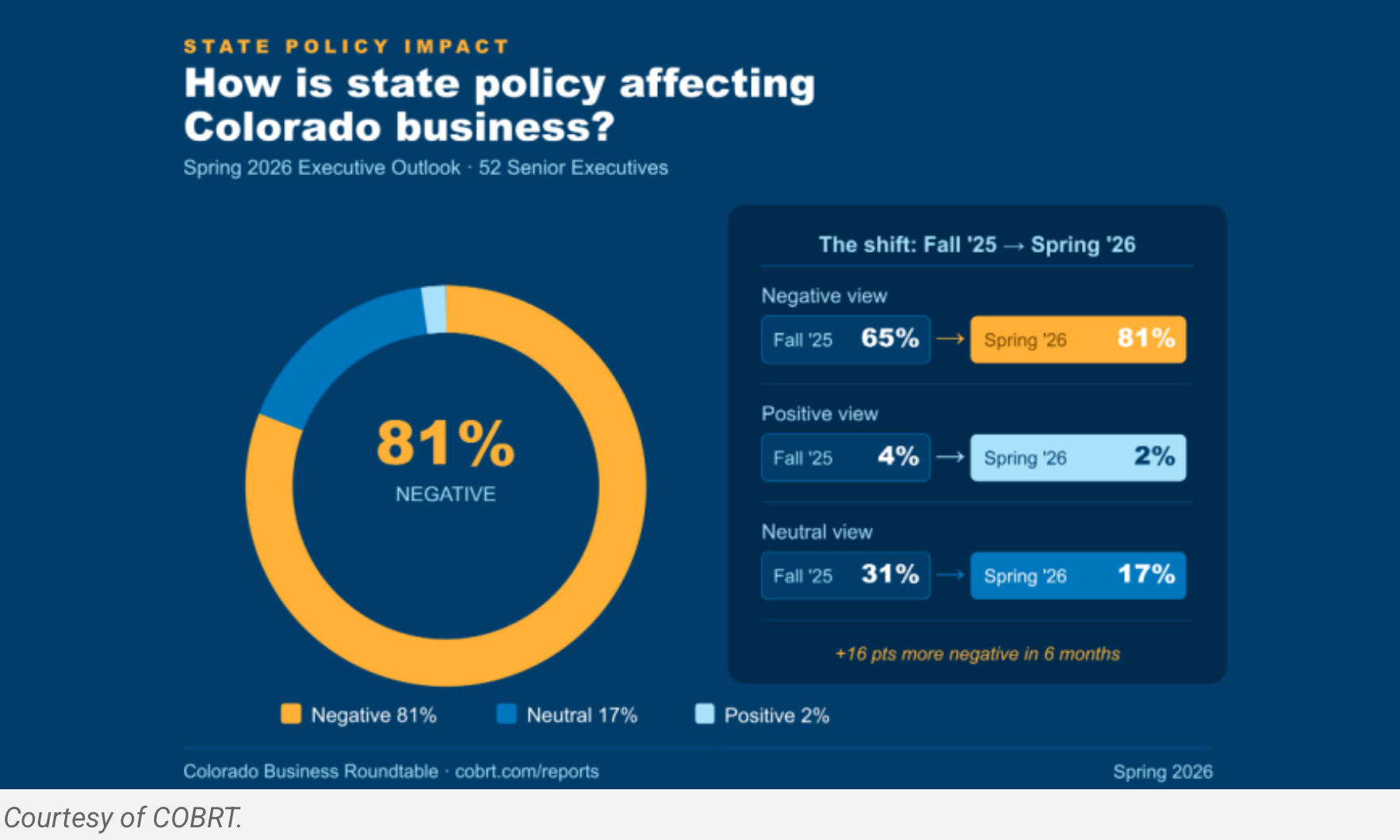
The Denver Post ran a story this week that has truly bugged me because it manages to describe the problem yet miss the cause in the same paragraph. And whether you live in Colorado or any other blue state, this story is a warning. Yes, we can look at Illinois, New York or California and say gee, we will never be like. Seriously? Blue or red states can quietly and without any notice, start down the same slippery slope. Colorado just offers everyone a microscope in real time of what one-party control by Democrats, especially members of the now outspoken Democrat Socialists of America wing, will do to your state.
Over the last eighteen months, Colorado has lost payroll jobs. Not gained slowly. Not held steady. Lost. 11,700 payroll jobs in 2025 alone, according to Colorado’s own labor department. The national economy in that same window grew. Not by a lot — plus one-tenth of one percent — but nonetheless grew. Nevada grew. Idaho grew. Utah grew. Our next-door neighbors, with the same weather and the same mountains and the same amenities we have, are leading the country in percentage job gains.
And Colorado — which has spent a generation branding itself as the economic star athlete of the mountain west — is, in the article’s own phrase, hanging out under the bleachers with a different crowd.
Now, the state’s response to this is what caught my attention. Governor Polis is standing up a competitiveness council. He’s directed the Office of Economic Development and International Trade to run a series of what they’re calling “convenings” across the state. Listening sessions. Every county. Businesses of every size in every sector.
If that playbook sounds familiar, it’s because we ran this play before. It was fifteen years ago. John Hickenlooper called his version of this playu the Colorado Blueprint. More than fifty regional working sessions, all sixty-four counties, the whole road show. And the answers that came back then are exactly the answers that are going to come back now. High cost of living. Regulatory burden. New workplace mandates piling up faster than employers can absorb them. Infrastructure bottlenecks. Housing costs that make it impossible to recruit.
We already know what the businesses are going to say. They said it in April, when 230 Colorado business leaders, organized by Dan Caruso at Engage Colorado, sent an open letter warning that Colorado was at risk of losing its reputation as an innovation hub if pro-business policy wasn’t prioritized. They said it through the Colorado Chamber, whose president Loren Furman said, and I’m quoting her, “Regulatory burdens, housing, rising costs and workforce needs remain key issues affecting the state’s competitiveness.”
They’ve been saying it for years. The listening tour isn’t an inquiry. It’s a substitute for one because political leaders know the cause, they just don’t want to document it or admit it.
Let me walk you through what the data actually says, because this matters for anyone trying to figure out whether we’re just having a rough quarter or whether something more structural is happening.
Start with the rankings, which the state itself has been tracking since 2012. CNBC’s “Top States for Business” list. Colorado ranked number one in 2011. This year? 25th. Cost of living, 49th in the country. Cost of doing business, 38th. Infrastructure, 32nd. The American Legislative Exchange Counsel (ALEC) economic outlook index has us at 29th this year, down from 17th last year, and far, far away from second place, which is where we were in 2008.
Now the even more interesting part. U.S. News and World Report has us at 11th overall and 6th for the economy. So which one is right?
They’re both right. And that’s the diagnosis. U.S. News weights structural measures: how educated the workforce is, how much venture capital sits in the state, how productive our workers are. Those are inherited assets. Assets that were built up over decades. CNBC and ALEC weight the current operating environment: what it costs to run a business here, right now, this year, at this desk, on this payroll.
Translation: Colorado is coasting on the capital of a previous era while the current environment actively repels the next round of business investment. We are, in the most literal economic sense, eating the seed corn.
And there is one number in this story that should stop everyone cold. It came from Michael O’Donnell, who runs the Prairie Rose Development Corporation. He told the state’s Economic Development Commission that Colorado has the largest numeric loss in startup activity of any state in the country.
Then he corrected himself. He said, actually, that we’ve become “a lot” less entrepreneurial than we used to be.
Startups can locate anywhere. They chose not here. Understand what that means. Startups are the future employer base. They are the companies that, ten years from now, are going to be the mid-sized firms hiring hundreds of Coloradans. And they’re not forming here at the rate they used to. By the time that shows up in a monthly jobs report, the damage is a decade old, and it is not fixable on any timeline that any current politician cares about.
Let’s talk about the why. Ndone of this is a mystery. It’s not weather. It’s not a data glitch. It’s not the business cycle. Every one of those has been ruled out.
It is, plain and simple, the accumulated weight of a decade of policy choices. Let me give you the picture from a hypothetical business owner’s chair.
In January 2026, Colorado’s minimum wage went above $15.00 an hour for the first time — $15.16 statewide. In Denver, it’s $19.29. In Edgewater, $18.17. Overtime kicks in at $22.22. The state’s exempt-employee salary threshold — the floor for salaried professional employees — is now $57,784.00 a year. That’s dramatically above the federal number.
On top of that: the FAMLI premium, or paid family and medical leave. 0.88% of wages, up to $184,500 — split between employer and employee. The state can raise that to 1.2% by statute. In 2024, the first year when were benefits paid out, the program processed a 135,000 claims and paid out $687 million. And it just expanded: up to 24 weeks of paid leave for parents of NICU babies. 28 weeks in some cases.
Every single one of those policies can be defensible on its own terms. If you take FAMLI in isolation, if you take the minimum wage in isolation, if you take the overtime rules in isolation — every proponent of those programs can walk you through why theirs is a good policy.
That’s not the question. The question is what happens when you stack all of them, plus workers’ comp, plus paid sick leave, plus the AI compliance regime, plus the evolving predictive scheduling rules? What happens when a CFO in a Colorado boardroom stacks all of those into a five-year forward model and compares it to the same model built in Salt Lake City, or Boise, or Reno, or Austin? That comparison isn’t even close. And the businesses that can leave, or that can locate their expansion somewhere else, are quietly doing exactly that.
Which brings us to Palantir. Because if you want to know what this looks like when it isn’t quiet, here it is.
In February, Palantir, Colorado’s largest publicly traded company, valued at over $300 billion dollars, moved its headquarters from downtown Denver to Aventura, Florida. They didn’t call the governor. They didn’t call the mayor. They posted it on X. The governor said, “I don’t know what the announcement means.”
But Palantir told us exactly what it meant. In their annual filing with the SEC, they cited by name: Colorado Senate Bill 24-205, the state’s consumer protections for artificial intelligence bill. Signed by Governor Polis. They said, and this is verbatim from the 10-K: “Compliance with such obligations may be difficult, onerous, and costly, and could adversely affect our business.”
The Common Sense Institute ran the numbers. If Palantir relocates ninety workers, Colorado’s economic output falls by $178 million. Then you have the ripple effects across vendors and suppliers that could cost more than 700 jobs a year.
But here’s what matters more than the direct job loss. When the most valuable public company headquartered in your state — a company that only five years ago moved to Denver from Palo Alto because Denver looked like the better bet — decides that Miami is the better bet now, every other publicly traded company in the country running the same model gets a new data point. That data point goes into the next site-selection meeting. And the next one. And the next one. That is how reputation compounds in both directions.
Now for the taxpayer piece, because this is where it all connects.
Colorado sells itself on a flat, relatively low income tax rate. And that’s what U.S. News is measuring when they put us 6th for the economy. That’s the sticker price.
The actual tax burden — the number the Tax Foundation calculates when they look at everything — puts Colorado at 33rd. And the reason is the fee enterprise architecture. TABOR limits how much revenue the state can keep and spend without going back to the voters. The workaround, for the last decade, has been to reclassify programs as “enterprises:” governmental businesses funded by fees rather than taxes. And fees don’t count against the TABOR cap.
That means a taxpayer sees a low income tax rate on paper, and then pays for it in every place that isn’t labeled a tax. Every utility bill. Every DMV transaction. Every vehicle registration. Every delivery-fee surcharge. The retail delivery fee. The road usage fees. The shared ride fee. It compounds, invisibly, without ever showing up as a tax increase, without ever going to a vote.
And what does the taxpayer get in exchange? RTD running a $210 million structural deficit while transit ridership stagnates. Infrastructure ranked 32nd. Xcel rate cases the PUC keeps rubber-stamping. And a state government that just admitted it doesn’t know why the economy is lagging and needs to hold meetings to find out.
That is the value proposition inverting in real time. And that is why the ALEC index, which looks at debt as a share of state and local revenue, puts Colorado near the bottom.
What do we actually do about it. Here is the list, because it isn’t going to come from the competitiveness council as they schlep around the state.
First. Sunset the labor mandate stack. Not repeal — sunset. Force every one of these programs to come back for affirmative re-enactment on a rolling schedule with a mandatory cumulative cost impact review. Because the problem isn’t any one mandate. The problem is the accumulated weight of all of them, and right now, nobody in the Capitol is required to weigh that total.
Second. Cap the fee enterprise mechanism. Every serious competitiveness reform in this state runs into TABOR’s workaround architecture. Either address it directly or admit you’re not serious.
Third. Simplify property tax. The last two so-called reform cycles have been political triage. The mill-levy-and-assessment mechanics are unintelligible to owners, unintelligible to legislators, and predictable only in one direction, which is upward. That is a structural drag on capital investment that shows up in the rankings and shows up in the departure decisions.
Fourth. Sunset the compliance stack. CDPHE, CDLE, PUC, CDOT, plus the municipal layer. Force periodic re-justification. The volume of regulation has grown faster than the staff capacity to comply with it, and mid-market employers (the ones without a dedicated compliance department) are drowning.
Fifth. Real energy accountability. Cheap, reliable baseload power is one of the biggest recruiting tools any state has. Colorado is trading that away for an ideological energy commitment that shows up in the ratepayer’s mailbox every month and in the industrial recruiter’s spreadsheet every day.
Sixth. Prioritize retention over recruitment. Texas will always outbid us on incentive packages. The winnable competition isn’t the marquee relocation. It’s the operating environment for the companies already here — the ones deciding whether to expand in Colorado or move that next facility to Idaho.
Seventh. Fix housing supply. Not housing demand. Not more subsidies that prop up demand while doing nothing about supply. State preemption of the most restrictive local zoning. Aggressive by-right multifamily conversion. The cost-of-living ranking of 49th is a policy outcome, not a market outcome, and until we accept that, the recruiting problem doesn’t get better.
And eighth. Rewrite the AI regulatory posture. Senate Bill 24-205 is the specific statute Palantir named in its 10-K. Whatever the merits of AI consumer protection in principle, we passed a first-mover, state-level regime that mirrors the European AI Act at exactly the moment when AI is the single most mobile, single most valuable category of new economic activity in the country. That is not just a policy error. It’s a signal to every AI-adjacent employer in America that Colorado is a compliance risk zone. And they are receiving that signal loud and clear. And they are staying away.
Colorado is not suffering from some mystery malady. Colorado is suffering from a policy regime whose costs have finally started to exceed the amenity dividend that hid them. The mountains, the weather, the educated workforce, the tech ecosystem that a previous generation of pro-growth policy built. All of those bought this state fifteen years of getting away with policy choices that our peer states didn’t make. That grace period is over. The rankings, the startup collapse, the payroll losses in a national expansion, the Palantir move — those aren’t separate stories. They are all measuring the same underlying fact.
Colorado does not need a listening tour. It has the answers. It got them from the 230-business-leader letter in April. It got them from the Colorado Chamber. It got them from the Leeds business confidence index, which has been running in the wrong direction for five straight quarters. It got them from Palantir, which sent its answer via SEC filing.
The question is whether the political coalition that produced this policy regime is willing to unwind any part of it. And the honest answer — mine, at least — is that this coalition is not, which is why the 2026 gubernatorial race matters more than any council Jared Polis will name on his way out the door. And Republicans are poised to suffer the single greatest political loss ever.
If you’re a Colorado voter, the question to ask every candidate for governor is not whether they will convene stakeholders so they can “listen.” Every candidate will convene stakeholders. The question is which of those eight items on the list will they actually do? And what they will trade away, inside their own party, to get any of it done.
Because we know what happens if the answer is none of it. We are already watching it happen. The lag isn’t a mystery. It’s a choice. And choices, unlike weather, can be reversed.
Excellent! Colorado….another classic example of how an abusive very progressive state can go to hell over time……a short period of time. Unfortunately there is no cavalry on the horizon ready to solve these issues. Hello…..Mr U-Haul
https://www.commonsenseinstituteus.org/colorado/research/taxes-and-fees/snapshot-of-fees-in-colorado-2026-update