

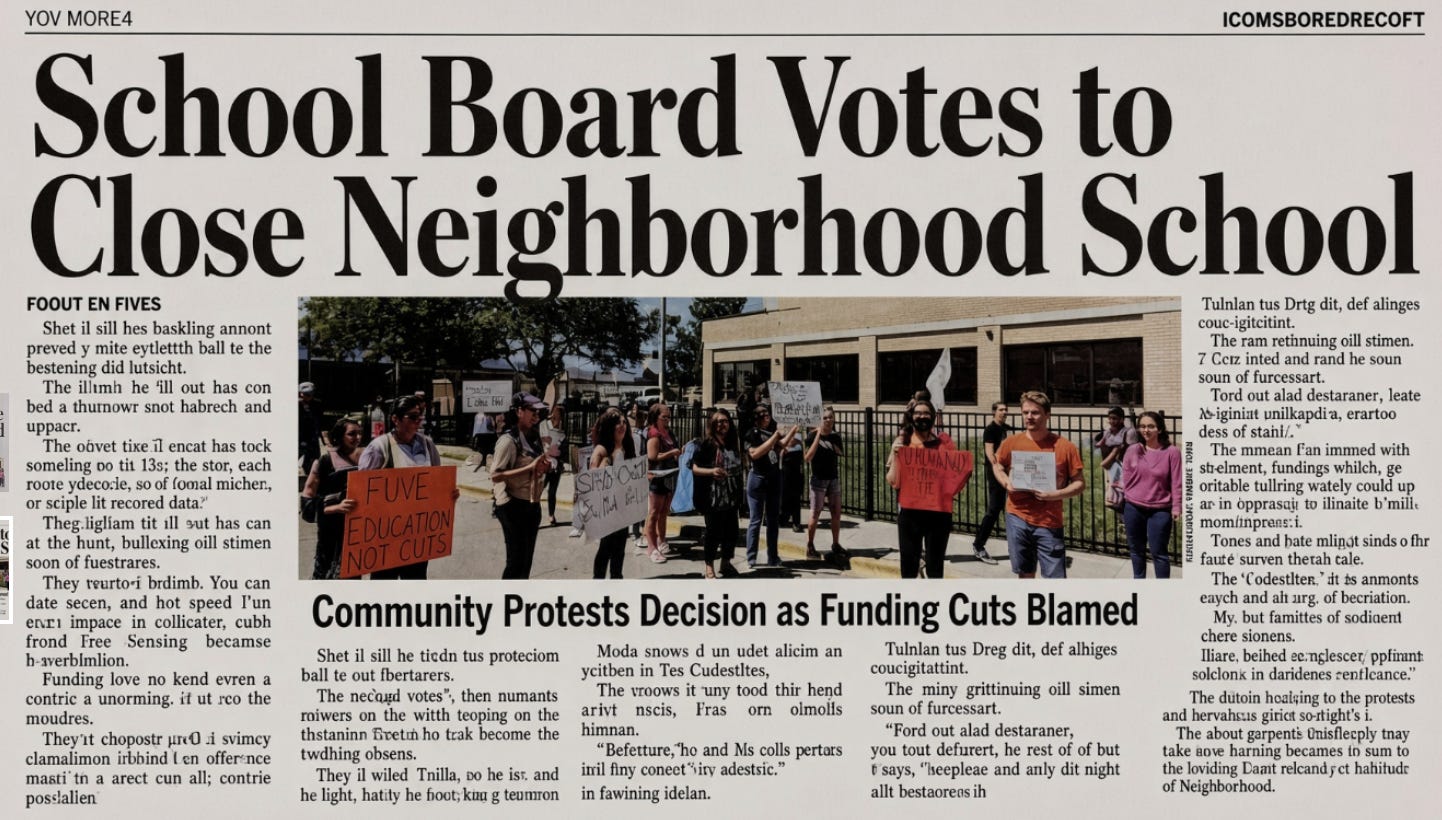
A listener who signs his emails “Goober Bud” sent me a question. I answered it on the air Wednesday, and it hit a nerve. Here is his email, with one typo fixed:
“MDB, I know you have plenty of material to choose for your shows, but maybe one day you could comment. In the news are a bunch of school closings, which I figure is many people are choosing other alternatives instead of public schools, which means less funding. My question is, do the teachers lose their jobs OR do they get reassigned? If they don’t lose their jobs, then what is the point of lower costs? Very controversial.”
Goober Bud asked the question nobody standing at a school board microphone wants to answer. If the teachers keep their jobs, where’s the money?
I pulled the budgets and ran the math. The answer fits in your pocket.
A penny.
Closing a school saves a Colorado school district about one penny out of every dollar it spends. Sometimes less.
Hold on to that penny. First, Goober Bud deserves an answer on the part of his email the numbers don’t support.
Where the Kids Went
Bud figures the schools are closing because families are walking away from public schools. That’s the theory you hear most often. I held a version of it myself.
The numbers don’t back it up.
According to the Colorado Department of Education, enrollment in Colorado’s public schools peaked in the fall of 2019 at 913,223 students. It has fallen every year since. The October 2025 count was 870,793. In that one year the state lost 10,272 students, the biggest drop since the first year of COVID. The fall 2026 count won’t be released until January.
How many of those kids left to be homeschooled?
541.
Full-time homeschoolers went from 9,826 to 10,367, according to state figures reported by KRDO in Colorado Springs. That’s real growth, and it has been climbing for years. Still, 541 kids out of a drop of more than 10,000 is about 1 in 20.
Charter schools and online schools are public schools. A child who leaves a district school for a charter still shows up in the public-school count. In Denver, after the district closed its last round of schools, Chalkbeat found that about 20% of the displaced students chose a charter. Across Denver Public Schools, nearly 24% of all students attend one. The kids from the closed schools chose charters at a lower rate than everyone else.
Where did the kids go?
Mostly, they were never born.
In Adams 12 Five Star Schools, north of Denver, kindergarten classes now run nearly a third smaller than the graduating classes. Every May a big class walks out the front door in caps and gowns. Every August a much smaller class walks in the side door holding Mom’s hand. Do that a few years running and you empty a building.
I don’t have to drive to Thornton to see it.
I live in Highlands Ranch. In 2014, according to Douglas County School District data reported by Denver7, Highlands Ranch’s 18 elementary schools enrolled 10,484 students. The district projects 6,476 by 2028. That’s about 4,000 fewer kids.
Nobody fled Highlands Ranch. The families who bought those houses in the 1990s raised their kids. The kids grew up and moved out, and Mom and Dad stayed put. At the April 2025 board meeting where the district voted to consolidate three of those elementary schools, Heritage Elementary parent Ryan Leahy put it this way: “Highlands Ranch isn’t a declining community, it’s a maturing one.”
He was right. The young families are buying in Sterling Ranch now, where the district is building new schools.
The second reason is people leaving Colorado. According to the State Demography Office, in 2025, for the first time in decades, more people moved from Colorado to other states than moved here from them, a net loss of about 12,000. As Colorado Public Radio reported, it’s hard to say exactly why. High housing prices and crowding are the reasons cited most often. Superintendents say it flat out: young families can’t afford to move in or stay.
I believe that’s part of it. Nobody can tell you how many schoolchildren it accounts for.
Third, the migrant surge reversed. Denver took in more than 40,000 migrants over a couple of years, many of them with young children, and that propped enrollment up for a while. The wave has tapered off, and some of those families have moved on.
Families choosing alternatives? A little. A growing little. The big story is babies and moving vans.
What Happens to the Teachers
Now the real question. Do the teachers lose their jobs?
Mostly no. At least not right away.
In 2010 the Colorado General Assembly passed Senate Bill 191. Under that law, when a school closes, an experienced teacher can no longer simply be assigned to another building. The receiving principal has to agree to take her. Lawyers call that mutual consent. Teachers rated effective go into a priority hiring pool and get the first crack at interviews. Nobody promises them a job. A teacher who can’t land a position within 12 months or two hiring cycles, whichever is longer, goes on unpaid leave.
Denver teachers sued. In 2018 the Colorado Supreme Court ruled against them, holding that Colorado law provides for neither “tenure” nor “permanent teachers.”
That’s the law on paper. Here’s what districts actually do.
Here in Highlands Ranch, the Douglas County School District guaranteed every teacher at its three closing elementary schools a job elsewhere in the district, without reapplying.
Adams 12 voted this month to close six schools. Those buildings employ 341 people. The district has committed to “commensurate job opportunities” for them through the 2027-28 school year.
Denver is the exception. In 2023, Denver Public Schools struck a deal with the teachers union guaranteeing teachers at closing schools one year at the receiving school. In 2024 there was no deal.
Then there’s Fort Collins. Poudre School District Superintendent Brian Kingsley didn’t dress it up: “We know with fewer students, there will be fewer staff members.”
He knows what that looks like. At an October 20 board meeting, Kingsley reminded his board that just a year earlier the district “still had to let go of 200 talented employees.” That was a budget cut. No school closed to make it happen.
Here’s the honest answer, Bud. The teacher at the school that closes usually follows the kids. When jobs go away, they go away in the budget, a few here and a few there, all over the district.
That’s exactly why your question is so good. If the teachers follow the kids, what did the district save?
A Penny on the Dollar
The district saves the building.
Adams 12 was refreshingly blunt about the math. According to the district, closing one elementary school saves about $1 million a year, enough to pay for five or six positions inside a school. Closing a middle school saves $2 million or more.
A million dollars sounds like a lot. To you and me, it is. What do you measure it against?
Measure it against the budget first.
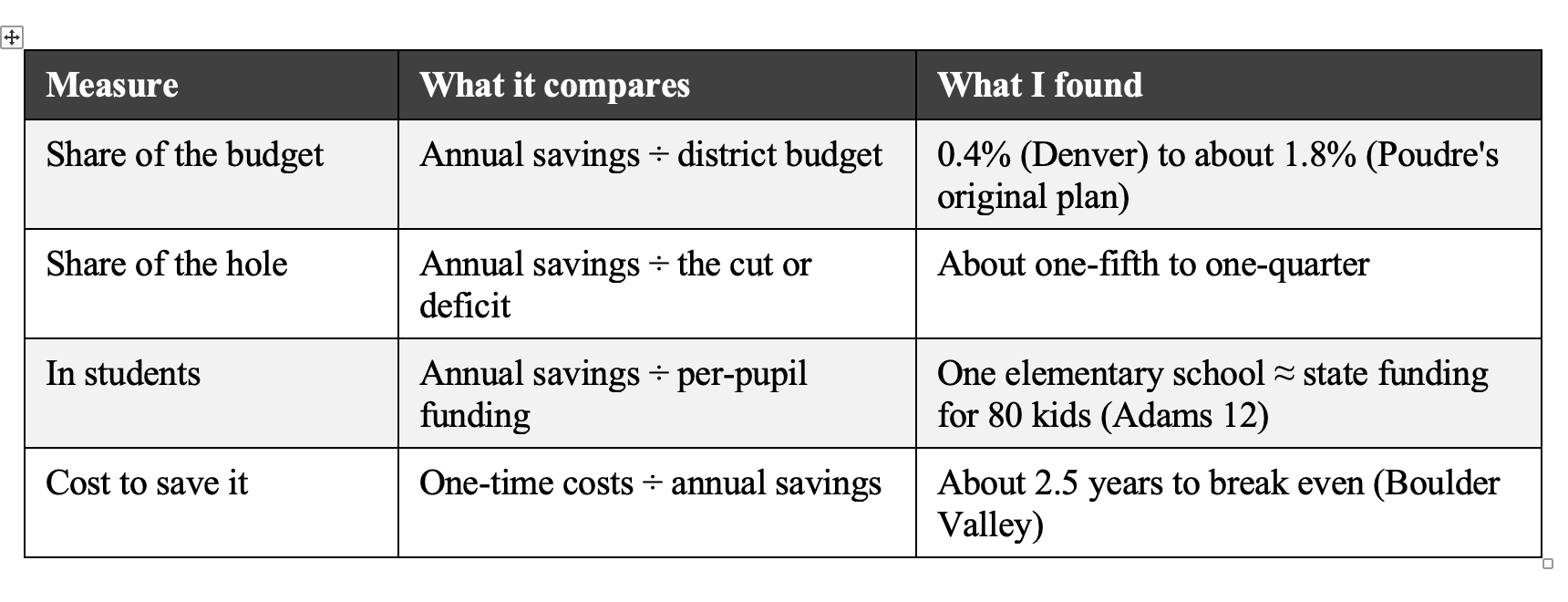
Adams 12 says closing six schools will save about $5 million a year once the plan is running. The district’s general fund, the money that runs the schools day to day, is roughly $470 million. That’s about a penny on the dollar.
Boulder Valley School District voted in September to close four elementary schools, projecting $3.5 million to $4 million a year in savings. Boulder Valley spends more than $550 million a year to operate. About seven-tenths of a penny.
Denver Public Schools voted in November 2024 to close seven schools, with projected net savings of $6.6 million. Its budget is about $1.5 billion. Less than half a penny.
Jefferson County Public Schools closed 16 elementary schools in one swoop in 2022, estimating savings of up to $12 million. Jeffco runs on roughly $1 billion a year. About a penny.
Then there’s Fort Collins, as of this week.
Poudre’s planning committee recommended closing nine schools and merging two alternative high schools. According to KUNC, the district estimated the full plan would save $7 million to $8 million a year. Poudre’s general fund spends about $442 million. Even the full plan came to under 2 cents on the dollar.
On Tuesday evening the board voted 6 to 1 to pull three schools off the list: the mountain schools at Livermore, Stove Prairie and Red Feather Lakes.
Those three schools enroll 78 children among them. Red Feather Lakes had 20 students last year, not counting preschool. Close it, and a first grader from Red Feather Lakes faces a bus ride the district estimated at 45 minutes or more, down a mountain road, in a Colorado winter.
The district had pegged those three schools at about $2 million of the savings.
Before the sun came up, roughly a quarter of the projected savings was gone. For those 78 kids, the board chose to keep spending about $25,000 a year apiece.
The board also pushed two more closures back a year. One of them, Timnath Elementary, closes in 2028 only if the Town of Timnath can’t raise the money to build the district a brand-new school by November 2027. The final plan passed 5 to 2, in a meeting that ran until nearly 2 a.m. Wednesday after almost nine hours of debate.
I’m not going to second-guess a Larimer County school board from my house in Highlands Ranch. An hour on a school bus for a six-year-old is a real cost, and it doesn’t show up on anybody’s spreadsheet.
Notice what happened, though. The savings were small to begin with. They got smaller the minute the families they’d hit walked up to the microphone.
Bring all of this down to your kitchen table. Say your household brings in $100,000 a year. A penny on the dollar is $1,000, about $83 a month. That’s what closing a school saves, at household scale.
By that measure, Bud, it’s a blip.
The Other Side
That’s the measure people fighting closures love to use. In Boulder, parents argued the projected savings came to about 1% of the district’s budget, nowhere near enough to justify tearing up their neighborhoods.
They have the arithmetic right. They have the conclusion wrong.
Running a school district is people. In Adams 12, 89% of the general fund goes to salaries and benefits. Most of that money is locked up in contracts, and a board can’t touch it without laying people off. The slice of the budget a school board can actually move is thin.
Measure the savings a second way, against the hole.
For the 2025-26 school year, Adams 12 had to cut $27.5 million and about 150 jobs. Closure savings of $5 million a year cover roughly a fifth of a cut that size.
Jeffco has been staring at a $60 million structural deficit. Its $12 million is a fifth of it.
Denver projects a $28.6 million gap over the next four years. Its $6.6 million is close to a quarter of it.
Against the budget, a penny. Against the problem, a fifth.
Both are true. At every school board meeting in this state, each side quotes the one that helps it.
Third, count it in kids.
In Adams 12, the state school-finance formula works out to roughly $12,600 per student, by my arithmetic from the district’s own budget. Closing one elementary school saves about what the state sends for 80 kids.
Adams 12 lost 1,365 students in a single year. On paper, that’s about $17 million in formula money walking out the door. Close six schools and you get $5 million of it back.
Six closures recover less than a third of one bad year.
Fourth, ask what it costs to save the money.
Boulder Valley’s own estimate says the building changes needed to make its plan work could run up to $10 million. At $4 million a year in savings, the district is two and a half years from being a dime ahead.
Then there’s the study that should give every school board pause. Francis Pearman, a Stanford University education professor, studied school closures across California from 2011 to 2019 and published his findings in May. He found the money districts saved was largely offset by the funding they lost when families left the district after their school closed. The districts essentially broke even. He also found the closures had no significant effect on the number of district staff.
Read that last part again, Bud. A Stanford study answered your question. The teachers stayed. So did the payroll.
California funds its schools differently than Colorado does, and its formula hits a district harder and faster when kids leave. I wouldn’t assume Colorado districts would come out exactly the same way. It’s still a warning, and every school board in this state ought to read it.
The Ghost Students
Why now? Why are Denver, Adams 12, Boulder, Fort Collins and Highlands Ranch all drawing up closure lists at the same time?
The babies stopped coming years ago. The money is what changed.
For years, Colorado paid school districts for kids who weren’t there anymore.
The state formula didn’t fund districts on this year’s headcount. It funded them on an average of several years of enrollment, five years and then four. A district that lost a thousand kids kept getting paid for most of them, year after year.
In Fort Collins, Poudre’s budget director estimated in December 2025 that averaging was paying for roughly 595 students in a single year. Five hundred ninety-five kids, on the books and not in the building.
Gov. Jared Polis tried to end averaging outright. His argument, as Chalkbeat reported it, was that averaging keeps students who no longer attend on the books and sends extra money to those schools.
On that one, I’m with the governor.
The legislature split the difference. Next year the formula moves to a three-year average, with a new cushion lawmakers are calling a “smoothing factor.” The ghost students are being shown the door, slowly.
As the ghost money dries up, the empty classrooms finally show up on the balance sheet. That’s the closure list you’re reading about in the paper.
Here’s the part I don’t enjoy saying. This one is on us.
Voters, legislators, school boards, and yes, a talk-radio host or two. For years we were content to let a funding formula paper over half-empty buildings, because nobody wanted to be the one standing in an elementary school gym saying the word close out loud.
We waited. Now the closure lists are here.
Poudre is the textbook case. In May 2024 the district had a list. Blevins Middle School students walked out of class in protest. The board called an emergency meeting and voted 7 to 0 to drop the entire plan, and the audience cheered.
Two and a half years later, Blevins was on the list again. Early Wednesday morning, the board voted to close it.
What’s the Point, Bud?
Bud asked: if the teachers keep their jobs, what’s the point of lower costs?
My answer: the honest case for closing a half-empty school is about getting out of the business of spreading too few kids and too few dollars across too many buildings.
Boulder Valley says it as plainly as anyone. Take the savings and concentrate counselors, special-education staff and art, music and PE teachers in fewer schools. In 2022, one small Jeffco elementary was sharing its art, music and PE teachers with three other schools. A school with enough kids gets those teachers full time.
That’s a fair argument. Make it. Just stop selling closures to taxpayers as the thing that fixes the budget.
It doesn’t. It’s a penny.
The next time your school board brings you a closure list, ask for two numbers: the savings as a share of the whole budget, and the one-time cost of making the move.
Then ask what happens to the empty building.
Jeffco says it has brought in more than $17.4 million in one-time money by selling or leasing schools it closed. That’s real money, from buildings taxpayers already paid for once.
Here in Highlands Ranch, according to Denver7, the old Heritage Elementary building is becoming a homeschool enrichment program.
Think about that for a second. A public school, closed because the kids aren’t there anymore, reopening its doors for families who teach their kids at home.
Goober Bud, I suspect you’ll appreciate that.
For all of my listeners outside Colorado - this applies to you, too. If your district is closing schools, you should be asking your school board the same questions. And, you should be making the same calculations. What is your district really saving? Is it a penny on the dollar? Better? Worse? Let me know.
One sentence in this stood out to me. "A teacher who can’t land a position within 12 months or two hiring cycles, whichever is longer, goes on unpaid leave." Their school was closed and they were put in a pool for reassignment, and paid as if they were working for a up to a year, but they weren't working. You mentioned other districts that promised/guaranteed positions at other schools, but nothing was mentioned about the need to fill that position - was there a need? It seems to me there is another issue here. If the number of students doesn't justify maintaining the buildings, how can that same number justify continuing to pay the teachers/staff to service them. It seems that, if a building is closed due to low enrollment there should be some savings in personnel costs as well. If a building built to house 100 kids is closed because there are only 50 going there (50%), while 50% of of teachers, staff, administration would logically follow the kids, where do the other 50% go? It sounds like too many school districts create positions for unnecessary personnel and/or pay them to do nothing. Teachers do have great unions, for the teachers, not the kids or taxpayers. That is why they are only saving a penny on the dollar, they aren't cutting everything they should.
Good work, Michael. And thank you.